




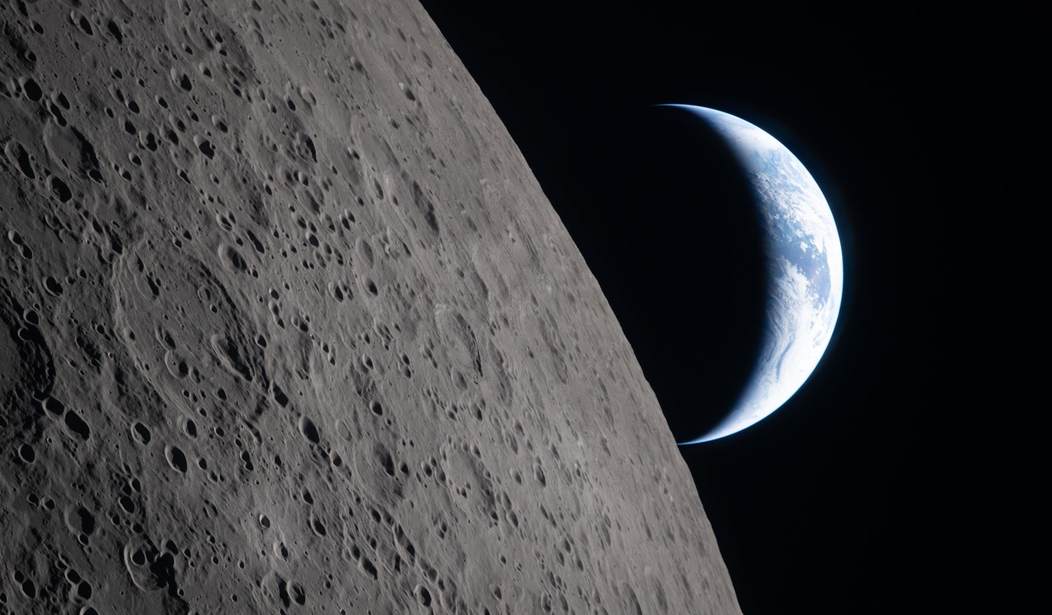
Communist China is usually tight-lipped about its space program, but officials just revealed that Beijing plans to put men on the Moon “before 2030," with a target date sometime in 2029.
At the Seventh Manned Spaceflight Conference this weekend, Wang Xiang, deputy chief planner of China's manned space program, and other officials announced an ambitious, multipart program much like NASA's Apollo missions of the late '60s and early '70s.
Here's what has to happen before then, according to conference materials shared on X and other platforms.
A successful uncrewed test flight of the new Long March 10A rocket and Mengzhou spaceship to Low Earth Orbit (LEO). That's tentatively set for early next year.
Another uncrewed test of the larger Long March 10 rocket — the one big and powerful enough for a lunar mission — carrying a Lanyue lander in early 2028. That mission will include an unmanned landing of Lanyue on the Moon.
Then in early 2029, a full (but unmanned) dress rehearsal of the manned mission, featuring all the rockets, the capsule, and the lander, followed by the real deal later that year.
It's an ambitious schedule, but absent any major setbacks, certainly doable.
"Notably, the plan (for now, at least) omits a mission similar to Apollo 8 or Artemis II," Eric Berger noted, "which involved a crew flying out to the Moon and either entering orbit or passing close by before returning to Earth." But another variant of Mengzhou will soon serve as China's crewed vessel for Tiangong space station crew and cargo transport, so it should be well-tested before 2029 rolls around.
The one catch is that the Long March 10 rocket is nowhere near as powerful as Apollo's Saturn V, and requires two launches to get the three taikonauts and their landing vessel to the Moon. One rocket will deliver the Lanyue landing module (still under development), the other will carry the Mengzhou space capsule (ditto).
And Another Thing: The current V3 variety of SpaceX's Starship Super Heavy booster (also under development) generates 2.4 times the thrust of a Saturn V first stage. Starship's upper stage by itself generates more than three times the thrust of Saturn V's second and third stages, combined. Saturn could deliver about 16 tons of mass to the lunar surface; Starship, 100 tons or more. What I'm trying to say with all these big numbers is that Starship will enable NASA to do so much more than simply perform do-overs of missions from five-plus decades ago.
All three taikonauts will travel to the Moon on Mengzhou, and then the two spacecraft will mate up in lunar orbit, where two of the crewmembers will move over to Lanyue for what Beijing hopes will be the first-ever manned lunar landing by anyone other than American astronauts.
Just as with the Apollo Command Module, one taikonaut will remain aboard Mengzhou in a support role.
And here's the inevitable infographic:
China’s pre-2030 Moon roadmap is locking in 🌕 The Tests: CZ-10A: Mengzhou cargo mission to CSS CZ-10: Standalone Lanyue descent/ascent test 2x CZ-10: uncrewed full dress rehearsal The Mission: • Crew of 3 (2 to surface) • 3-day surface stay (daily EVAs) https://t.co/tUHEpt5DUx
— CNSPACE (@CNSpaceflight) October 31, 2026
Aside from the addition of a Moon rover called Tansuo — Wang said it was "notable that we will deploy a rover on our first crewed lunar landing mission" — it's essentially a two-rocket replay of the Apollo 11 mission from July, 1969.
NASA chief Jared Isaacman said last week, "I'll be fired" if China beats us back to the Moon, and he hopes to get the astronauts of Artemis IV on the surface before President Donald Trump leaves office in January of 2029.
The race is on.
Recommended: Mamdani's Massive Real Estate Swindle Just Took a Huge Step Forward
Gain insight. Get cool stuff.
PJ Media VIP members get tons of exclusive goodies, including podcasts and video live chats with your favorite writers, almost none of which are Russian or Pakistani bots — guaranteed! You can support alternative conservative news and save 60% with promo code FIGHT.


Join the Conversation
VIP members get the ability to comment on articles.