Note: Most Thursdays, I take readers on a deep dive into a topic I hope you'll find interesting, important, or at least amusing. These essays are made possible by — and are exclusive to — our VIP supporters. If you'd like to join us, take advantage of our 60% off promotion.
"Where you gonna go, where you gonna run, where you gonna hide? Nowhere... 'cause there's no one like you left." —Carole Malone, Body Snatchers (1993)
Most Americans — at least for another generation or two — trace their roots back to some "old country" in Europe. Or several old countries, like in my case, with roots in England, Scotland, Wales, Ireland, France, Austria, and some forgotten part of the old Jewish Pale of Settlement that might have belonged to Poland, Lithuania, Russia, or (most likely) all three at one time or another.
"It's complicated," as they say, but Americans maintain a fondness for Europe demonstrated by billions of dollars’ worth of tourism every year, and a growing frustration with Europe's rejection of its birthright.
All that is my long-winded way of getting to our delight these last few weeks with FIFA tourists like Freddy the German — a common European fellow learning the common joys of American life far from the usual tourist destinations.
You know, like our gas stations.
DUDE LMAO THIS IS A GAS STATION😭😭😭 pic.twitter.com/YYFmWJiCQa
— Freddy🇩🇪 (@FreddyLA7) June 10, 2026
Freddy loved Buc-ee's, by the way.
And Another Thing: Not quite germane, but there's also video of Australian tourists visiting Buc-ee's, one of whom says, "Only America can make a gas station an attraction that everyone wants to come and see." We build it, they come.
I was about to add, wait'll Freddy sees the firearms selection at a Bass Pro Shop, but then he did.
We found another surreal place on our way. I know some people will say I’m too positive about everything I see, but this place was crazy. They had a shooting range in the store. pic.twitter.com/dBkEDzmRKo
— Freddy🇩🇪 (@FreddyLA7) June 11, 2026
Then there was the whole Ranch dressing craze, which admittedly got an unfair start because a chesty Swedish OnlyFans star named Elsa decided she loved it.
Why did no one tell me ranch sauce is like crack? EUROPE WE NEED RANCH ASAP https://t.co/YNtnPJopVZ pic.twitter.com/gN0iSjiKSe
— Elsa (@elsathora) June 9, 2026
Elsa had so much fun in Real America that she added these to her bucket list:
- See an eagle
- Meet Guy Fieri
- Witness a B-2 flyover
- Shoot a gun
- Eat at Waffle House at 1 a.m.
- Go to a rodeo
- Eat Southern comfort food
- Visit a state fair
Welcome to America, Elsa. You'll fit right in.
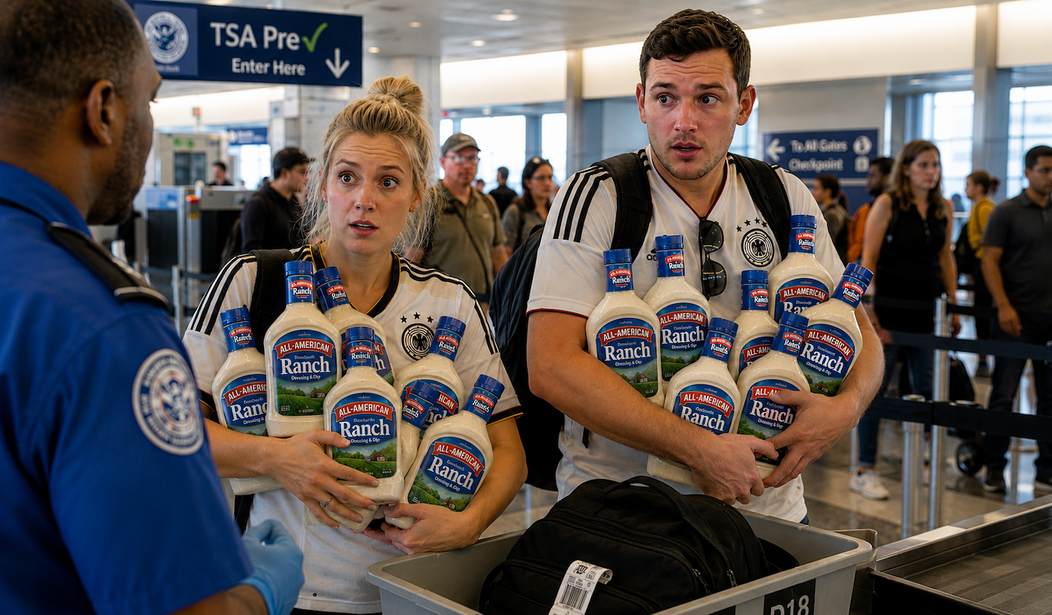
How crazy did the Ranch thing get? This crazy: "TSA warns tourists visiting for World Cup not to smuggle ranch dressing in carry-on baggage as love affair with condiment rages on."
Kraft responded by almost instantaneously ramping up production of TSA-sized bottles of Ranch, something only possible because the company didn't have to first get permission from the E.U.’s Directorate-General for Condiment Packaging.
Besides, the Permanent Undersecretary for Three-to-Seven Ounce Containers is on holiday this month.
As awesome as Freddy is, and as weirdly attractive as Ranch dressing suddenly became, behind their touristy delights lies an uncomfortable question that our cousins will take back with them to the Old Country, provided they have the guts to ask it.
"How did we fall so far behind the Americans?"
The difference isn't scale. The EU has 449 million people living in a single market, compared to 342 million Americans. The difference is the explosion of wealth, abundance, and experiences that come from a regulatory climate where innovation is still (mostly) prized.
Hardly anything happens in Europe without getting permission first. That's why Europe can't build a social media platform like X, but Brussels can slap a record-setting $140 million fine on the firm for ignoring Europe's censorship mandates.
Brussels and the whole "European project" smothered innovation almost out of existence in the name of unity, safety, and homogeneity — and the scale of Europe's failure shocked even me.
Instead of teasing this out, let me show you right now the single chart that blew me away.
A staggering piece of data viz from @amcafee pic.twitter.com/82h65qYFNf
— Travis Sawchik (@Travis_Sawchik) June 21, 2026
So a "from scratch" company is a startup, not the result of a merger, acquisition, or spinoff. Think of Apple, with Steve Wozniak and Steve Jobs hiring a few friends to build computers in a garage.
If you take every single from-scratch company launched in the E.U. in the last 50 years, the total value is maybe a little bigger than Costco (founded in 1983), and it's certainly smaller than Tesla (2003). Just eyeballing that chart, you could probably fit every single European startup since 1976 (the same year Apple was founded) inside Apple's Mac and iPad offices.
As for the iPhone? Fuggidaboudit.
European firms still produce world-class products, but their tech sector in aggregate is barely bigger than Adobe. Granted, I'm not sure you've really driven until you've driven a Mercedes-Benz SL with the top down and the AirScarf system keeping you perfectly comfortable in almost any weather. Karl Benz invented the gas-powered automobile in Germany 140 years ago, but that chart basically screams, "What have you done for me lately?"
What you see on the left side of that chart is an explosion of creativity and wealth perhaps unparalleled in human history, all since 1976. What you see on the right is an entire continent just limping along — a continent that used to be the wealthiest and most sophisticated on Earth, but is now blown away by our easy access to Ranch dressing.
I asked both Grok and ChatGPT to estimate the size of the E.U.'s entire tech sector, and both LLMs — invented and run by American companies — gave me a range of 1.8-2.2 trillion dollars. That's aggregating all the major players like ASML, SAP, Spotify, Dassault, Infineon, etc., plus smaller firms, in fields including software, semiconductors, fintech, and internet.
If you merged them all into one company called EuroTech and listed it on NASDAQ (where most of America's Big Tech firms are traded), it would slot in somewhere between two 21st-century upstarts: Meta and SpaceX.
America, with a quarter fewer people than Europe, has a tech sector at least six times larger.
Six. Times. Larger.
And I singled out tech because tech is innovation.
Want to know why Freddy can buy 57 varieties of jerky at a truck stop chain the likes of which Europe doesn't even have a single location? That's why, right there.
Back in April, you and I looked at Britain's sad decline vis-à-vis the U.S. "30 years ago, Britain would have ranked fifth among U.S. states, just behind Connecticut, Massachusetts, New York, and New Jersey," I wrote then, but today Britain would rank 51st behind Mississippi.
But here's the thing. When polled on where their island nation ranks among U.S. states, Britons guessed "seventh" on average. Europoors don't know they're poor until they've stepped inside an air-conditioned Costco on a steamy afternoon in Nowhere, Texas.
Europeans ought to ask themselves, "Where is our Costco? Where is our Buc-ee's? Why does America have more and better stadiums than we do, even when they barely play Fußball? How come they have SpaceX, Apple, Facebook, and Nvidia, and we don't?"
Simple. Europe collectivized decision-making and handed it to unelected bureaucrats. We have that problem, too, but we're still decades behind Europe in that regard.
The thing about collectivism — or its pan-European equivalent, multinationalism — is that the collectivists always want you to believe that it's inescapable. Here in the U.S. more than a century ago, our homegrown collectivists took old-school European collectivism and renamed it "Progressivism," to signal that moving backwards from our founding principles was somehow progress.
It reminds me of director Abel Ferrara's admittedly uneven but also underappreciated 1993 remake of Invasion of the Body Snatchers, simply titled Body Snatchers. This time set on a remote Army base in Alabama, Ferrara's version served as an anti-fascist metaphor, instead of Don Siegel's 1956 original anti-communist warning.
And Another Thing: For me, Philip Kaufman's 1978 remake of Invasion is the best and most effective of the three films. Set in San Francisco, the pods corrupt the city's civic institutions first. They're enabled by a feel-good pop-science figure — Leonard Nimoy's Dr. David Kibner, who was creepy even before he turned into a pod person. I say "of the three films" because 2007's The Invasion was such a pointless waste of everyone's talent and time that I deny it ever happened.
Ferrara's take has plenty of frightening moments, thanks to Phil Cory's special effects team and Ferrara's notoriously unflinching eye. But the scariest scene — and the entire reason I took you on this detour — is a single minute of dialogue between Steve Malone (Terry Kinney), having just discovered the pods, and his wife Carol (Meg Tilly), who he doesn't know has already been turned.
"Where you gonna go, where you gonna run, where you gonna hide? Nowhere... 'cause there's no one like you left," Carol says with eerily flat insistence. She was talking about the pods having already taken over the Army base where they lived, but she might as well have been talking about starting a business anywhere in the bureaucratically homogenized European Union where, as Carol went on to say, "We're going to be together, we'll be connected, we'll be close."
The inevitability of their so-called progress — the "right side of history," as America's first red-diaper president liked to say — is what the collectivists want you to believe. That's regardless of whether they label themselves progressives, democratic socialists, communists, or fascists.
Difference without distinction, as we used to say in debate club.
The U.S. remains blessed by Providence, as the Founders might have put it 250 years ago, or at least by a remnant of federalism still strong enough for our 50 states to continue their roles as laboratories of democracy. Or as I've come to think of it, as release valves from leftism.
It seems like just earlier this week [It was just earlier this week, Steve —Editor] I detailed for Longtime Sharp VodkaPundit Readers™ how California is losing its newly minted SpaceX and Anthropic IPO millionaires to Florida:
"The California area codes have already started showing up," Fort Lauderdale Downtown Development Authority CEO and President Jenni Morejon told Altus. "It's just that the conversations are evolving."
As it turns out, Florida's appeal isn't just about friendly tax and regulatory environments — it's about the culture. "Silicon Valley is absolutely a boring place to live compared to Miami," Naftali Group CEO Miki Naftali told Fox. "How can you even compare between living in Miami and Silicon Valley?"
Set aside California's affordability crisis, epic fire mismanagement, punitive taxes, and all the rest for the moment, because the cultural part is maybe what fascinates me the most.
There used to be literally no place on Earth cooler than California. Hollywood. Surf culture. Silicon Valley. The Beach Boys. Disneyland. Stanford. Apple. Lucasfilm. Napa. Yosemite. California wasn’t merely prosperous — it was aspirational. As I've written here for years, companies like Apple or Google will probably never leave California, but the next Apple and the next Google likely won't be founded there.
That ain't cool, but unlike Europe, California's innovators have Florida and Texas to escape to. A tech visionary in France has nowhere to go in the E.U. to escape Brussels' smothering embrace.
It doesn't have to be that way, but decline is Europe's by choice.
The odds are long, but maybe Europe could change course.
More than a century ago, when America was the comparative backwater, songwriters Walter Donaldson, Joe Young, and Sam M. Lewis asked about our doughboys returning home from the Great War, "How Ya Gonna Keep 'em Down on the Farm (After They've Seen Paree)?"
It could be world-changing if Freddy inspired Europeans to sing, "How Ya Gonna Keep 'em Bowing to Brussels (After They've Tasted Some Buc-ee's?)"
Last Thursday: The Terrible Mercy of AI Killbots