Note: Most Thursdays, I take readers on a deep dive into a topic I hope you'll find interesting, important, or at least amusing. These essays are made possible by — and are exclusive to — our VIP supporters. If you'd like to join us, take advantage of our 60% off promotion.
“China is a riddle riding a sphinx, wrapped in a cloaking device, stuffed inside a fortune cookie.” —Some drunk guy who isn't Winston Churchill and doesn’t always do metaphor very well.
If you ever thought you had a handle on what in the actual hell is going on in China, it was probably interrupted by a story like the recent disappearance of Yang Wei, the 62-year-old designer of China's top-of-the-line stealth fighter.
The South China Morning Post — which in recent years largely serves as a mouthpiece for the CCP — reported in March that Yang's name is now scrubbed from the Chinese Academy of Sciences "amid a sweeping campaign to stamp out corruption in the defence sector."
"Corrupt" is how CCP mouthpieces describe people who displease or might someday prove a threat to Communist Party boss Xi Jinping. Some reports claim Yang is dead, but that's unconfirmed — so for now, treat his death as a rumor at best, mere X clickbait.
The paper also noted that "Yang has not appeared in public for more than a year," and that "no explanation has been given for his absence, or for the removal of his name from the site."
Yang seems to be an unperson — and he isn't the only recent disappearance from China's defense sector.
Beijing has spent the last two years purging senior officers from its missile forces and investigating executives at its top aerospace firms. What’s far less clear — but increasingly hard to ignore — is whether that same pressure extends to the engineers responsible for making those systems actually work.
The SCMP also reported just two days after Yang's memory-holing that "controversy haunts" the "likely death of China’s hypersonic weapons expert Fang Daining."
One week later, former Chinese aerospace executive Tan Ruisong was given a suspended death sentence over corruption and insider trading. Maybe he was genuinely too corrupt for even Beijing to tolerate, or maybe Xi was just frustrated by his company's continued failures and delays in producing the kind of world-class jet engines demanded by Yang's J-20 stealth fighter.
Thinly documented but still worth noting are recent and consistent social media reports of lower-level aerospace engineers vanishing from conference circuits, losing their institutional affiliations (vital in a communist hierarchy), and their publications disappearing down the old memory hole.
Historically, Xi goes after "corrupt" generals and high-ranking executives, but he may now have widened the net to include engineers and scientists.
What does all of this say about the efficacy of China's best military gear?
Don't get me wrong. I don't at all mean to imply that Communist China's People's Liberation Army is a paper dragon. In fact, China shows more than a few indications of being — or at least trying to be — as imaginative as the Japanese were during World War II, or as the Soviets were in Tom Clancy's (still) excellent Red Storm Rising.
But the poor performance of Chinese air defense systems — and by "poor," I mean, "they blowed up real good" — has even China-friendly nations rethinking their commitments.
The National Interest last December reported on "the real reason" that Thailand chose Israel's Barak MX system for its air defense needs, following clashes with neighboring Cambodia.
As the magazine noted: "It is more than likely that the Royal Thai Air Force, which is purchasing these Israeli systems, wants to overmatch whatever the Cambodians can threaten Thailand’s border regions with." Cambodia, of course, buys Chinese.
Thailand made its decision weeks before Operation Absolute Resolve, and shortly after the Israeli Air Force made short work of Iran’s Chinese and Russian air defenses during the 12-Day War. Both likely gave China’s usual export customers at least one second thought about their supplier.
These are eye-opening developments for those of us concerned by how much China appears to have caught up with Western technology — particularly the high-tech aircraft and warships whose pilots and sailors would decide a Great Pacific War.
My mistake — if I was wrong — was treating China's space program as a rough barometer for the country's military development. "Space is hard," as you well know, and China's achievements took them, if not from 0-60, then at least from 0-50 in almost nothing flat.
China didn't put a man into space until 2003, when taikonaut Yang Liwei boarded the Shenzhou 5 space capsule atop a Long March 2F rocket, and completed 14 orbits before returning safely to Earth. Beijing launched its first space lab, Tiangong-1, just eight years later, and used it to practice rendezvous, docking, and short stays until 2018.
In orbit from 2016-2019, Tiangong-2 was a more ambitious effort, proving that China could resupply a space lab and maintain crews for much longer stays. For the last five years, China has operated and continuously manned the Tianhe, a full-fledged modular space station. Just like on the West's larger International Space Station, crews work on six-month rotations, and perform space walks, research, robotic arm operations, and gain insight into long-term space habitation.
China is the only country to return samples from the far side of the moon, and these days it seems possible that a taikonaut will set foot on Luna before another American astronaut does.
It might be difficult for a Westerner to admit, but China's space program so far proves that the country has mastered extremely difficult arts and sciences with clear military applications. There's rocketry (missiles), materials science (stealth applications), precision (targeting), high-risk logistics (amphibious invasions), autonomous systems (AI and military robotics), and the kind of reliability required for sustained military operations.
Surely, the country that can do all that can build a "good enough" stealth fighter like the Chengdu J-20 Mighty Dragon.
Well, maybe not, if Yang Wei's demotion to "unperson" is any indication.
But before I get all the way into that, let's look at what I mean by "good enough."
Every new type of fighter jet is engineered with a series of necessary compromises, even gold-plated miracle platforms like the F-22 Raptor and the F-35 Lightning II. One compromise similar to both American fighters is that they were given "short legs," that is, a short combat radius. The Pentagon's assumption was that they'd most likely be used in Europe or the Middle East, and with access to nearby friendly airbases.
The fact that the Pacific is fricken yuge and that China was a rising world power was either forgotten or ignored by the people in charge of both projects.
For needed perspective, here's a map of the Pacific Ocean with its vast stretches of zero friendly airbases, and where China may one day contest our very presence.
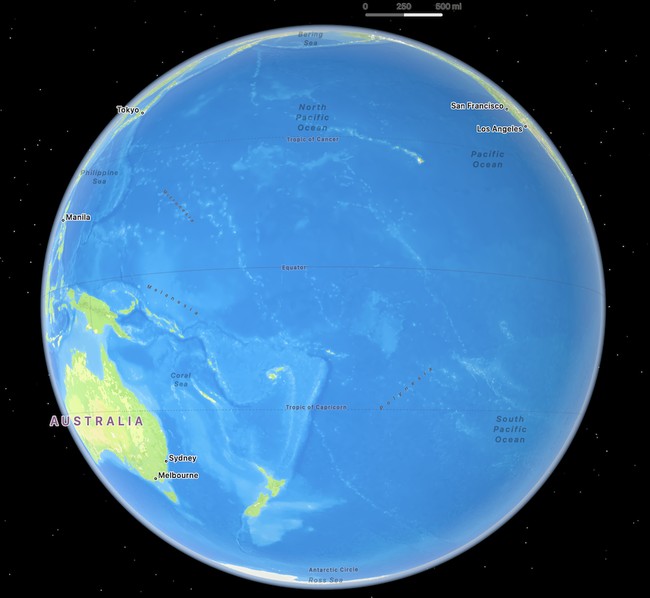
Don't even get me started.
China, on the other hand, seems to have designed its premier stealth fighter, the J-20, with the size of the Pacific Ocean — and our jets' short legs — firmly in mind.
The Mighty Dragon is optimized for frontal stealth, likely in part due to its sheer size, materials, and manufacturing constraints, and known weaknesses in the country's jet engine technology. Even then, the J-20's frontal stealth is compromised when its large canard wings rotate out of the neutral position during rapid maneuvers.
But the jet has a couple of things going for it. Its size allows for long-range and belly-stored anti-aircraft missiles that out-range anything currently in the American fighter-jet arsenal — at least until our long-range AIM-260 JATM is fully fielded.
So it's always been my impression that the J-20 has two primary missions. The first is to serve as stealthy scouts against our aircraft carrier strike groups, sneaking in close enough to provide targeting data for China's DF-21D "carrier-killer" ballistic missiles located safely on the Chinese mainland.
And Another Thing: The Pentagon also believes China is working on a longer-range carrier killer, known to us as the DF-27. It's also believed to serve as the launch vehicle for a hypersonic glide vehicle China hope can penetrate a carrier group's impressive missile defenses.
The J-20's likely other role is using its frontal stealth, long legs, and extremely long-range PL-17 anti-aircraft missiles to spot and shoot down our refueling aircraft (and all-seeing AWACS platforms, too). Without those tankers, our short-legged jets just can't do much in the vast Pacific. And that is how a "good enough" stealth fighter effectively defeats better jets like the F-22.
Amateurs study tactics, professionals study logistics, as they say — and Beijing at least appeared quite professional when considering what engineering compromises to go with on the J-20. They might not yet have mastered all-aspect stealth or offensive carrier operations, but the J-20 seems to be custom-built to play down China's weaknesses, while preying on ours.
But then Yang and other top military engineering talent started vanishing, and here we are, forced to reconsider not just how we evaluate the People's Liberation Army, but how Beijing evaluates its combat potential, too.
You'll find speculation on X and elsewhere about why China's "stealth-defeating" radars performed so badly in Venezuela in January, and again in Iran during Operation Epic Fury. The thinking goes that China used Weng's J-20 stealth fighter to test the country's stealth-beating air defense networks, found that those networks performed A-OK (however you say that in Mandarin) in producing mock-shootdowns of the J-20, and concluded that those same systems would perform just as well against America's stealth fighters.
While that makes some sense, I'm not entirely convinced. But however China got to exporting stealth-defeating radars that do not, in fact, defeat American stealth, the point remains that Beijing seems to be unhappy with some of the country's top engineering talent. Unhappy in the same way that leads George Orwell’s Big Brother to quietly turn persons into unpersons.
Regardless of what became of Yang, there's more to stealth than being "invisible" to radar, which isn't even a thing — and might even reflect Beijing’s doubts about its technological and operational strengths.
No country produces undetectable jets able to fly around at will, completely immune to enemy aircraft or air defenses. The reality is complicated, but it's also fascinating enough to break down into civilian-friendly morsels.
Very High Frequency radar like China's JY-27A may be able to detect or cue stealth aircraft at useful ranges, but that's not the same as generating a weapons-quality track, or "missile lock." The F-22 and F-35 don't return strong enough radar signatures to generate that weapons-quality track until those jets are practically right on top of the bad guys. By that time, it's too late, and the enemy's air defenses or fighters consist mostly of twisted metal.
But stealth isn't just the way you design and build a plane. It’s also an operational system of route planning, emissions discipline, high-speed data links, electronic warfare, stand-off jamming, and the rest of a strike package like the one that neutralized Venezuela's Chinese-made (and perhaps Chinese-operated) air defense network.
The American military has this stuff down cold, and all the publicly available information indicates that Beijing is still unable to counter 21st-century U.S. air power under real-world combat conditions. There might — might — be a broader implication buried under all that. If China hasn't figured out a counter to America's stealth operations, it seems possible, perhaps even likely, that they also haven't figured out how to implement their own.
Which, while speculative, could also explain Beijing's extreme displeasure with Yang and the others.
The only thing I know for sure is, whenever I ask, "What in the actual Hell is going on in China?" nobody can answer. Nobody, that is, except for Xi Jinping and his inner circle who remain stealthy enough not to say anything at all.
Last Thursday: Here Comes Skynet