Note: Most Thursdays, I take readers on a deep dive into a topic I hope you'll find interesting, important, or at least amusing. These essays are made possible by — and are exclusive to — our VIP supporters. If you'd like to join us, take advantage of our 60% off promotion.
"The First World War was at once piteous, in the poet’s sense, and ‘a pity’. It was something worse than a tragedy… It was nothing less than the greatest error of modern history." —Niall Ferguson
Generaloberst Helmut von Moltke stood even straighter than usual, his unpleasant and unprecedented duty to tell his emperor — Kaiser Wilhelm II, Supreme Warlord of the German Army, Field Marshal, and Admiral of the Fleet — something he didn't want to hear.
"Before you order the mobilization... before we break Belgian neutrality... before we draw Great Britain into a wider war when we already face France to the west and Russia to the east... there is something you must hear."
Wilhelm's mustache twitched. Unaccustomed as he was to bad news, he had no trouble recognizing that this was exactly what Moltke the Younger had come to deliver.
"I must correct a persistent misunderstanding," Moltke nearly stammered. "What you know as the Schlieffen Plan was never an operational war plan. It was a memorandum — an argument for additional manpower, not a blueprint for victory. We cannot defeat France in six weeks. Give me two years, perhaps three..." he trailed off.
"Nonsense. Schlieffen promised me Paris in six weeks, and so did you and the rest of my General Staff." Working himself into a full head of steam, Wilhelm bellowed, "My grandfather defeated France in six months when he wasn't even emperor yet!"
"With respect, Majesty," Moltke said, finding his voice, "Schlieffen promised nothing. His plan asked for 30 more divisions we never raised. And if I may speak frankly, after marching through Belgium and northern France, the fresh divisions needed to take Paris... Schlieffen conjured them out of thin air. The roads and the railways to deliver them, as they exist now, simply aren't up to the task."
"Are you saying," Wilhelm demanded, "that all of those lovely army exercises I commanded were lies?"
"I am saying, Your Majesty, that military exercises are a vital part of our preparations for total victory, but..." What Moltke wanted to say was, "You built yourself a pretty Navy instead of raising Schlieffen's divisions," but he preferred to leave the palace with his head still attached. Moltke's brain scurried for words that would not find any fault with the Kaiser. "But we never quite achieved the full material conditions necessary for a swift victory."
"Then what, Moltke? You tell me I must back down and acquiesce to the French?" But Wilhelm knew the situation in the weeks since Archduke Ferdinand's assassination was now too far gone for a diplomatic solution. He had too much prestige on the line. Es muss Krieg sein.
"It must be war."
Moltke drew in a breath. "I tell you, Majesty, that we can still defeat France and Russia. But doing so requires a new plan, one of my own design, and we must move quickly."
— — —
The scene you just read is of course a total fiction.
What Germany needed in the summer of 1914 was an Otto von Bismarck, not a Moltke or a BethmannHollweg, and certainly not a pompous little Wilhelm II. But you go to war with the leadership you've got, I suppose.
Bismarck was an ambitious man, no doubt — not just for himself, but for establishing a new German Empire by force of arms. But Bismarck also possessed a necessary touch of humility beneath the warmongering.
As minister-president and foreign minister of Prussia under King Wilhelm I, Bismarck was hardly shy about using warfare as his primary tool in pursuit of an emperor's crown for his king. "Not through speeches and majority decisions will the great questions of the day be decided," Bismarck announced before Wilhelm was crowned Kaiser, "but by iron and blood."
He wasn't kidding. In 1864, Prussia and Austria went to war against Denmark to seize a couple of mostly-German provinces from the Danes. The genius bit was that Bismarck proposed that Berlin and Vienna jointly rule Schleswig-Holstein — and when that didn't work out, Bismarck used the resulting fallout to go to war against Austria two years later. That war established Prussian dominance over the minor German states that had formerly been in Austria's sphere.
Next up, France, and Bismarck engineered the Ems Dispatch to trick Napoleon III — a dim shadow of his great uncle — into declaring war on Prussia. As the seemingly injured party, Prussia rallied the minor German states to war and together they defeated France in six months and snagged the long-disputed Alsace-Lorraine region.
The German princes offered victorious Wilhelm the emperor's crown, and this time, he accepted.
But Bismarck's genius — aside from annoying European liberals with his blood and iron speech — was that he understood Germany's weaknesses as well as its strengths, and he tempered his goals accordingly.
The empire Bismarck built for Wilhelm was the Lesser Germany (Kleindeutschland) first proposed by the short-lived Frankfurt Parliament of 1848-49, and rejected by Wilhelm. He called the Frankfurt crown a "dog collar" offered by revolutionaries — and Habsburg Austria wasn't interested in joining a Greater Germany (Großdeutschland), anyway.
But most importantly, once France was defeated and the Prussian King was crowned Kaiser Wilhelm I of the new empire, Bismarck was careful to present Germany as a "satiated power" with no urgent strategic need for colonies, naval arms races, or further European wars. That meant maintaining warm relations with Russia and Austria, keeping France diplomatically isolated, and Britain unconcerned that Wilhelm meant to become another Napoleon.
Britain was the linchpin, you see.
Britain didn't fight Napoleon for a quarter of a century because he was a bad guy, although he surely was. Britain didn't stand alone against Hitler because he was a bad guy either, even though he was literally Hitler. Britain didn't keep 50,000 men stationed on the Rhine during the Cold War, ready to resist Soviet aggression, because Stalin was a bad guy. But you gotta admit, Stalin was right up there with Hitler.
Britain, safe behind the Channel and the mighty Royal Navy — ah, those were the days! — enjoyed the luxury of picking and choosing which European wars to fight. Largely, they chose not to fight at all.
Unless it looked as though all or most of Europe might fall under a single power, Britain usually stayed out. But a united and hostile Europe could challenge Britain at sea, and that was a danger London could neither tolerate nor risk.
Napoleonic France posed that risk. So did Nazi Germany. As did the Soviet Union. Great Britain resisted all three, even though they were very different countries led by very different men.
That's exactly what Lord Palmerston meant when he said that Britain has "no eternal allies, and we have no perpetual enemies. Our interests are eternal and perpetual, and those interests it is our duty to follow."
There's a lesson here for would-be European conquerors: Keep your ego in check. Keep your goals in line with your abilities. Because the Brits (and later the Americans) will in the end tip the balance against you.
That was exactly what Wilhelm II’s Germany failed to do. Hell, they barely even lived in this reality.
The fictional scenario I opened this week's essay with did contain truths about the Schlieffen Plan, discussed in a previous column. If you're familiar, feel free to skip this previously quoted item from John Vincent Palatine:
Perhaps the most famous – and most misinterpreted military document in world history – but not, as is often claimed, the blueprint for 1914 – is the so-called “Great Memorandum” (also known as the “Schlieffen Plan”), written by German Field Marshal and Chief of Staff Alfred Graf von Schlieffen – dated 1905, the year of his retirement, but probably completed in 1906. It was simply a memorandum – a military-political statement that repeatedly addressed the issue of (in Schlieffen’s opinion) a much-needed expansion of the German army at a time when much of the budget went to the Navy. It was not a current deployment, let alone a mobilization plan.
To accomplish the goals set out by Schlieffen in 1905-06, Imperial Germany would need an army of 94 divisions. His successor, Moltke the Younger, had an army of 68 divisions to work with instead. Even then, Schlieffen fudged it. The fresh troops needed to take Paris simply had no way to get to the front in time.
Berlin was obsessed with defeating France first and fast, before the slow-moving Russians could mobilize in the east. But there was no way to defeat France quickly.
Half-memorandum, half-fantasy, Schlieffen’s memorandum was nevertheless enshrined by the German General Staff as holy writ, forming the core of imperial war-planning.
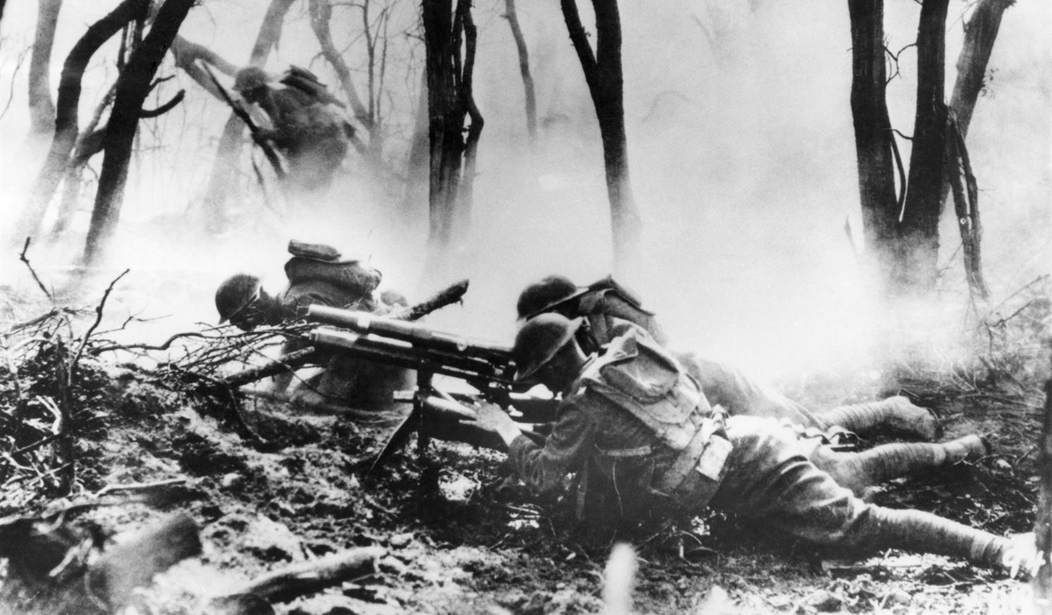
And Another Thing: It wasn't just the Germans indulging in fantasy. France's dedication to recovering the "lost provinces" of Alsace and Lorraine wasn't a civilization-ending mistake, but it was certainly a whopper. Paris knew how well Berlin had fortified Alsace-Lorraine, but the French General Staff believed that élan — enthusiasm — would be enough to overcome German machine guns and pre-sited artillery. France's Plan XVII sent men with nothing but rifles and élan into a deathtrap. After three weeks of fighting, France lost 350,000 dead, injured, and missing, marking the beginning of the end of France as a major power.
Worse, once activated, Schlieffen's so-called plan gave zero room for maneuver. The General Staff's intricate railway timetables, troop activations, and deployments were all meticulously scripted down to the minute — every railcar, horse, and battalion had a precise slot. Deviating from it risked paralyzing the entire mobilization and turning the finely tuned Imperial German Army into an incoherent mess.
German mobilization was a vast logistical Rube Goldberg machine with no off switch.
When Wilhelm II nearly panicked in July 1914, and tried to call off the attack after mobilization began, Moltke told him it couldn't be done. Es muss Krieg sein.
But we still haven't gotten to the worst part.
The Schlieffen Plan required invading Belgium to skate around France's strongest defenses — an act that required treaty-bound Britain to wage war on anyone violating Belgian neutrality.
Schlieffen ignored Germany's most vital national interest — keeping Britain uninterested in Europe's wars — and everybody else just went along. YOLO, I guess.
And so began the greatest, most damaging, and most damnable folly in the history of Western Civilization — all because the men tasked with the most serious decisions instead clung to a fantasy vision out of sheer hubris. For all of German talk of realpolitik, there was little realism to be found in two decades of fantasy planning.
A realistic, sober, and most importantly a humble assessment of Germany's position and priorities results in much different but achievable war aims.
- France is not a direct threat; keeping them isolated as Bismarck did is enough.
- Do nothing to frighten or force Britain into action, or at least not until much later.
- Russia is the existential threat that must be dealt with.
Germany's proper war aims should have been "Russia first, France later — if then."
Even with minimal troops committed to the west, Germany could have let the French pound their heads against the fortresses of Alsace-Lorraine for approximately ever. Full mobilization against Russia was the way to go, and likely would have led to a quicker win in the east, maybe in 1916, almost certainly no later than 1917. Austria would have been spared the crippling losses of 1915, perhaps allowing the Habsburg empire to stagger along for another generation or two.
And Another Thing: Italy would probably have sat out this version of the war, but Ottoman Turkey might have jumped in at the last moment to take back lost bits of the Caucasus from a faltering Russia. And without British intervention in the Middle East, maybe even the Ottomans survive for another generation or two.
There would have been no defeat at the hands of the Franco-Anglo-American armies in the west. No abdication, no Weimar, no Hitler, no WWII, and no Cold War. I suspect German hegemony might have lasted a bit longer than Napoleon's did — but who knows?
As for the Brits in this scenario, without the invasion of Belgium, there is no clear casus belli. The “scrap of paper” protecting Belgian neutrality is left intact. Grey cannot bring the Cabinet or Parliament to war over French attacks on German soil, and a bitter split ensues: the Liberal government nearly falls, but Asquith holds a razor-thin majority for neutrality provided British interests (France's Channel ports, British trade) are left alone. Maybe they eventually join the war, but likely too late to matter.
In any case, a German Empire enlarged in the east— but one that showed no interest in the Channel ports of France or the Low Countries — was something Britain could have lived with.
Russia defeated, Berlin establishes hegemony over Mitteleuropa, just as they did in our timeline. The big difference is that had Germany understood its limitations, had they not gone all-in on conquering France and neutralizing Britain... they would have kept their new empire in Poland, Ukraine, and the Baltics.
And here is the lesson that petulant, grandiose Wilhelm II and his entire military leadership failed to grasp, the failure that led to two world wars and the eventual emasculation of Europe...
From humility comes greatness.
Last Thursday: The Lost Art of Selling a Song