





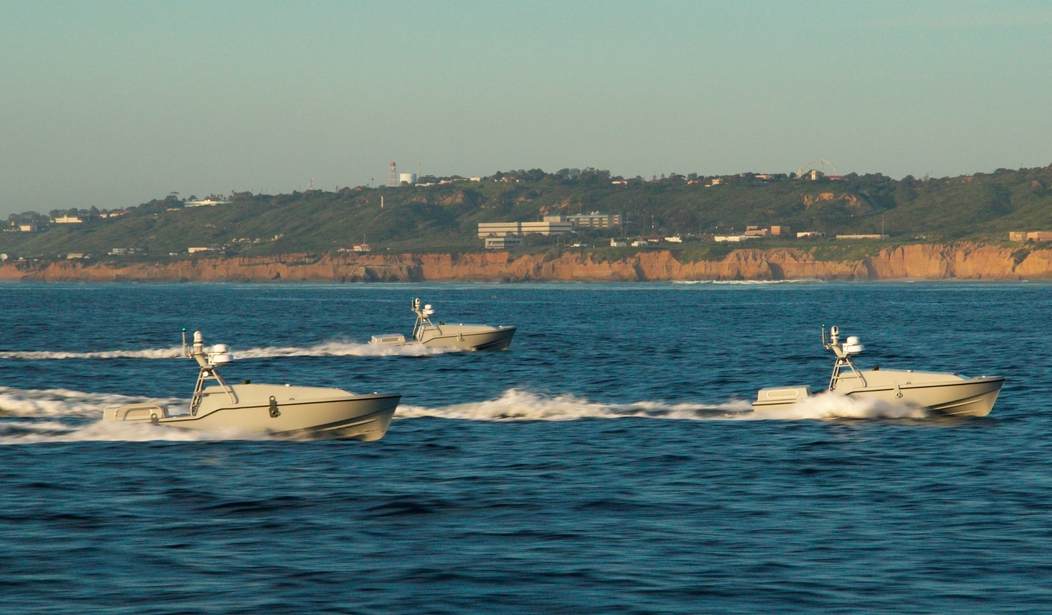
For many, the first time you heard that the United States possessed autonomous boats and ships— drone boats — was when one was used to rescue two American Apache helicopter pilots in the Gulf of Oman after Iran sent a flying drone into their cockpit. The IRGC claimed it was a mistake. Uh huh.
But, oh my, advances in the unmanned boat and shipbuilding space are happening at hyper speed — especially for Saronic, the company that made the drone boat that saved the day.
Under President Trump and War Secretary Pete Hegseth and Navy Secretary Hung Cao, things are moving fast to bring the U.S. Navy fleet up to par with China. And it's feeling like America's back.
America's shipbuilding is slow, especially by comparison to China. And we're going backward. As China's fleet grows, the U.S. will take two warships offline by 2030. A 2024 Pentagon report stated that China’s navy “is the largest navy in the world with a battle force of over 370 platforms" and the U.S. Navy has 292.
And let's stipulate that it's easier to build in China when they stole our technology and have slave labor at their disposal.
But America may be catching up faster than we could imagine.
Saronic was contracted a year ago, in August 2025, to build boats for the Navy. These were put into service by the Navy in March of 2026.
By June 8, the first autonomous boat, a 24-footer called the Corsair, was sent to find the Apache pilots. Both survived.
The backstory of getting these boats adopted into the fleet is fascinating. You can read about the founder, a former SEAL Team member, in The Story Behind That Drone Boat Is Almost as Cool as the Apache Pilot Rescue.
It was the first wartime use of naval autonomous drone boat technology.
Here's a look at the 24-foot Corsair.
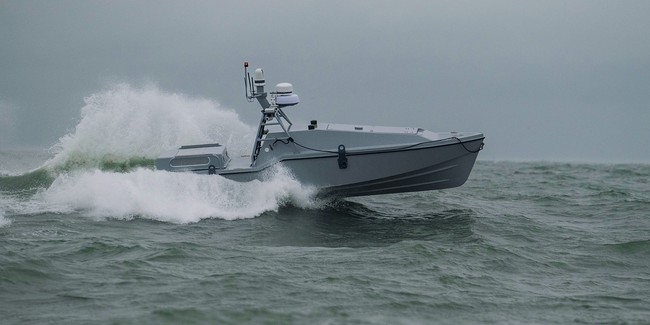
The autonomous surface vessels (ASVs) have sensors built in around the entire boat or ship with "360-degree passive sensing capabilities for day and night operations, which likely helped in locating the two soldiers off the coast of Oman after their helicopter went down," Defense Scoop reports.
Hours after the drone attack on the Apache, in the early morning of June 9, U.S. Air Force and Navy fighters struck Iranian air defense sites, ground control operations, and radar installations in what CENTCOM called a proportional attack in retaliation.
On June 12, the Navy also greenlit Saronic to participate in the "sea testing phase of the Medium Unmanned Surface Vessel (MUSV) Marketplace — a program designed to rapidly field unmanned technologies by leveraging mature, commercial-ready solutions." Duh.
A few weeks later, the drone boats were used for kinetic activity in combat for the first time. On July 12, the Pentagon directed three of the one-way Corsairs to an Iranian submarine and ship maintenance facility at the Bandar Abbas Naval Base.
Yesterday, using multiple one-way attack surface drones, CENTCOM forces successfully struck a submarine and ship maintenance facility in Iran. Three Corsair unmanned surface vessels hit the port at Bandar Abbas Naval Base, marking the first time American forces have employed sea… pic.twitter.com/bOM2kmgRxz
— U.S. Central Command (@CENTCOM) July 13, 2026
Now, the company making these drone boats, Saronic, announced on July 16, 2026, that it has purchased land right next to the Gulf of America that will be fashioned into the largest shipyard in U.S. history. They call it Port Alpha.
Initially situated on 835 acres at the Port of Brownsville, with the opportunity to expand to nearly 4,400 acres, Port Alpha will encompass a shipyard and manufacturing facility capable of producing vessels up to 850-ft. Future site expansion could support the production of vessels over 1,200 ft.
The site provides hundreds of acres of waterfront access, deepwater channel connectivity, multimodal logistics infrastructure, and room for long-term expansion — everything required to anchor a next-generation shipbuilding hub.
The Brownsville facility is just a 40-minute drive to Elon Musk's Starbase.
One of the founders, Dino Mavrookas, calls it the "shipyard of the future."
The Austin, Texas, based Saronic previously bought a large shipyard in Franklin, La., that makes the company's larger ships, and on Aug. 9, 2026, announced that it's testing its vessels on the waters off Gulfport, Miss.
Is it just my extra-powerful rocket fuel coffee I had this morning, or is the adoption of this technology moving at double Trump Time?
"This is going to bring American ship building back to a place that we haven't seen since World War II," the former Navy SEAL told the All In podcast.
"[T]o be clear, we're already operating a shipyard," Mavrookas said. "We have a shipyard in Franklin, Louisiana. That's where we're building Marauder. We're ramping that up to 20 Marauder. We can bring that up to 50 Marauders per year, every single year."
The company says the Marauder has "dual-use autonomous capability far from shore across the full range of defense and commercial applications."
Because I know some of you guys like to nerd out on this stuff, here are some of the specs.
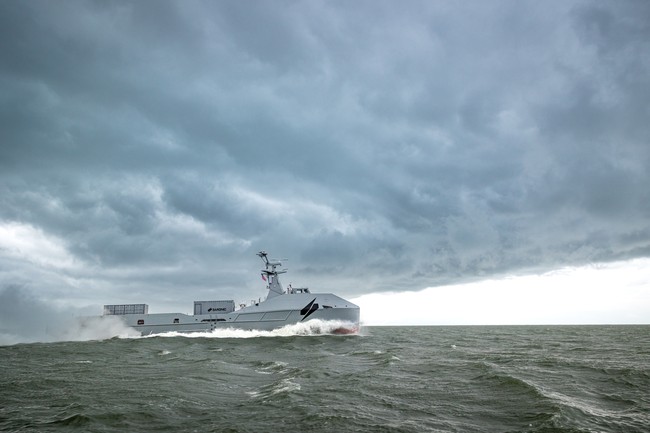
With a top speed of 25+ knots and a range of up to 5,400 nautical miles, Marauder can reposition rapidly and sustain operations across vast ocean distances. Its 150-metric-ton payload capacity, configurable to accommodate up to four 40-foot or eight 20-foot ISO containers
And here's a beauty shot of the 180-foot Marauder-class drone ship.
They also make a 52-footer called the Mirage-class vessel.
The Brownsville operation will eventually employ 10,000 people. Three hundred jobs were open for its facilities when they recorded this interview. I just checked, and there are 216 left.
America's back.
Editor's Note: Do you enjoy PJ Media's conservative reporting exposing the radical left and woke media? Support our work so we can keep bringing you the truth.
Join PJ Media VIP and use promo code FIGHT to receive 60% off your membership.


Join the Conversation
VIP members get the ability to comment on articles.