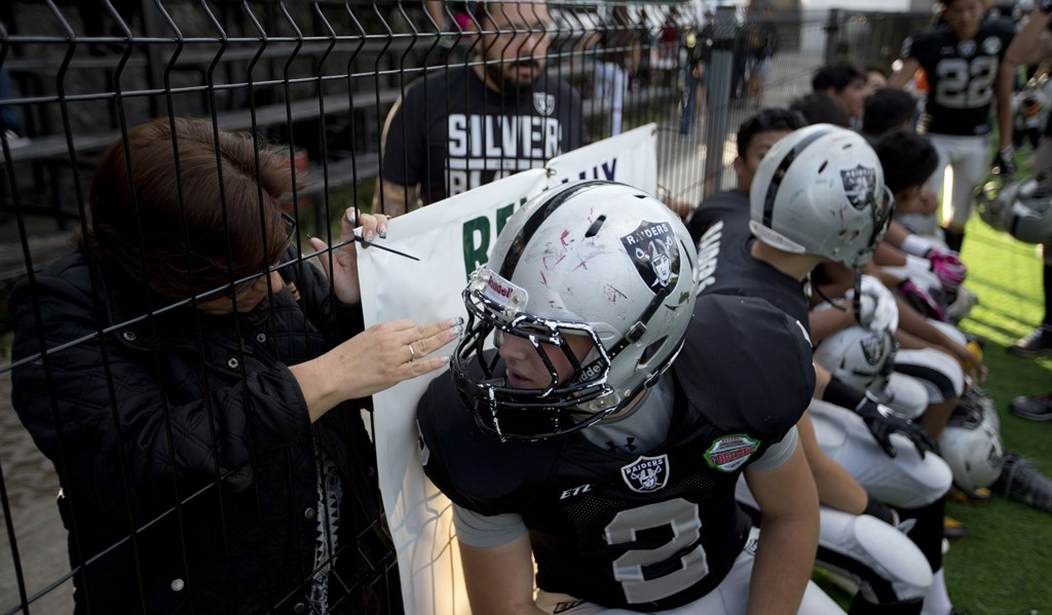

It’s cliché to think that the problem with youth sports, particularly football, is a win-at-all-costs mentality. It’s not that at all. If it were, the kids who actually play would be on the field on the basis of talent, ability, and commitment to winning. That’s usually not the case.
The real problem, for starters, is dads coaching their own kids, which is a huge challenge, because if you don’t let dads coach their sons’ teams, you won’t get many volunteer coaches at all, and the leagues will dry up.
The next problem is dads who coach but never played football beyond youth leagues or middle school. What you find if you get to know many of these youth football coaches is that the entirety of their understanding of the game is based on ESPN’s SportsCenter, their fantasy football leagues, and the Madden video game.
The third problem, and I’ll limit this list to three for our purposes, is the current social media and hype environment surrounding sports at all levels. Little League baseball players should not have “walk-up music” any more than youth league football players should have “recruiting videos,” but they do.
Gone are the days when team pictures involved a guy with a camera and a tripod asking the boys to kneel next to a helmet and smile. Now, the picture looks like Marvel Comics used AI to turn your 80-pound child in his Nike uniform into the Incredible Hulk.
None of this, of course, helps the boys to be good at, you know, football. Over the years, I’ve seen dads teach safeties to get down in a three-point stance. I’ve seen coaches teach players to try to catch a football using the crook between their forearm and bicep. And very commonly, I’ve seen these coaches teach arm-tackling, or tackling with the head down, risking serious head and neck injury.
The point is, the dad-coaches who have relied on screens for their understanding of the game don’t know what they don’t know, nor do they seem to care. But youth league football is a very forgiving environment for men who are only on the field to ensure their son gets his preferred jersey number, his desired position on the field, and most importantly, playing time.
Youth coaches are typically not win-at-all-costs. Many don’t mind the losing so long as their kid is the starting QB, running back, or wide receiver. If, in order to win, their son would have to play on the line or not much at all, they’d probably quit. But please don’t get me wrong. Neither approach to the game is healthy at the youth level. The last thing I’d argue for is that win-at-all-costs approach to youth football.
For a kid who plays youth football, what does a day in the life actually look like? Most often, coaches, moms and dads, and other adults in these kids’ lives put a lot of emphasis on the performance of the child or the team on a given day. They do this while ignoring that he’s in the early developmental phase as a player. The adults lose sight of the fact that this is the time for making mistakes and learning from them, while still having fun.
“Did he win today?” “How’d he do?” Those are the most common knee-jerk questions you’re likely to get from family who weren’t at the game. What no one asks is, “Did he have fun?” “What did he learn?” While I'm still all for keeping score to determine game outcomes, and I'm no fan of every-kid-gets-a-trophy, a little perspective is required.
Youth football is supposed to be a beginning phase of the child’s experience with football, not the end of it. Too many coaches and parents expect these kids to know many facets of the game without ever having taken the time to properly teach them, and to do so in a fun, low-pressure way.
One of my kids’ youth coaches was notorious for this, and so in the middle of a game, when one of his players would miss a tackle or a block, he’d yell at the top of his voice, “Come on!” as though the kid was supposed to know something the coach never really taught him. I learned to watch the cycle with this guy. One by one, he’d discourage kids until you could be sure at least a third of the team would decide to quit at the end of the season.
To remedy that in our house, I purposely decided not to coach my kids’ teams, even though I had played the game myself, because if I was going to dedicate my own time to helping my kids succeed, it would be as their biggest fan at practices and games, and in the quiet of fields and tracks at other times away from the team and the pressure.
Too much emphasis on youthful mistakes on a football field is a sure way to create a former youth football player, and one who may resent his mom or dad in the process. The worst thing a dad-coach or a dad can do is to revisit all of it after the game and do a post-mortem the way they do in high school, college, or the pros. For a kid who’s not yet wired for the intensity of higher levels of football, this is morale-killing and a pathway to burnout.
According to an organization called StriveOn.com, 55.4% of children aged 6 to 17 participate in organized sports, but this statistic is more heavily weighted toward the younger ages. By the time the kids hit high school age, roughly 40% of them have dropped off and quit. Based on other data I’ve found, this is the most conservative number. It could be higher.
Among the reasons given for those who stopped playing organized sports before high school are: lack of enjoyment from pressure, criticism, intensity of the training versus the fun of playing the game; lack of improvement and not being able to compete against peers; social pressures from peers who make quitting look more attractive; competing priorities, which include academics, family and social circumstances; and cost and access, such as proximity to an ice rink, a field, or a league, or lack thereof.
All of this, of course, is a balancing act. While one kid may quit because he felt too pressured to practice harder and more consistently, another kid may quit because he wasn’t developing as a player. That kid may have had more fun and performed better if he was better encouraged to practice more and work harder.
To be sure, there is no one-size-fits-all approach to youth football. Just as each kid is different, the way to keep him excited to play and to help him be the best he can be varies as well.
The one thing they don't need to find a love of football is an over-the-top hype environment. But if you talk to any random parent at a youth game about this, you might hear: “This is how the kids have fun. It’s not all about Xs and Os. We want the kids to enjoy the whole experience.”
That’s why the expensive uniforms, spikes, hype music, merchandise sales, highlight videos, websites, social media, and probably a lot more I’m forgetting right now. To me, this is all noise. It’s the bells and whistles that will mean nothing if the boy isn’t having fun and achieving his goals once the ball is snapped.
The reality is, all too often it’s not about the kids at all. It’s about the parents. Some are reliving their younger days, while others are trying to experience the game for the first time through their kids. That’s how you end up with this.
Let’s check in on youth football at Bill Cowher’s alma mater, Carlynton…. pic.twitter.com/nN2V0oqQLF
— (Not) Art Rooney II (@OldManRooney) August 30, 2026
And this.
Dad Runs Onto Youth Football Field, Trips 9-Year-Old Mid-Play, Only Fined $313 pic.twitter.com/OQl7k5N9PF
— TaraBull (@TaraBull) August 29, 2026
And this absolute foolishness.
Parents vs their kids in sports 🏈 😳😂
— ꧁Bobbi꧂ (@SaltyBitch_52) August 29, 2026
Youth sports parents who refuse to let their kids win on purpose are doing something most sideline culture quietly stopped doing. These clips aren’t about humiliation. They’re about the moment a 10-year-old realizes the person who packs… pic.twitter.com/MoGKNLZT69
Fortunately for our family, we were able to weather the gauntlet of youth football in our house so that our boys still wanted to play and did play through high school, and one through four years of college. Looking back, I can say that their youth football experiences barely prepared them for high school. I can also say that on numerous occasions, dad-coaches did quite a bit, unintentionally and intentionally, to discourage our kids from even wanting to continue playing a game that they loved most. In at least one case, it was very intentional since my son’s coach saw my son as competition for his son as they moved up.
I had decided early on not to coach the team but instead save all my support for my kids from the sidelines. This was most important when my kids needed those periodic one-on-one times to help them deal with whatever was bothering them. By staying off the field during practices and games, as a dad, my focus was always on making sure the whole process was a learning experience and a positive one. I’m not saying this is what others should do; I’m just saying it’s what I did.
Related: Know Your Place
At the same time, this doesn’t mean the learning process was always fun. Learning is often frustrating. Sometimes you learn about adversity when you get hurt, or you don’t get the position you wanted, or things don’t go your way on the field. Those are valuable teachable moments, and where a mom or a dad can make the biggest difference. If handled right, they can become the spark that leads your son to motivate himself to overcome any obstacles in his path, fair or not. Based on what I’ve seen, this lesson is the one most likely to carry over into life, long after their playing days are behind them.
The best advice I ever got came from the dad of another player at my one son’s high school. My son was a freshman quarterback at a school known for its QBs. This father’s older son had already done very well at the school and as a Division I quarterback, and he was playing in the NFL at the time.
The father told me never to critique my son after a practice or a game. “The coaches will do that,” he said, and he was right. He told me my job was just to be there. Be there for my son if he wanted to talk, or if he just wanted quiet on the ride home. He told me that if my son does bring up the game, or something he did on the field, don’t give an opinion; resist that urge at all costs. “Just ask him what he saw, and let him do the talking,” this father told me.
I followed his advice, and while I can’t say it made a difference one way or the other with my son’s play, I can say that it prevented football and any hangups I may have had about the game from getting between him and me. It enabled me to be there for him as a sounding board when he needed it.
If you have a youth football player in your family, the only thing I’d add is, always make sure it’s about your child, and it’s not about you. Check yourself frequently. Try to make sure it’s always fun and that they like playing, even if it doesn’t always work out the way they want, and then let the experience do the rest of the work from one week to the next and from one season to the next.