
One of the left’s lazy critiques of America’s founding fathers is the accusation that these were not good or honorable men, that they really didn’t believe that “all men are created equal,” because some owned slaves. One of the first things I learned in college history class was never to judge someone who lived 200 or 1,000 years before by the moral standards of your own times.
It’s not enough to simply say, “Times were different” as a means to broadly brush the past. But you should know just how different previous time periods were and why before casting judgment. That doesn’t excuse slavery, of course, but anyone living in America in this 250th anniversary year needs to understand that America started as a work in progress. As a reminder, prior to 1776, democracy like this had never been tried before.
Mark Maloy wrote an excellent analysis of this issue for American Battlefield Trust. He argues that the founding fathers were anything but unanimous on the issue of slavery. Some came from the northern colonies, where slavery was less common, while those from southern plantations came from a culture where slavery was accepted.
The institution of slavery proved to be a difficult issue for the Founding Fathers to navigate. They all had been born into a slaveholding society where the morality of owning slaves was rarely questioned. While some colonies were for slavery, and others against slavery, the fact was that the institution had deep roots in the colonies. A majority of the signers of the Declaration of Independence and nearly half of the delegates to the Constitutional Convention owned slaves. Four of the first five presidents of the United States were slaveowners. As the ideals of the enlightenment began to spread through the American colonies in the 1760s and 1770s, the articulation of the ideals of liberty and freedom began to take shape. As the Revolution progressed, the issue of slavery soon became a controversial topic that eventually resulted in vast regional and political divides, Maloy wrote.
While America had its share of “haves” and “have nots,” all were subjects of the British crown. None were free citizens living in a democracy, a concept that seems incomprehensible to most Americans today.
Notable slave-owning founding fathers included George Washington, Thomas Jefferson, James Madison, and Alexander Hamilton.
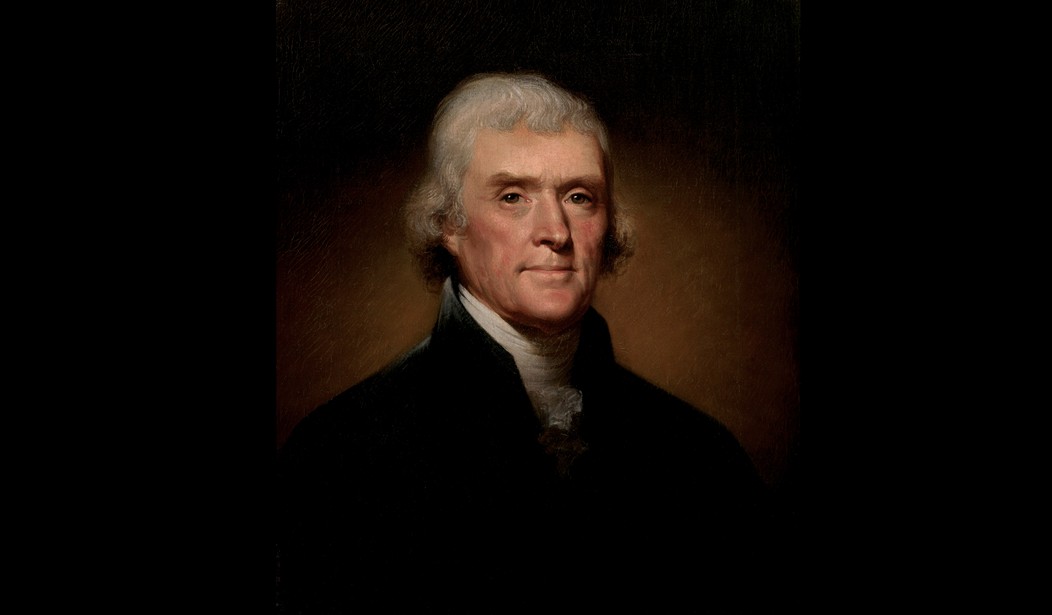
In recent years, it’s been Thomas Jefferson who’s come under the most scrutiny for his holding of slaves, and the now well-known story that he fathered children with at least one of his slaves, Sally Hemings.
How could the same man who wrote these immortal words also be a slave owner?
“We hold these truths to be self-evident, that all men are created equal, that they are endowed by their Creator with certain unalienable Rights, that among these are Life, Liberty and the pursuit of Happiness.”
Maloy found the answer in the words of Jefferson himself, who said that in spite of his slave ownership, he “still wrote how he believed slavery to be a political and moral evil and how he wished to have the institution abolished. Jefferson felt powerless to change the situation and summed it up near the end of his life as ‘we have the wolf by the ear, and we can neither hold him, nor safely let him go. Justice is in one scale, and self-preservation in the other.’ Despite his wish to end slavery, Jefferson never personally freed his slaves. When he died in 1826, his estate was in so much debt that his slaves were sold off to the highest bidder.”
During his life, Jefferson worked successfully to outlaw the international slave trade in Virginia, but he failed to put an end to slavery itself in his home state. He did all this while owning hundreds of slaves who lived and worked at Monticello and on nearby farms and other businesses he owned.
Historians say that Jefferson and other likeminded founding fathers feared that to abolish slavery would be to trigger a level of violence that the fragile new nation could not survive. They knew that the southern states would rebel if the federal government made any serious effort to abolish slavery.
Closer to home, given Jefferson's massive agricultural holdings, the only viable economic model for running those farms depended on slave labor, literally. Changing this business model would have put him and many others out of business. The cost of using hired help would have shown up in higher prices that would have killed the market for his farm’s output. No firm using hired help could have competed with operations that used legal slave labor.
With the creation of a democratic new nation, Jefferson and the other founding fathers were farmers, private business owners, and from other walks of life. But once they founded the United States of America, they added "politician" to their titles. As politicians, they negotiated and compromised in ways they themselves may never have anticipated prior to the Revolution. But to make peace across the 13 original states, and new territories as they were added, they had to allow for differences. Slavery was one of the more contentious areas of dispute.
Even then, however, the double standard between Jefferson’s not-so-discreet disdain for slavery and his personal ownership of slaves was not lost on his contemporaries.
While it is too simplistic to say that the American Civil War started because of one issue – slavery – it certainly was a major issue. And it may have had its smoldering origins prior to the very signing of the Declaration of Independence. Jefferson’s writing of the Declaration was the creation of an aspirational document that provided a vision for the country America could become, not the one it was in the very beginning.
To sit back in 2026 and expect everything in the Declaration to have been finalized and complete on Day One is to ignore all that it took over the course of America's 250-year history to get where we are today.
Long after Jefferson and the others were gone, the Civil War validated their concerns. They pragmatically recognized that in 1776, America just wasn’t ready to tackle the issue of slavery and survive as a nation. They knew that the issue of slavery would not resolve itself peacefully, and it didn't. Fortunately, by 1861, when the war between the states did happen, the nation proved itself to be resilient enough to survive.
After that war, with future amendments to the U.S. Constitution and continued evolution as a nation, America was able to more fully embrace the promise that, indeed, “all men are created equal.”