





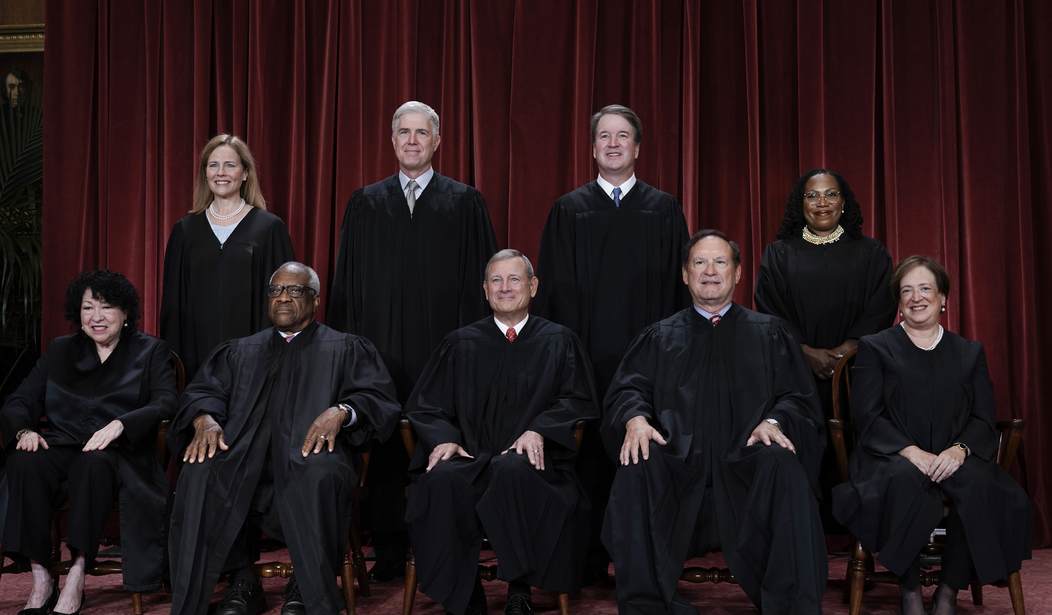
The U.S. Supreme Court will hear arguments for and against birthright citizenship on Wednesday in a case that could have a tsunami effect on the makeup of the future population of the United States and its immigration patterns… or not.
The case centers on whether an executive order from President Donald Trump on birthright citizenship is constitutional. In January 2025, soon after his inauguration for his second term, Trump signed an executive action that would deny birthright citizenship to the children of illegal aliens who are born on U.S. soil, primarily because they were born on U.S. soil.
The federal government has consistently operated under the interpretation that the U.S. Constitution provides that anyone born on U.S. soil is a U.S. citizen at birth, no matter what their parents’ citizenship status may be.
The issue for the court will be whether Trump’s executive order violates the Citizenship Clause of the 14th Amendment and federal law that codified that clause.
The clause says that “all persons born or naturalized in the United States and subject to the jurisdiction thereof, are citizens of the United States and of the state wherein they reside."
The amendment was passed shortly after the Civil War in 1868 to address the legal status and the constitutional rights of former slaves. Prior to that, the Dred Scott v. Sandford SCOTUS decision from 1857 had ruled that black people were not considered U.S. citizens.
In 1940, President Franklin D. Roosevelt signed into law the Nationality Act of 1940, which established the conditions required for someone to obtain U.S. citizenship through birth. It detailed the process for how immigrants could obtain citizenship through naturalization, and it listed the classes of non-citizens who would be ineligible for naturalization.
Twelve years later, President Harry Truman signed into law the Immigration and Nationality Act of 1952 (INA), which restructured American immigration law. The INA has been amended frequently over the years, but it is what governs U.S. immigration law.
Legal experts say that the big difference between the two statutes is that the former focuses only on citizenship eligibility, while the latter provides a legal framework for the entire immigration system.
Trump reframes the issue
Trump’s 2025 executive order instructed federal agencies to deny birthright citizenship to children of parents who are illegal aliens or who are in the country on temporary visas. More to the point, the order says that citizenship cannot be automatically be bestowed on children “when that person’s mother was unlawfully present in the United States and the person’s father was not a United States citizen or lawful permanent resident at the time of said person’s birth, or (2) when that person’s mother’s presence in the United States was lawful but temporary, and the person’s father was not a United States citizen or lawful permanent resident at the time of said person’s birth.”
The executive order plainly states the rationale behind Trump’s decision and likely lays the groundwork for how the administration’s attorneys will make their case before the court this week. When addressing the 14th Amendment and the Citizenship Clause, the Trump executive order stated:
That provision rightly repudiated the Supreme Court of the United States’s shameful decision in Dred Scott v. Sandford, 60 U.S. (19 How.) 393 (1857), which misinterpreted the Constitution as permanently excluding people of African descent from eligibility for United States citizenship solely based on their race.
But the Fourteenth Amendment has never been interpreted to extend citizenship universally to everyone born within the United States. The Fourteenth Amendment has always excluded from birthright citizenship persons who were born in the United States but not “subject to the jurisdiction thereof.” Consistent with this understanding, the Congress has further specified through legislation that “a person born in the United States, and subject to the jurisdiction thereof” is a national and citizen of the United States at birth, 8 U.S.C. 1401, generally mirroring the Fourteenth Amendment’s text.
To date, the order has not been implemented since the left mounted legal challenges to it before the ink on Trump’s signature even dried, and lower courts have blocked it every step of the way.
That said, this executive order did lead to some action at SCOTUS in the last session.
In June 2025, SCOTUS focused on and limited the use of national injunctions, seeking to rein in activist judges who have consistently issued orders with widespread impact, seemingly to slow the administration’s implementation of its policies. This all stemmed from Trump’s executive order on birthright status.
In its decision, SCOTUS voted 6-3 to grant the administration’s request to limit the reach of injunctions that blocked the president’s order. To be sure, none of that gets at the core issue of birthright citizenship.
Road to SCOTUS
This case comes as a result of the American Civil Liberties Union and other groups filing a class-action lawsuit for three plaintiffs who gave birth to children on American soil in 2025, who were likely to be denied citizenship under the Trump administration’s policy.
The plaintiffs’ attorneys maintain that the order violates the Constitution's Citizenship Clause and the provision of the INA that codified the clause's language.
No lower courts decided in favor of the Trump administration, and so in December, SCOTUS said it would hear the case and decide on the constitutionality of Trump’s order.
What will it all come down to?
Most likely, this case will all come down to the five or six “conservative” justices on the court and whether they, as a group, will be as originalist as conservatives and the administration hope. The usual wild cards are Chief Justice John Roberts and justices Brett Kavanaugh and Amy Coney Barrett. If you’re following the case this week, pay particular attention to their line of questioning if you want a sense of where the court will land on this one.
Of course, if you just want to reaffirm your faith in our conservative justices, enjoy the questioning from justices Clarence Thomas, Samuel Alito, and Neil Gorsuch.
Solicitor General D. John Sauer has already provided a glimpse of what you’re likely to hear from the White House. He maintains that the Citizenship Clause assures the rights of citizenship to individuals who are "completely subject" to the United States’ “political jurisdiction.” In other words, they must owe "direct and immediate allegiance" to America.
Sauer says that people here on temporary status do not fit this framework. For illegals, Sauer believes that by definition, these people have broken U.S. law, and so they are in defiance of it. This is "inconsistent with establishing the requisite allegiance" to America.
Woo. I’m not sure about you, but I’d love to be in that room to watch everyone react when this comes up. Sauer and the administration are not questioning the 14th Amendment or the Citizenship Clause as written. To say this new interpretation will give the justices something to think about is an understatement.
Sauer’s points are that longstanding misinterpretation of the law has contributed to the problem of illegal immigration in America, it has put national security and public safety at risk, and it has contributed to the explosion of “birth tourism.”
The ACLU will likely point to longstanding precedent in practice and in the interpretation of the 14th Amendment. It will argue on behalf of the millions who’ve already been granted birthright citizenship. In short, it will take the absolutist approach we’ve come to expect on this matter.
What to watch for
Pay attention to the line of questioning from the justices on all sides of this issue. Pay attention to how lawyers for both sides respond. But pay particular attention to the news media’s coverage of this. Pay attention to what the left may or may not do to draw attention to or distract from this case.
If the case is going well for the ACLU, the news media will give this wall-to-wall coverage, painting it as another likely loss for the administration on illegal immigration. But if the case isn’t going so well for the ACLU, don’t look for spin on the case — rather, distractions from it.
The last thing the media will want is for Americans to pay attention to the birthright citizenship issue if they think that’s a sinking ship. They will want time to demonize the conservative justices on the court, call for impeachments of some of those justices, and then mount a campaign to make packing the court a midterm election issue.
A decision in this case is expected in June or July.
Find out what you’re missing behind the members-only wall. It’s time for you to take advantage of the full catalogue of common sense thinking that comes with a PJ Media VIP membership. You’ll get access to content you didn’t even know you wanted, and you’ll be hooked. The good news is, PJ Media VIP memberships are on sale! Get 60% off of an annual VIP, VIP Gold, or VIP Platinum membership! Use promo code FIGHT to get 60% off a VIP membership!

Join the Conversation
VIP members get the ability to comment on articles.