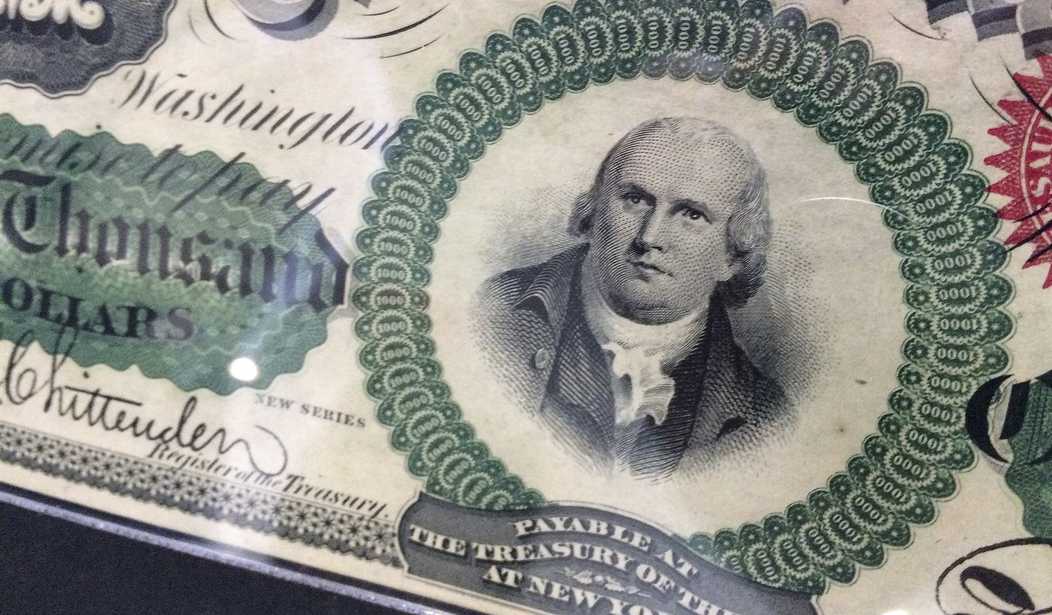

You can’t fight a war without money. Fortunately for the founding fathers, they had a man among them named Robert Morris. He’s known to historians as the “Financier of the Revolution.” Without his financial genius, the Revolution might have failed.
Born in Liverpool, England, in January 1734, Morris was the son of a successful businessman who had ties to the British colonies in America.
His family was connected to the Atlantic trading world, dealing in the sale and movement of tobacco. They represented American planters overseas in Great Britain. When Robert Morris, Jr. was 13, his father sent him to Maryland to apprentice in a mercantile firm. What Morris discovered was that in the colonies, unlike in England, your status wasn’t inherited but earned through success in commerce, among other things. He enjoyed this, and in the process, he demonstrated a knack for his profession.
As fate would have it, when Morris was 15 in 1749, his father, Robert Morris, Sr., was shot and killed in a freak accident. What happened, according to historians, is that the elder Morris was on a ship in the Norfolk harbor. That’s when a gun discharged during a celebration or a salute. He died not long afterward.
Robert Morris, Jr. inherited his father’s estate, which catapulted him into a career in commerce and finance. First, Morris apprenticed at a firm in Philadelphia. Then he entered into partnership with Thomas Willing. They named their firm Willing, Morris & Co., which became one of the most successful merchant houses in the city and eventually the country.
Morris’s firm oversaw the import of manufactured goods and the export of agricultural products, which included wheat and tobacco. In the course of this, Morris developed a talent for handling complex credit transactions, exchange rates, insurance, and even the logistics of shipping.
When the Revolutionary War broke out, he had become one of the richest people in the country. He helped Gen. George Washington purchase supplies. Reports are that on a few occasions, he made personal loans to the cause, and other times, he borrowed from friends and associates to finance the Revolution.
What spurred him to get involved was his growing disenfranchisement with the trade policies of the British crown. He didn’t like the Stamp Act or the Townshend duties, which he felt created instability and posed threats to the prosperity of American commerce.
His pathway to revolution started with his support of reconciliation with Britain. He thought it was possible to achieve common ground between the colonies and the British. He abandoned this hope when the fighting started in 1775. By then, he realized that in order to survive, particularly in an economic sense, the colonies needed to cut ties with Britain and become an independent nation.
Morris had direct experience with the specific kinds of matters he handled for the rebellion. He had already managed financial transactions and operations at scale. He knew the credit system, the international trade networks, and the role financial institutions like banks played in all of it. He was also said to be a good negotiator.
Morris enters politics
In 1775, Morris got involved in politics when he ran for and won a seat in the Continental Congress. Quickly, he became one of the body’s strongest leaders. While he took a slow, methodical, and cautious approach to rebellion, he soon found himself in support of breaking free from the crown.
Robert Morris was one of the signers of the Declaration of Independence on July 4, 1776. His role from that point forward was to manage finance and logistics for the war effort.
Since the Continental Congress did not yet have the power to collect taxes directly from the people, it had tremendous difficulties in raising money to fight the war. Inflation rose. Currency depreciated. Time and again, the army went unpaid. The army struggled to meet its supply needs. Without Morris, this house of cards would have collapsed in on itself. He brought stability to the infrastructure needed to wage war.
We have a saying where if you really believe in something, you “put your money where your mouth is,” which is to say if you really believe in something, prove it. Morris did just that when he demonstrated his own willingness to take out personal loans to buy supplies for the Continental Army.
Several times, he backed up loans or provided the funds when Congress failed to do so. In the run-up to the battle of and victory at Yorktown in 1781, it was Morris who arranged to get all of the materials, supplies, and transportation that Gen. George Washington needed to move his troops into place.
Congress appointed Morris to the position of Superintendent of Finance in 1781. In this capacity, Morris tried to address problems in government that continue to this day. He sought to reduce waste and corruption in the way the government spent money. He worked to ensure confidence in American credit.
He supported the establishment of the Bank of North America in 1781. This was the country’s first national bank. It was this bank that gave the country stability in credit and laid the foundation to restore faith in the new government’s financial promises. Morris introduced structured financial management and centralization. This provided a financial foundation for the federal system.
During the war, Morris was integral to obtaining loans from foreign governments, France in particular. Other countries respected Morris for his competency and his character. He kept his word.
Philosophically, Morris believed in a strong central government for the sake of economic stability. That’s why he grew frustrated with the Articles of Confederation and Congress’s inability to impose taxes. This drove him to debate for and win on the issue of constitutional reform.
Morris’s Revolutionary War legacy was that he was the one who took the rebellion from the brink of bankruptcy, and he did his part to turn it into a functioning democratic government through reliable credit and financial infrastructures.
The fall of a patriot
After the Revolution, Morris served in the Confederation Congress and later as a U.S. senator from Pennsylvania when the Constitution was ratified. That was yet another founding document that boasts his signature.
In his personal life, he was a risk-taker and bet on the country’s westward expansion, perhaps a bit too soon. He was involved in frontier land speculation on a large scale.
America experienced an economic recession in the 1790s and essentially wiped Morris out, leaving him with mountains of debt.
In 1798, he was actually sentenced to prison over unmet debt obligations, and he remained there for several years before he was released. He died in 1806, almost in poverty.
While his personal story provides a cautionary tale, one thing that cannot be underestimated is the critical role Robert Morris played in helping America win independence from Great Britain.