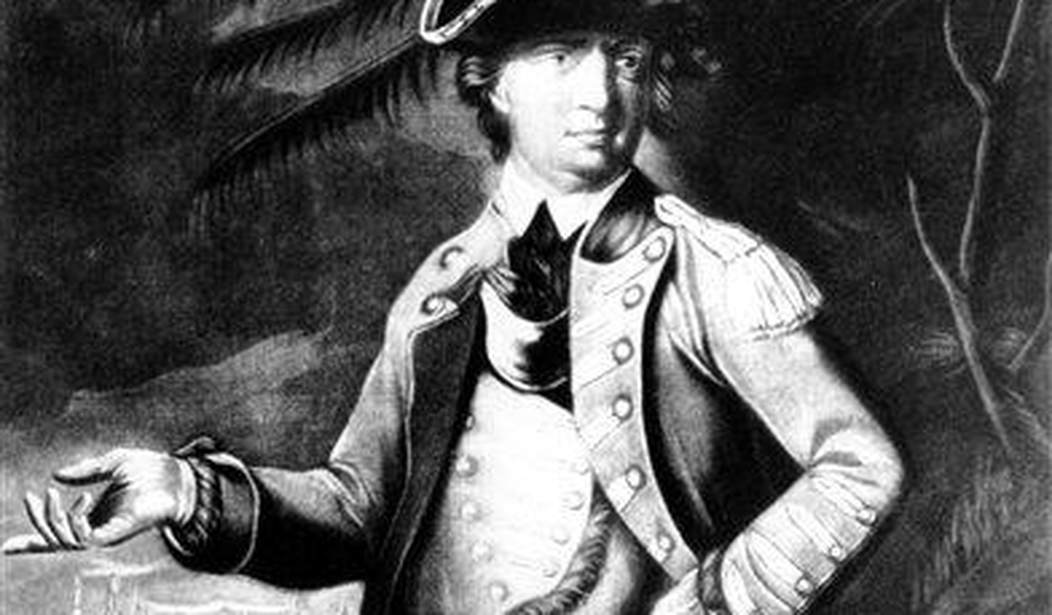
The mention of the name “Benedict Arnold” is synonymous with treason, yet if that’s all you know about Arnold, then you don’t know the whole story.
Militarily, historians say that without Arnold, the Continental Army might have failed. Before he betrayed the cause of the American Revolution in 1780, the officer was considered one of the army’s most daring, resilient, and effective commanders.
Arnold was born in 1741 in Norwich, Conn., into a prominent and respected family. That respect was mostly spent by the time Arnold became a man due to his father’s financial collapse and alcoholism. This had an impact on Arnold that would influence every decision he would make after that. The psychological impact on him would shape every major decision of his life.
In the 1760s, he had established himself in New Haven, Conn., as an apothecary and trader, eventually expanding into shipping and West Indies commerce. Arnold thrived, buying ships, moving cargo, and developing himself as a decisive leader, which would come in handy later during the revolution.
He saw firsthand the harm to American commerce under British rule, which brought with it imperial regulation, unreasonable taxation, and brutal enforcement. Like many colonial merchants, Arnold smuggled goods and sometimes clashed with British customs officials.
When the Revolution began in 1775, Arnold didn't hesitate to get involved. For him, the war wasn't just to gain national independence, but it was also a way for him, ironically, to redeem his family’s honor.
One of his first accomplishments was to lobby for the capture of Fort Ticonderoga, a British stronghold on Lake Champlain. The Continental Army seized the fort in May 1775, giving the army one of its first victories. This also provided the army with badly needed artillery.
The victory is most often associated with Ethan Allen and the Green Mountain Boys, even though Arnold played a central role. But when the dust settled and he saw that he was not getting the credit he felt he deserved, he revealed something about himself that resurfaced time and again. He became divisive and toxic to everyone around him.
Later in 1775, he came up with a daring plan to invade Canada by leading a group through the Maine wilderness to attack Quebec from the rear. To accomplish this, troops had to march through some of the worst conditions of the war. Their maps were poor, they didn’t have the supplies they needed, the weather was freezing, and disease started to kill the men.
Arnold pressed on. While the assault on Quebec happened and failed on New Year’s Eve, Arnold distinguished himself as a warrior. In the course of the battle, he was wounded in the leg, and the battle was a military defeat. Still, word of his actions and decisions spread throughout the colonies, establishing his reputation for courage.
In 1776, Arnold impressed again. He was charged with halting a British advance from Canada along Lake Champlain. As such, he oversaw the construction of a makeshift fleet from green timber, limited supplies, and with inexperienced crews.
At the Battle of Valcour Island, Arnold’s flotilla was outgunned and defeated, but he was able to delay British movements long enough to prevent them from invading that year. This gave the Americans time to prepare, recruit, and fortify. The consensus among historians is that without this delay, the British might have crushed American troops in the north before they could consolidate.
Arnold reached the peak of his popularity in 1777 during the Saratoga campaign. By this point, he was a major general, and still he was openly frustrated by disputes over rank and authority. General Horatio Gates had so many problems just trying to manage Arnold that he sidelined him during the second battle at Bemis Heights. Arnold ignored Gates and took to the battlefield without any orders. Once engaged, he led a series of aggressive attacks that destroyed British positions. In the course of the fighting, Arnold was wounded in the same leg that had been wounded before.
At Saratoga, he did get credit for his role in the victory over General John Burgoyne’s British army. Saratoga was pivotal to the entire war effort. It was the event that convinced France to openly ally with America. Arnold was critical to this, and had his ego and personal character flaws not gotten the best of him, he’d be remembered as one of the most important figures in the Revolutionary War.
By now, his injuries left him physically compromised. He was irascible. He believed himself entitled, and he let it show. His ego took over. He felt under-appreciated and marginalized. Some of this was true, but it was of his own making. At Saratoga National Historical Park stands the Boot Monument, which commemorates the wound suffered by “the most brilliant soldier of the Continental Army.” Quite by intent, the marker never mentions Arnold by name, a reflection of the nation’s weariness of him.
After Saratoga, Arnold was appointed military commander of Philadelphia after the British evacuated that city. Once there, Arnold lived like a king. He engaged in speculative ventures, and he moved in elite social circles, which included some Loyalists to the British crown.
He fed rumors that he was corrupt and involved in profiteering. While some of these accusations were politically motivated, there was a certain amount of truth in them.
To clear his name, Arnold demanded a court-martial. This process dragged on for years. In 1780, he was acquitted of the most serious charges, but Gen. George Washington reprimanded Arnold for the lesser misconduct.
Arnold was devastated. He saw the reprimand as a form of public humiliation. The self-centered Arnold decided that the American government was ungrateful, corrupt, and couldn’t see his merit.
Meanwhile, on the personal front, Arnold married a Philadelphia socialite named Peggy Shippen in 1779. This appears to be where he reached his tipping point. Her family had Loyalist sympathies and social ties to British officers. One of them was Major John André. It is not clear exactly how she may have influenced Arnold in making his decision to become a traitor, but being married to her, and living where he did, made it much easier for him to rationalize his disloyalties.
Also for our VIPs: ‘America 250’ Tuesday: The New Year’s Day Mutiny of The Pennsylvania Line
By 1780, Arnold had begun secret correspondence with British authorities, offering intelligence and proposing a critical act of betrayal.
Once entrusted to command West Point, the most strategically important installation in America because it controlled the Hudson River, Arnold made treasonous plans. The river was the critical artery that connected New England to the southern colonies. To cut it off would split the rebellion in half. Arnold decided to weaken the West Point defenses and surrender to British forces. In return, he would get money and a commission in the British Army.
American militiamen foiled the plot in September 1780 when they captured Major John André. He carried documents, hidden in his boot, that detailed Arnold’s plans. The papers proved that Arnold was a traitor. Arnold was warned in time, and so he fled to the British army. André was put on trial and executed as a spy.
Arnold’s defection devastated the nation, particularly Washington, who had trusted Arnold and defended him repeatedly. Later, Arnold wrote to Washington, asking for mercy for his wife. While he did express concern for her safety, he showed no remorse or regret for his own treasonous actions.
Once in a British army uniform, Arnold found no satisfaction. He was commissioned as a brigadier general, but his fellow British officers didn’t trust him. Americans hated him.
He led raids in Virginia and Connecticut that confirmed his reputation as a turncoat but did nothing to change the outcome of the war.
After the conflict was over, Arnold lived in England, where it is said he remained bitter until his death in 1801. He never earned the wealth or respect he craved. Upon his death, his very name became toxic, which to this day is used as an insult – the worst sort of epithet. When you call someone a “Benedict Arnold,” everyone knows you’re calling him a traitor.