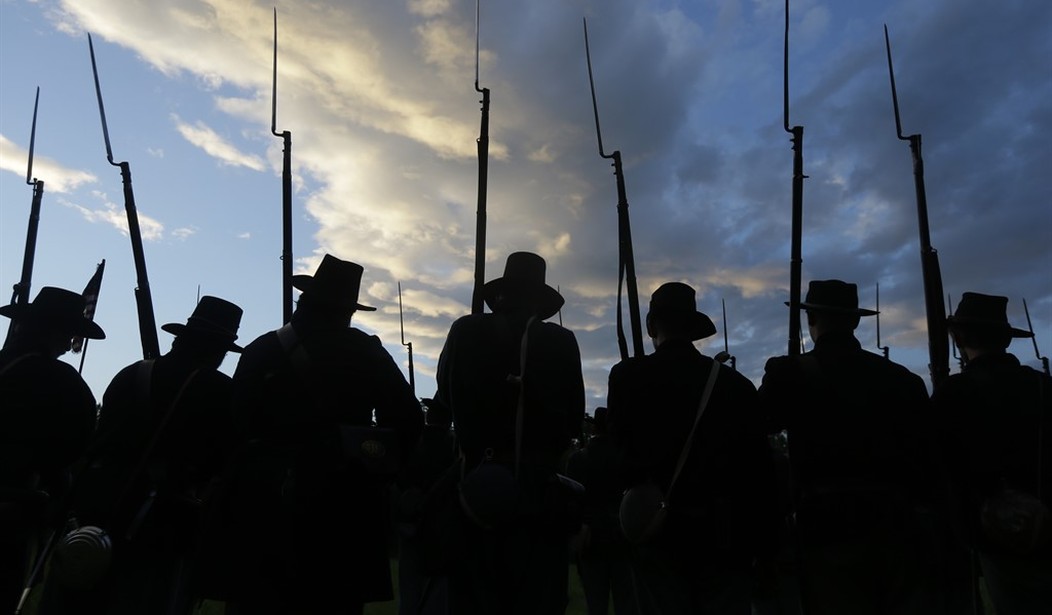
Gettysburg has created more than a few Civil War fanatics.
What did it for me was when an attorney client of mine, who was also a Civil War buff (and who would later become the Chief Justice of the Pennsylvania Supreme Court), recommended I read a historical novel called Killer Angels, by Michael Shaara. I rarely take people’s reading recommendations, not because I don’t want to, but usually because I never get around to it. That was the case here as well. I didn’t go out and read the book.
But about a year later, while driving home from the beach with a restless two-year-old in his car seat, ready to have a hunger fit at any minute, we decided to get off the highway and take a detour to find a nice diner or restaurant. One thing led to another, and we landed in the midst of a town where I’d never been — Gettysburg, Pa.
The small-town atmosphere alone felt comfortable, with plenty to pique my curiosity, where, everywhere you looked, history had been made. There was no shortage of souvenir shops of all kinds, and we stopped at a few. That’s where, at eye level, I saw the book my client had mentioned. So, I bought it.
After we got home from our trip, I read it and decided we had to go back to that place. We had to go back to Gettysburg.
The film Gettysburg, which stars Martin Sheen and a solid cast of veteran actors, is based on the book, but at the time, the movie had not yet come out, and I’m glad I read the book first.
A year later, my wife, my son, and I made the short drive to Gettysburg for a weekend, and we got to know the town better through the prism of that book. Approaching from the West on the Lincoln Highway, Pennsylvania Route 30, I had an immediate sense of place, like I knew where everything would be even before I got there. Killer Angels had created a map of the town in my mind.
We passed the cannon that marked the spot where the first shots of the battle were fired. Then we turned the corner to find a monument amongst some trees where Gen. John Reynolds was mortally wounded on his horse on the first day of the three-day battle.
By the time we toured the battlefield and I got to see just about every location mentioned in the book, I only wanted to learn more. In between trips to the Central Pennsylvania town, I’d do more reading. I’d research new ways to explore that town and learn even more about its history.
Meanwhile, we had another son, and my older son was enjoying his own immersive learning experiences every time we went there. Both of my sons are grown now, and they are just as into Gettysburg and Civil War history as ever. I credit that to a spontaneous dad thing I did while my older son and I were waiting outside our motel as my wife changed my younger son’s diaper inside our room.
The grassy area just outside the motel’s office had a direct line of sight to one of the most famous parts of the battlefield and the Civil War – The Angle at the Copse of Trees (near the stone wall on Cemetery Ridge). This was as far north as the Confederate army would ever get during the course of the war. It’s known as “the High Water Mark of the Confederacy.” At the time we stood there, the National Park Service was still manicuring the grounds, so it looked less like how the battlefield looks today. In 2025, the Park Service keeps it less manicured, more like it was in 1863.
Inside the motel’s gift shop, I had bought five replica musket bullets for a dollar apiece. They were made of lead and looked just like the bullets (not musket balls) we had seen behind glass in the town’s museums. As my son stood there in his blue Union Civil War hat, holding his plastic sword, I discreetly dropped the five bullets into the grass around him.
Then I said, “You know, if you look around here, you never know if you might find things from the battle. They may not have cleaned everything up.”
So, head down, he started looking around in the grass, and wouldn’t you know, he started finding bullets. Each time he found one, it was like Christmas morning, opening gifts. By that fifth bullet, he was hooked on Gettysburg and American history — for good. We made numerous father-son and father-sons trips after that, exploring the town and its history in fresh and new ways each time. Bus tours, guided tours, walking, riding, listening tours. Visits to every major spot on the battlefield, and other notable locations in the cemetery, and, of course, the Jennie Wade House.
Jennie Wade, at 20 years old, was the only civilian casualty in the battle. A stray Confederate sharpshooter’s bullet passed through two doors of the house where she was and landed in her back, killing her on the spot. She died holding the dough she had been kneading to make bread for the Union troops. Visitors to the house can still put their fingers into the bullet-hole in the door to that kitchen. That experience is the one that hooked my younger son on the Gettysburg story.
Why Gettysburg?
What makes history so interesting is that for every battle or event, there are at least 1,000 distinctly original stories. It’s not just one story of a battle. It’s as many stories as there were people in that town on those three days. There were stories of hometown boys coming back to Gettysburg to fight, wearing both Union blue and Confederate gray uniforms, at war against each other. Stories of heroes, of historical military innovation, and stories of massive screw-ups.
The story of Little Roundtop is one of the 'innovation' sort. The story of Gen. George Pickett and his disastrous open-field attack (“Pickett’s Charge”) in broad daylight on that third day is another.
When my kids were young teens, we happened to be at the crest of the big hill known as Little Roundtop when a tour bus pulled in, and one by one, soldiers in camo fatigues filed out and went directly to a spot back in the woods where, in July of 1863, one Union colonel devised a genius counter-attack after his men ran out of ammo. We followed the troops, who we learned were all cadets from West Point. We listened as one of their leaders and instructors gave a quick lesson on what happened there and what the military implications were.
Over the years, we’ve stayed at hotels, motels, Airbnbs, and B&Bs. We ate at great restaurants, and did some non-history things like just hanging out as a family by an open fire under the stars. I’ve lost count of how many times I've been there.
After all of this, I still feel I have so much more to learn. I’ve been to other battlefields as well. If you are open to taking a bike tour of Antietam, I’d highly recommend it. But for me, Gettysburg is where it all started. It's the historical place I like most. Maybe it’s because they worked so hard to preserve it almost from day one.
Related: Is Ireland About to Erupt Into a Civil War Over ‘Illegal Immigration’?
It’s now been a few years since the last time I went, and I’m starting to get the itch to return one day soon. Someone once asked me, “What do you get out of that place, since you’ve already been there so often?” I think it’s because you can’t go there without being fully aware that thousands and thousands of men gave their lives in that place, that now sacred place, to ensure the future of the United States of America. The more you learn about that battle and the Civil War, the more you realize that we are still feeling its impacts on our nation even today.
Without those three days in July 1863, at this crossroads town in Pennsylvania, America as we know it would be a much different country. These days, my visits there are as much a pilgrimage as anything. It's a retreat where I recharge my own batteries, returning home with a renewed sense of patriotism and gratitude.