





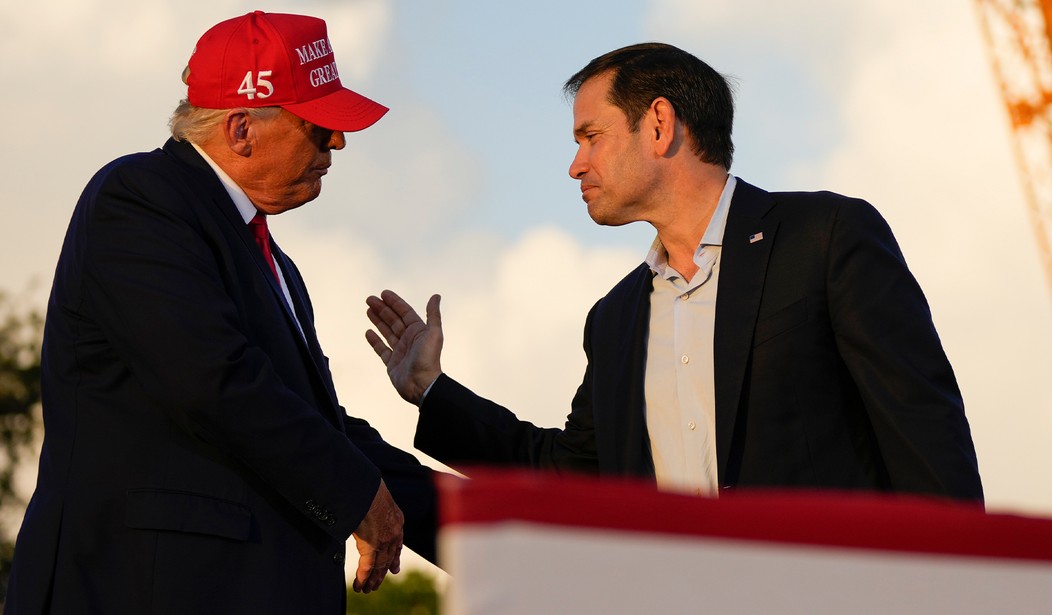
The hits against the International Criminal Court (ICC) keep on coming.
Last month, Marco Rubio "launched a diplomatic campaign to dismantle the ICC’s threat to our national sovereignty." On Tuesday, he announced that he's sanctioning the president of the ICC, Tomoko Akane of Japan, and ICC senior trial lawyer Abdoulaye Seye of Senegal.
Last month, I launched a diplomatic campaign to dismantle the ICC’s threat to our national sovereignty. The Trump Administration is sanctioning ICC President Tomoko Akane and Senior Trial Lawyer Abdoulaye Seye in our unwavering mission to protect Americans from this sham of a…
— Secretary Marco Rubio (@SecRubio) August 18, 2026
"These individuals have directly engaged in efforts by the ICC to investigate, arrest, detain, or prosecute officials whose government has not consented to ICC jurisdiction," Rubio added in an official statement from the State Department.
Here's more:
The Trump Administration has been clear: the International Criminal Court (ICC) is a corrupt and fatally politicized supranational court that has maliciously abused its authority and exceeded its mandate. We will not tolerate its assault on state sovereignty.
[...]The ICC has repeatedly attempted to assert authority over nationals of the United States and other countries that have not consented to its jurisdiction or ratified the Rome Statute. This sets a dangerous precedent for all nations.
Our whole of government campaign to dismantle the threat posed by the ICC to national sovereignty will be sweeping and we expect more countries to join our campaign by ending their funding and participation in this politicized and unaccountable court. The ICC’s ability to target American nationals and those of other non-States Parties must end. The Trump Administration stands ready to take additional measures, if necessary, to systematically dismantle the ICC until it is incapable of threatening American sovereignty.
The sanctions will prevent U.S. citizens from conducting transactions with Akane and Seye, and if they do, they'll face penalties. The sanctions also prevent both individuals from accessing U.S. financial systems.
If you'll recall, in mid-July, Rubio announced that he planned to "dismantle" the ICC "brick-by-brick, if necessary" and teach it the meaning of "American resolve."
"Independence is our birthright. We don’t intend to trade it for rule by a self-appointed priesthood of 'international law," he said.
The International Criminal Court seeks to become the unaccountable arbiter of a new global law — empowered to prosecute and arrest our citizens at will and existentially threaten American sovereignty.
— Secretary Marco Rubio (@SecRubio) July 13, 2026
We will teach the ICC the full meaning of American resolve. pic.twitter.com/2egHK1jA98
He also added that he would encourage other countries to follow. Shortly after that, we saw Venezuela — under Rubio's guidance — take steps to withdraw itself from the ICC. Though I doubt he had to twist any hands — the regime still in place, led by Delcy Rodríguez, was most likely enthusiastic about these particular orders because they protect it from any future warrants.
We also saw the African nation of Chad begin the process last month after a phone call with the State Department. That country's leadership suggested the ICC "disproportionately focused on African countries, creating the perception of selective justice."
And before Rubio announced these new sanctions on Tuesday, I saw reports that Colombia, under the new U.S.-aligned president Abelardo de la Espriella, is planning to withdraw from the ICC as well:
According to information reported Tuesday, sources in The Hague cited by Caracol Radio consider Colombia’s intention to withdraw from the treaty that created the International Criminal Court to be certain. However, the information remains unofficial.
So far, neither President Abelardo de la Espriella nor the Ministry of Foreign Affairs has announced that the government has submitted to the United Nations the notification required to formally begin the withdrawal process. For that reason, there is still no official date or procedure underway that would allow it to be stated that Colombia has decided to leave the court.
Even though the Colombian government hasn't confirmed it, I see no reason why this rumor would be untrue. President de la Espriella is aligned with the United States on pretty much everything, and is seeking to repair his country's relationship with the U.S. and Israel. This would be a step toward doing that. Rubio and de la Espriella actually spoke on the phone today, though according to the State Department, that conversation was more focused on earthquake recovery in Colombia.
The process of withdrawing from the court requires a written statement provided to the United Nations secretary-general, followed by a one-year waiting period before it officially takes effect. He writes how scary the situation has become:
Antisemitism doesn't stop being antisemitism just because the word Israel appears in the sentence. This is what Sweden must confront. The same yardstick must apply regardless of the sender's name, background, political affiliation, or public standing.Mohamsson's Star of David was intended as a stand against antisemitism. The reactions to it have become a far stronger illustration of why that stand was needed.It's starting to feel truly uncomfortable.
The true heroes of our time right now are the non-Jews who stand with Israel and the Jewish people, as I write in these two columns. I'll do my part to keep highlighting them.
Editor’s Note: Thanks to President Trump’s leadership and bold policies, America’s economy is back on track.
Help us continue to report on the president’s successes and combat the Democrats' lies about America's economic revival. Join PJ Media VIP and use promo code FIGHT to receive 60% off your membership.

Join the Conversation
VIP members get the ability to comment on articles.