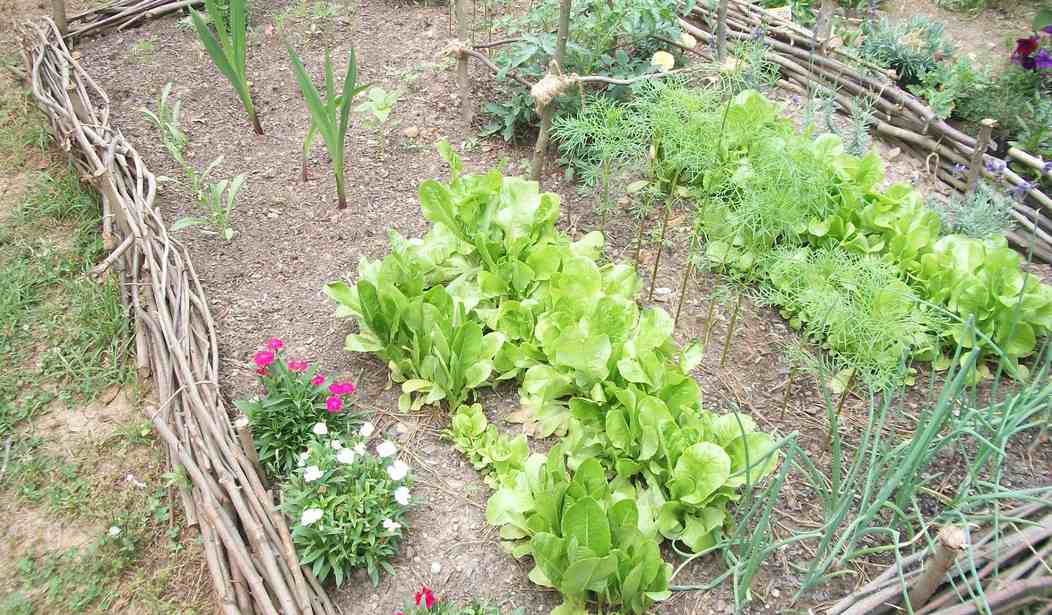

A few weeks ago, I went to cook some potatoes I'd purchased at the grocery store, and I quickly realized that was not going to happen. They all had little half-inch sprouts all over them. I didn't want to throw them away, so I considered planting them. It's the perfect time of year to plant them here in Georgia, plus it's also the time of year when I start fantasizing about growing huge gardens filled with flowers and food all over my property, even though I usually end up doing about one-tenth of what I plan, if that.
Anyway, I know a lot of store-bought produce contains agents that act as growth inhibitors, but these were organic, so I thought maybe I'd have some luck. Plus, in all my years of gardening, I'd never actually planted potatoes, so I thought it'd be fun to try. I sliced them up, let them sit for a few days to callous, and then I went outside to plant them in one of my mom's old raised beds that's tucked away here on the family property.
First of all, the raised bed was full of weeds and old tomato cages, so I had to clean that up. Second of all, once I did that and worked the dirt, about six of my chickens decided it was the perfect spot for a dust bath. I walked away and let them do their thing, and by the time I got around to actually planting the darn things, it started pouring. It rained so hard that my rows were disappearing, and when it stopped, my chickens thought "dig up the potatoes" sounded like a fun game to play, so I had to find a way to keep them out of the space.
Long story short, by the end of the evening, I was sitting on the ground in the mud, soaking wet and covered in ant and mosquito bites, and my back was killing me, but dang it, I had several rows of potatoes planted — my unofficial start to the gardening season.
Every day for the last three or four weeks, I've anxiously walked out to that bed and checked the ground, waiting for those potatoes to pop out, and every day I've been disappointed. Just like I've been disappointed by the tomato starts I accidentally left out in the cold one night last week, only for them to shrivel up and die, and the larkspur I managed to start by seed this year that somehow just disappeared one day, and the stack of lettuce seeds that a might cat somehow mistook for a litter box, and the lavender I tried to propagate that just kind of died, and I could go on.
They say gardening is good for your mental health, but I am beginning to wonder whose bright idea that was.
I'm kidding. Gardening isn't good for your mental health because everything goes smoothly. It actually helps you set realistic expectations for life. You learn that you aren't in control of everything and learn to accept that those potatoes may not grow, no matter how much work you put into them.
It also helps you let go of the idea of perfection. I follow a lot of gardening accounts on Instagram, and for a long time, I tried to mimic the ones that were the most aesthetically pleasing (see: the picture of one of my first little attempts at an Instagram-worthy garden bed from years ago at the top of this article). These days, I prefer the ones who prioritize actual results over appearance. I still like pretty, but I'm far more excited about growing food and flowers and experimenting with various methods than I am planting something that looks like it belongs in a glossy magazine.
Which brings me to something Psychology Today suggests: Gardening helps you develop a "growth mindset." That means you see activities, like gardening, as a constant educational process instead of something that's fixed. You learn from your mistakes rather than view them as failures. I'm trying to embrace that.
Of course, just being outside in nature is good for our mental and physical health, even on the most frustrating of days. According to Penn State, simply connecting with the natural world is grounding and can do wonders for our minds, confidence, and stress and anxiety reduction:
Connecting with the natural world, in general, helps relieve people from attention fatigue. Gardening is a great hands-on experience with nature. Working with the soil, smelling the plants and dirt, feeling the different textures, and seeing all the green foliage and flowers can help relax the mind and ground yourself. When you ground yourself, you reduce stress, anxiety, and even built-up anger.
Gardening can be a healthy tool to connect to the current moment and not be caught up in your mind. For many people, it can also be a place of spiritual or holistic practice. It's very relaxing to be surrounded by plants and nature, so many find their garden spaces or houseplant areas to be quiet or peaceful places for meditation or prayer
Studies have shown that having a garden and/or owning house plants increases motivation and reduces fatigue. Taking care of plants involves having to water, weed, prune, etc. on a regular basis to keep the plant or garden alive and thriving. After weeks/months of all this work, the results are easy to see, and this will lead to increased confidence.
I'd like to add that gardening teaches you patience. This morning, I got up, went outside to feed my animals, and made my way over to that old bed where I planted the potatoes. I started to walk away disappointed yet again when I spotted a mound of dirt that looked like it was about to burst open with something green underneath it. I got down on my hands and knees and looked as closely as I could, and sure enough, it was a potato sprout. While I was down at eye level, I noticed two or three others coming up as well.
Finally! That tiny win was far bigger than any of the gardening losses I've suffered in recent weeks. As a matter of fact, it was so exciting that I forgot all about most of them. I wanted to skip work today and stay outside and play because seeing those sprouts made me happier than anything else I've done lately.
So yes, gardening can be messy, chaotic, and full of disappointments (believe me, there will be plenty more as the season progresses), and it may make you tired, sore, anxious, and a little cranky at times, but the truth is that despite all of that, it's healing in you ways that nothing else can.