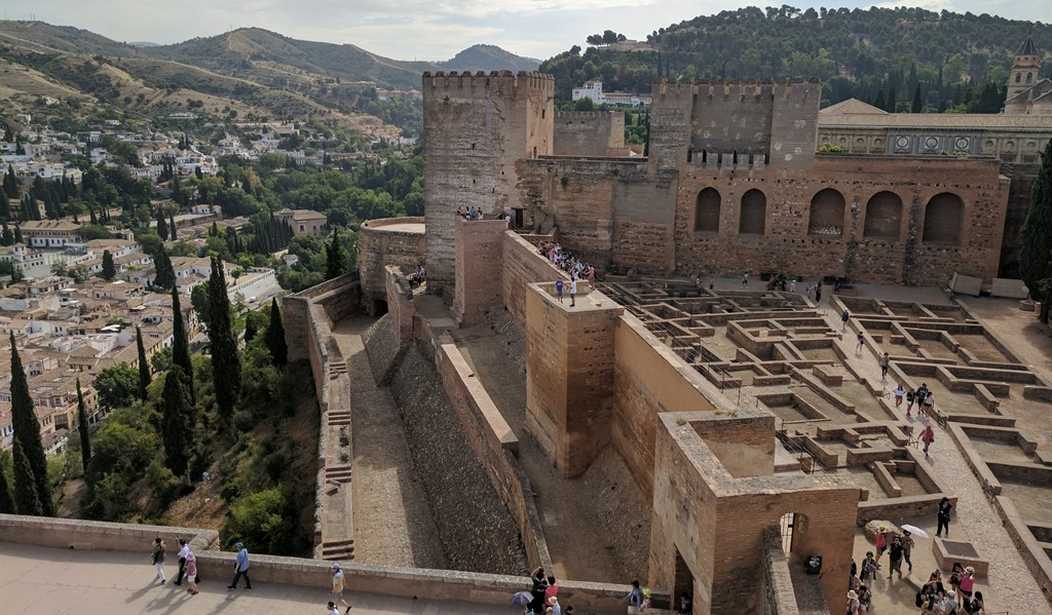

It’s nearly universally accepted that al-Andalus, Spain during its seven centuries of Muslim rule, was a paradise of tolerance, mutual respect, and multiculturalism. Tuesday, however, was the 959th anniversary of a long-forgotten incident that shows not only that al-Andalus never was what its contemporary boosters claim it to have been, but also that Islamic antisemitism is not (as is often claimed today) simply a reaction to the alleged misdeeds of the State of Israel, but something much more deeply rooted and longer-lasting.
Islamic al-Andalus actually mandated in its laws the subjugation and second-class status of its two primary non-Muslim communities, Jews and Christians. Although Christian communities in Muslim Spain were a principal supply source for al-Andalus’ thriving slave trade, which provided slaves to the entire Islamic world, The History of Jihad makes it clear that Jews in al-Andalus sometimes had it even worse than Christians did.
In the middle of the eleventh century, a Jew named Samuel ibn Naghrila gained the trust of the Muslim rulers and was granted political power in Granada. Later, Samuel’s son Joseph also held positions of great honor and responsibility. Islamic law mandated that a non-Muslim could not hold authority over a Muslim, but as with all legal systems, there are some people who flout the rules and periods of relaxation in which the rules are simply ignored.
However, the Muslims in Granada knew Islamic law and were considerably resentful of the power of Samuel, and later of Joseph. The Muslim jurist Abu Ishaq composed verses addressed to the Berber king Badis that vividly demonstrate the Muslim conviction that Muslims must enjoy a place superior to that of the dhimmis, who must endure a state of humiliation. Of Granada’s Muslim ruler, Abu Ishaq wrote:
He has chosen an infidel as his secretary / when he could, had he wished, have chosen a Believer. / Through him, the Jews have become great and proud / and arrogant—they, who were among the most abject. / And have gained their desires and attained the utmost / and this happened suddenly, before they even realized it. / And how many a worthy Muslim humbly obeys / the vilest ape among these miscreants….
That was a reference to the Qur’an, which depicts Allah transforming disobedient and recalcitrant Jews to apes and pigs (2:63-66; 5:59-60; 7:166).
Put them back where they belong / and reduce them to the lowest of the low, / Roaming among us, with their little bags, / with contempt, degradation and scorn as their lot, / Scrabbling in the dunghills for colored rags / to shroud their dead for burial… / These low-born people would not be seated in society / or paraded along with the intimates of the ruler.…
This idea is also derived from the Qur’an, which mandates that Muslims must fight against “the people of the book” (that is, primarily Jews and Christians) “until they pay the jizya,” a poll tax, “with willing submission and feel themselves subdued” (9:29). Historically, this has meant that Jews and Christians can never and must never enjoy equality of rights with Muslims in a society in which Islamic law is fully implemented.
Turn your eyes to other countries / and you will find the Jews are outcast dogs. / Why should you alone be different and bring them near / when in all the land they are kept afar?… / I came to live in Granada / and I saw them frolicking there. / They divided up the city and the provinces / with one of their accursed men everywhere. / They collect all the revenues, / they munch and they crunch. / They dress in the finest clothes / while you wear the meanest. / They are the trustees of your secrets, / yet how can traitors be trusted? / Others eat a dirham’s worth, afar, / while they are near and dine well.…/ Their chief ape has marbled his house / and led the finest spring water to it. / Our affairs are now in his hands / and we stand at his door. / He laughs at God and our religion.…/ Hasten to slaughter him as an offering, / sacrifice him, for he is a precious thing.…/ Do not consider it a breach of faith to kill them, / the breach of faith would be to let them carry on. / They have violated our covenant with them.…/ God watches His own people / and the people of God will prevail.
The Muslims of Granada heeded Abu Ishaq’s call. On Dec. 30, 1066, rioting Muslims, enraged by the humiliation of a Jew ruling over Muslims, murdered four thousand Jews in Granada. The maddened Muslim mob crucified Joseph ibn Naghrila and plundered the homes of the Jews.
Related: ISIS Is Working to Make This Holiday Season One We’ll Always Remember
All these centuries later, the hatred that led to this bloody act of barbarism is very much still in place, as nothing can be expunged from the Qur’an. This means that no matter what Israel does or does not do, some Muslims will believe that they have a duty before Allah to do violence to them and make sure that they “feel themselves subdued.” That is the enduring lesson of Dec. 30, 1066.