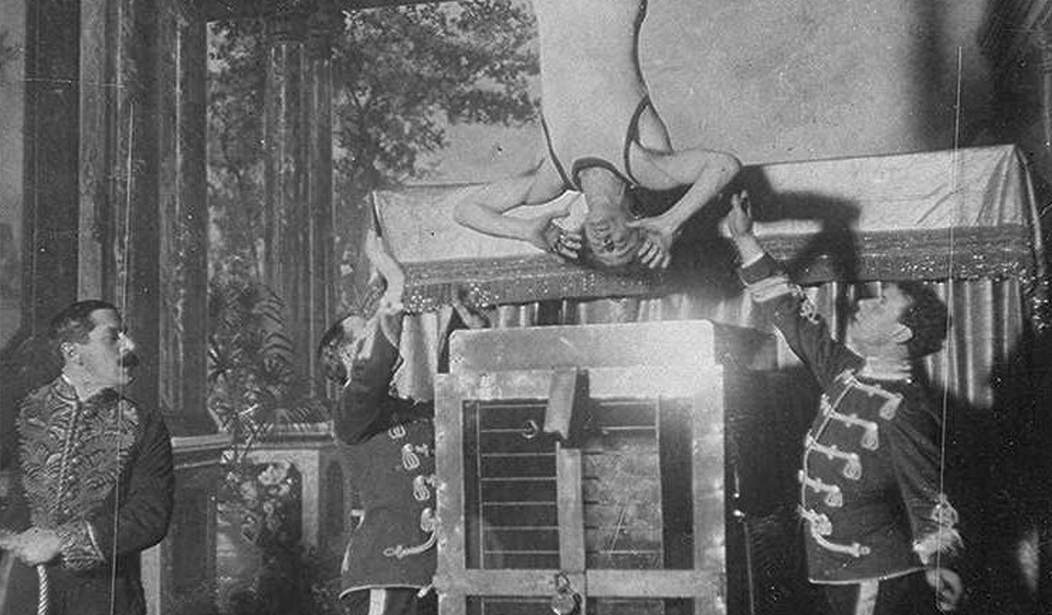

Harry Houdini, the greatest illusionist and magician in American history, was lounging in a hotel room on Oct. 22, 1926, when three university students came to see him. He had given a lecture at the University of Montreal earlier in the week, and the students had some questions.
The lecture was about his efforts to debunk fraudulent spiritualists, mediums, and psychics, a passion of Houdini's in the later years of his life. Houdini exposed several fraudulent mediums and spiritualists, because they used many of the same tricks and ruses he used in his shows.
Before the students left his hotel room, one of them, Joscelyn Gordon Whitehead, asked if it were true that his abdomen was so strong that it could withstand any blow. Houdini worked out religiously, and "myth had it that he could control individual muscles, dislocating his shoulders on demand," notes the New York Times.
Some have speculated that Whitehead delivered several blows before Houdini was ready. Whatever happened, nine days later, after being transferred to Grace Hospital in Detroit, Houdini was dead. The initial death certificate said Houdini died when appendicitis, aggravated by the blow, led to streptococcus pyogenes peritonitis, a form of infection.
Larrian Gillespie, a 77-year-old retired urologic surgeon, got interested in Houdini's death after helping a friend design a website about the magician. She had little interest in magic, but after reviewing the original death certificate, she realized something was off. "Information was scratched out. Names were inaccurate. It was signed by a physician who had not been present when Houdini died," reports the Times.
“I knew immediately things were wrong, that this was not the way a death certificate is normally filled out,” she told the newspaper.
Gillespie said that, in addition to the Michigan death certificate, there had been two others, one filed in Detroit and another with Houdini’s insurance company. The city one was later proven to be invalid by the head of fraud at the Michigan State Vital Statistics Department, Gillespie said, because of several indications of tampering.
Gillespie said she found a paper trail of misstatements and actions by more than a dozen people close to Houdini, including relatives and employees. Among them, she asserts, several helped to cover up of the date he died, in part to make it appear to be Oct. 31 — “we remember Houdini because of the association with Halloween,” she said.
So, while "officially," Houdini died on Halloween, the actual, unrecorded date of his death was October 30. It was a clever marketing ploy since Houdini's debunking of the idea that one could speak to someone after he died would keep his name in front of the press and public forever. They knew that spiritualists would try to contact Houdini on Halloween, bringing attention to themselves and to Houdini.
Houdini made sure they wouldn't succeed by creating a famous posthumous experiment with his wife Bess. They agreed upon a secret ten-word code ("Rosabelle, believe") to test whether communication from beyond the grave was actually possible. Houdini promised that if anyone could successfully deliver that exact phrase through a legitimate medium after his death, it would prove the spiritualists right.
Bess held annual Halloween séances for 10 years after his death, but the correct code was never produced. She finally gave up in 1936, famously declaring, "Ten years is long enough to wait for any man."
If the original death certificate was fraudulent and no autopsy was performed, how did Houdini actually die?
Gillespie argues that the appendicitis was not the primary cause, and that the punch was not a critical factor. Rather, she argues, the culprit was a bowel obstruction, brought on by a fibrous mass of chop suey that Houdini ate on Oct. 28.
The obstruction led to emergency surgery on Oct. 29 in the late afternoon, Gillespie argues, an enterotomy to evacuate the bowel. But it was too late; according to the author, septic shock set in, Houdini’s fever spiked to 105 and his rapid breathing led to muscle spasms and unconsciousness.
“You don’t expect someone to survive 24 hours in this condition,” she said, “and so he doesn’t.”
But the bowel obstruction was never mentioned in any of the death records.
“Not identifying on the death certificate the second surgery is the critical tip-off,” Dr. Gillespie said. "That’s the smoking gun. Why was that not mentioned?”
Gillespie speculates that the physicians attending Houdini were very worried that the family would file a medical malpractice suit. They would have had an excellent case. Feeding Houdini chop suey 48 hours previously had created a bowel obstruction that led directly to his death, according to Dr. Gillespie.
And what of Joscelyn Gordon Whitehead? The young man who punched Houdini in the abdomen went through life being blamed for his death, when his blow had nothing to do with Houdini's condition.
"Though he was never charged with a crime, he paid a heavy price for Houdini’s death, becoming a recluse and a hermit to avoid the shame of being labeled the man who killed Houdini," notes The Times. "He ultimately died of malnutrition in 1954 at 58 and was buried in an unmarked Montreal grave."
Dr. Gillespie took it upon herself to exonerate Whitehead. After writing a book that cleared his name, she got a relative's permission to place a granite headstone on his unmarked grave. The headstone read,
“WHITEHEAD, Joscelyn Gordon, Nov. 25, 1896, July 5, 1954. Falsely Accused No More.”