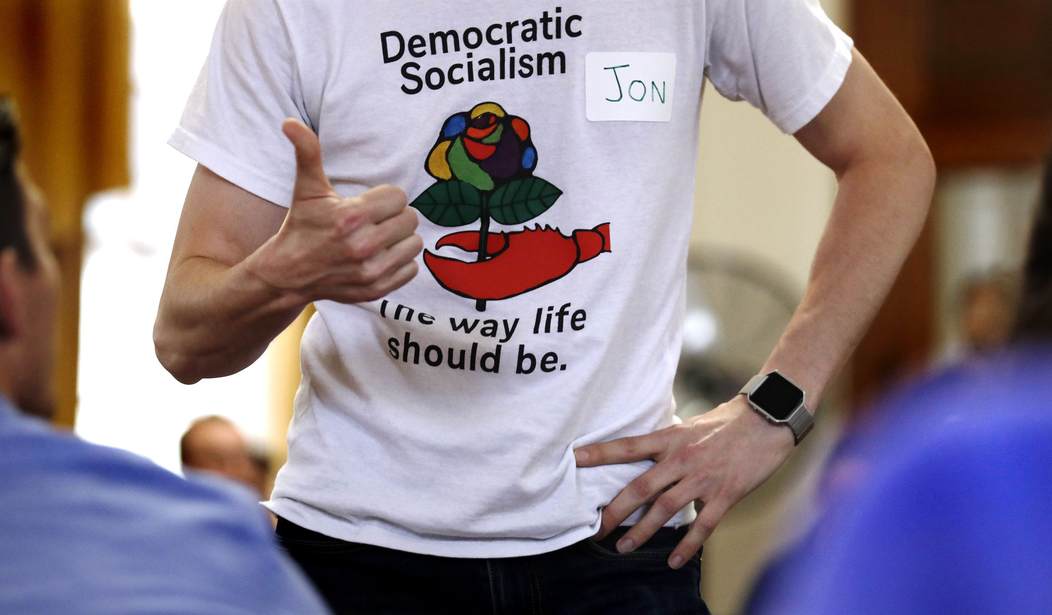
Ah, to be young and a member of the Democratic Socialists of America (DSA). It's springtime for the DSA, and as we head into summer, the socialists are positively giddy at the prospect of destroying capitalism, taking over the U.S., and taxing the billionaires (and everyone else, to be honest) into penury.
First things first, they have to finish their takeover of the Democratic Party. In that, they are well on their way to a smashing success. The Democrats are caught betwixt and between. They need the energy and cash that the rich socialist Gen Xers and Millennials living in deep blue cities give to the party. The Democratic Socialists also fill out the staff and leadership of the non-profits and NGOs that are a vital part of the Democrats' coalition.
But as Democrats found to their chagrin in 2024, what the socialists and other radical leftists believe and advocate for terrifies and disgusts ordinary Americans. The closer Democrats get to the DSA and other radicals, the more repulsed ordinary Americans are at the party.
As of now, there are over 250 DSA members holding elected office nationwide, spanning local, state, and federal levels. The vast majority of these incumbents who are up for reelection this cycle will automatically advance to the November ballot. There are also several highly competitive congressional races where a DSA candidate has a good shot at winning. "The Squad's" numbers will almost certainly grow after the midterm elections.
Where the DSA is really flexing its muscle is in the big Democratic-run cities. New York City elected Zohran Mamdani, a true-blue DSA member, last year, and Seattle followed up with a victory for Katie B. Wilson. In November, a third big city mayor will join them when Washington, D.C. elects Democratic Socialist Janeese Lewis George, who won the Democratic primary last week.
It's no accident that the DSA found fertile soil to plant the seeds of socialism in those three cities. They were all run into the ground by Democratic mayors, and feature big budget deficits, high crime rates, and faltering city services. The DSA offers a seductive mix of class warfare and relief from the high cost of living.
Megan McArdle, writing in The Washington Post, explains the dilemma for the DSA.
It is a heady moment for the left, because socialism’s tainted brand has recovered from the vivid failures of the Soviet Union. Fully 66 percent of Democrats tell Gallup they view socialism favorably, while 42 percent say the same of capitalism. This makes the left see a revolution marching toward victory, because it can promise something that the center left cannot: a disruptive break with an unsatisfying status quo.
The challenge is that socialism’s rise is spiky, concentrated in blue cities where affluent (but often downwardly mobile) college graduates cluster. That’s a problem for the Democratic Party, where the excesses of progressive governance are helping to make the party’s brand toxic in the less true-blue areas. But it’s also a challenge for the socialists, because cities are the hardest place to execute big plans for new taxing and spending.
I doubt very much that anyone under the age of 40 in big cities even remembers much about the Soviet Union and the spectacular failures of Communism. That's the DSA's greatest ally: ignorance of the past.
McArdle's mention of the "downwardly mobile" college graduates in big cities points to the loss of middle-management jobs at large corporations that, until the last decades, made big-city life so attractive. Thirty-something hipsters could afford the outrageous housing costs, overpriced restaurants, and other perks of upper-middle-class urban life until corporations stopped paying the exorbitant business taxes imposed by Democratic mayors and looked for greener pastures.
And that's why the DSA and socialism in general are just a passing fad. As McArdle reminds us, "It is much easier to leave a city than it is to leave a state or a country."
Even if the traditional downtown office culture hadn’t changed, socialist mayors would find it challenging to deliver truly disruptive change. The last time socialists were a force in American politics was a century ago, when government was tiny, and a practically virgin tax base was ripe for the plucking. A hundred years later, the government already does a lot, funded with a progressive tax structure that places much of the burden on the high-income taxpayers the socialists want to tap to pay for their programs.
Those services are often absurdly expensive for what they deliver. American infrastructure costs, for example, are a scandal. But every excessive cost is someone else’s income, and that someone will fight like a cornered tiger if you try to reduce their income by one thin dime. This eats up fiscal capacity that might otherwise be used to fund new services. New York, D.C., Seattle and Chicago are wrestling with major structural budget gaps.
The chances of DSA's toxic ideas and politics escaping the confines of big cities and deep-blue enclaves are slim. The "socialist moment" is just that: a moment in time when the American people, desperate to find an alternative to the hysterical politics of today, will grasp at anything. The DSA's agenda may sound reasonable only until the tax bills arrive, and its failure to deliver on its pie-in-the-sky promises becomes too obvious to hide.