
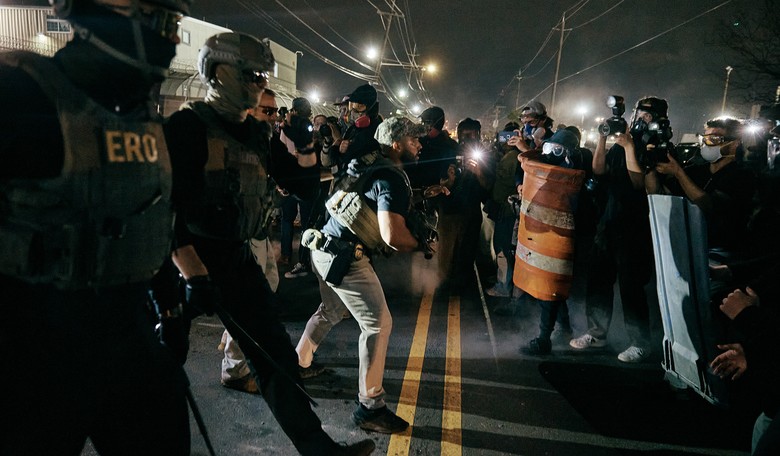
Denver’s politicians decided they could tell federal immigration agents what they may wear while enforcing federal law. President Donald Trump’s Justice Department has a different interpretation of the Constitution, and now a federal judge will decide whose interpretation prevails.
On Thursday, the Justice Department sued Denver, Mayor Mike Johnson, City Attorney Michiko Brown, and Police Chief Ronald Thomas over a municipal ordinance that restricts federal officers from covering their faces and requires specific identification. The DOJ argues that Denver has stepped beyond its authority and attempted to regulate federal law enforcement.
Denver’s City Council unanimously approved the ordinance on March 2. The measure prohibits officers from concealing their identities while questioning, detaining, or arresting people within city limits. It also requires officers to identify themselves upon request. Denver included exceptions for undercover operations, occupational safety, and certain other circumstances.
Supporters presented the measure as a public accountability safeguard. They argue that people should know who exercises police powers in their neighborhoods, particularly when armed officers conduct arrests. Denver applied the ordinance broadly to law enforcement, although federal immigration operations plainly motivated the debate.
But accountability doesn’t automatically give city governments authority over federal operations. The Constitution’s Supremacy Clause makes federal law supreme when state or local rules conflict with valid federal authority. The DOJ argues that Denver’s ordinance crosses that boundary by dictating how federal agents identify and protect themselves during official duties.
Associate Attorney General Stanley Woodward argues that the restrictions threaten officers and their families. Federal agents, he says, face harassment, doxxing, and violence, and local governments can’t expose them to additional danger simply because they oppose federal enforcement practices.
The DOJ also objects to the possibility that Denver could prosecute officers who follow federal procedures rather than municipal rules. Assistant Attorney General Brett Shumate maintains that the federal government, not Denver’s City Council, determines which protective equipment federal officers may wear.
Now, Wisconsin enters this fight.
On July 23, the DOJ sued Milwaukee, Mayor Cavalier Johnson, City Attorney Evan Goyke, and Police Chief Jeffrey Norman over a similar ordinance. Milwaukee’s restrictions prohibit federal officers from wearing masks and require individual identification while performing law enforcement duties. Federal prosecutors challenged those requirements under the same constitutional principle.
Milwaukee’s case makes clear that Denver isn’t an isolated disagreement. The administration has pursued similar challenges in Philadelphia, New York, and other jurisdictions. Each lawsuit raises questions about how far local governments can go when they object to federal enforcement methods.
The legal argument carries historical weight. In 1819, the Supreme Court’s McCulloch v. Maryland decision established that Maryland couldn’t use its taxing power to interfere with a legitimate federal institution. That ruling helped define the constitutional limits on state interference with federal authority.
More than two centuries later, federal officers still operate within a system that gives Washington substantial authority while preserving important state and local powers. The current lawsuits will test how that division applies to officer identification and protective equipment.
Denver’s ordinance raises legitimate questions about transparency, public confidence, and recognizing law enforcement officers. The Justice Department raises equally concrete concerns about operational control, officer safety, and federal supremacy. Neither the ordinance’s stated purpose nor DOJ’s allegations settles the constitutional question.
The courts must examine the actual restrictions, their exceptions, and how they interact with federal law. Denver’s residents deserve accountable law enforcement, and federal officers deserve clear rules that protect their safety and lawful responsibilities.
The outcome could shape how cities nationwide regulate the visible identity of officers operating within their borders. For now, Denver’s City Council has discovered that passing an ordinance is only the beginning of a much larger constitutional fight.