
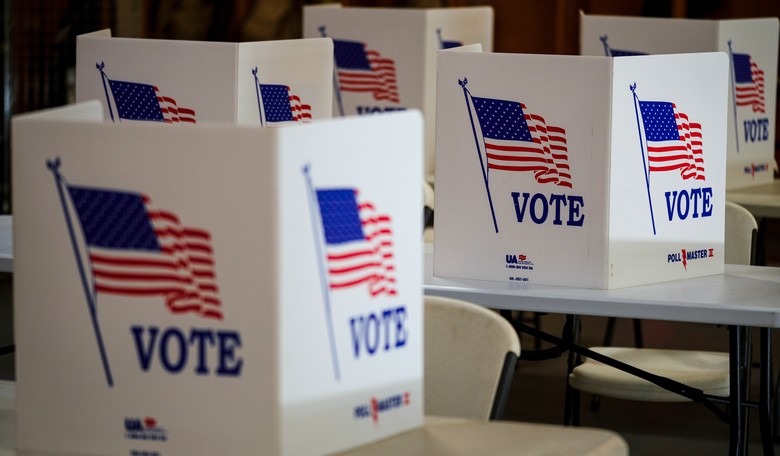
White House Border Czar Tom Homan says there is no plan to send ICE agents sweeping through polling places in November. States including Maine, Michigan, New Mexico, and Oregon are preparing anyway, coordinating with local authorities and attorneys general in case federal immigration officers appear near voting sites.
From Newsmax:
The preparations come as President Donald Trump has argued that greater federal involvement is needed to protect election integrity, including addressing what he has described as a high potential for fraud.
Trump has made election security a focus ahead of the midterms, including efforts involving mail voting, voter rolls and citizenship verification. The administration has said those measures are intended to prevent unlawful voting and protect election integrity.
The rhetoric around the issue has quickly risen. Homan called the polling-place scenario a fear tactic. Democratic officials and voting-rights groups say their concern is different: even targeted federal enforcement near a polling place could intimidate eligible voters, including naturalized citizens or people in mixed-status families.
The law supplies some important boundaries. Noncitizens generally may not vote in federal elections under 18 U.S.C. § 611. Another federal law, 18 U.S.C. § 592, restricts federal officials from bringing "troops or armed men" to places where elections are being held. The Justice Department's election-crimes manual also says federal investigators can't simply be sent into the area surrounding an open polling place.
Recommended: Could At Least This One Leftist Politician Actually Face Justice?
So there are two legitimate questions here. One concerns eligibility: who may legally vote? For federal elections, the law limits voting to citizens, subject to narrow statutory exceptions.
The other concerns federal power around polling sites, where existing law puts unusual restrictions on armed federal personnel.
Noncitizen voting does happen, although the available evidence doesn't establish that it occurs on a widespread scale. On Sept. 4, the Justice Department announced charges against five people in Pennsylvania, New Jersey, and Wisconsin involving alleged illegal voting or fraudulent registration in the 2022 or 2024 elections. The defendants are presumed innocent unless convicted.
From the U.S. Department of Justice:
“As alleged, these five individuals in New Jersey, Wisconsin, and Pennsylvania, including two illegal aliens, stole votes from American citizens when they decided to break the law and undermine our elections,” said FBI Director Kash Patel. “Protecting election integrity for the American people is one of the top priorities for this FBI. Every American citizen has a right to free and fair elections, and we will not hesitate to use all available resources to investigate every credible allegation of election fraud and illegal voting.”
“The crime of illegal voting undermines the integrity of our elections and harms citizens by stealing the power of our votes,” said U.S. Attorney Brian Miller for the Middle District of Pennsylvania. “Illegal voting is not a victimless crime but a serious affront to the principles of our democratic republic. This office will prosecute to the full extent of the law those who illegally vote in federal elections as well as those who facilitate illegal voting.”
Michigan's own review supplies the other half of the picture. State officials identified 15 credible cases involving apparent noncitizen voting among more than 5.7 million ballots in the 2024 general election, about 0.00028%. Thirteen were referred for possible prosecution. The offense existed in the state's review, but it was rare.
The 2020 court record deserves similar care. It's accurate to say every election challenge was rejected only after judges fully tested the evidence. It's also inaccurate to say most were dismissed because of lack of standing.
A 2022 review by eight conservative legal figures counted 64 post-election cases. Twenty were dismissed before a merits hearing, 14 were voluntarily withdrawn, and 30 included a hearing on the merits. Standing ended some prominent cases, including Texas v. Pennsylvania, but not a majority.
The sharper question is what happens next. If ICE says polling-place sweeps aren't planned, public discussion should distinguish speculation from an announced operation. If federal law already limits armed federal activity around polling places, federal officials should also be clear about how targeted enforcement would comply with those restrictions.
Election law already addresses both sides of this argument. Noncitizens may not legally vote in federal elections, and federal agents don't have unlimited authority around polling places. Keeping those two facts together produces a more accurate debate than pretending illegal voting never occurs or treating an ICE sweep as established government policy when officials say none is planned.