
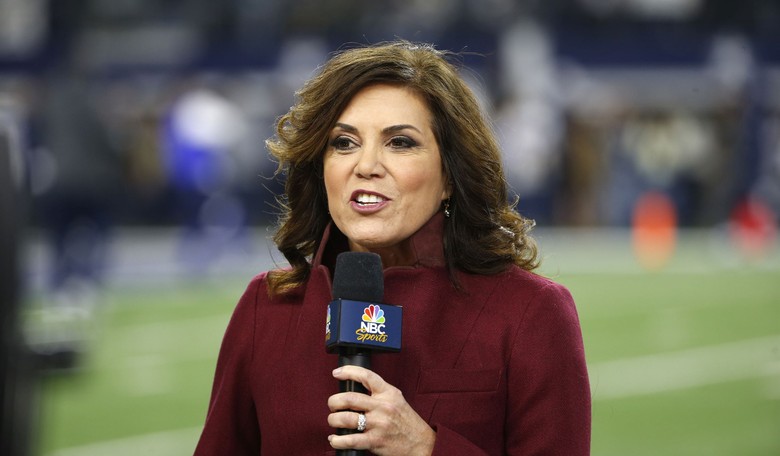
Michele Tafoya spent years working the NFL sideline, where chaos comes with a headset, a camera, bad weather, loud coaches, and about seven seconds to make a point before America goes back to third-and-long.
Now, the former Monday Night Football and NBC sideline reporter has moved into a different kind of contest: Minnesota's 2026 U.S. Senate race. Tafoya is running as a Republican for the open seat held by Sen. Tina Smith (D-Minn.), who announced she won't seek reelection when her term ends in 2017.
Her campaign just picked up a useful boost from Tony Dungy, the Pro Football Hall of Fame coach whose reputation reaches well beyond football. Dungy's endorsement gives Tafoya something most first-time candidates would love to have: instant credibility with voters who may remember her from sports before they know her politics.
Super Bowl champion. Hall of Fame coach. A man of faith and integrity, @TonyDungy knows winners.
— Michele Tafoya (@Michele_Tafoya) May 26, 2026
Tony and I worked side-by-side for over a decade, and his support means the world to me.
He knows what I stand for. He knows why I’m running. And he believes, like I do, that… pic.twitter.com/DjG2PYRBJu
In a crowded Republican primary, name recognition doesn't win by itself, but it can buy a candidate the one thing campaigns can't fake for long: voter curiosity.
Minnesota won't hand Republicans anything easily; the state has leaned Democratic in statewide federal races for a long time, and Republicans haven't won a U.S. Senate race there since Norm Coleman's 2002 victory.
Still, open seats create strange weather. Familiar habits weaken, party machinery has to work harder, and voters who might tune out a typical race sometimes take another look when the ballot doesn't include an incumbent.
The early field reflects a real fight; Tafoya faces Republican competition from Royce White, a former NBA player and 2024 Republican Senate nominee; Adam Schwarze, a former Navy SEAL; Tom Weiler, a retired Navy officer; and others.
On the Democratic side, Rep. Angie Craig (D-Minn.) and Minnesota Lt. Gov. Peggy Flanagan are already major names in the race. A January 2026 SurveyUSA poll of 575 registered Minnesota voters showed Craig at 20%, Flanagan at 19%, Tafoya at 13%, White at 7%, Weiler at 5%, Schwarze at 3%, and 26% undecided.
Those numbers don't make Tafoya a favorite, but they do show room to move. A first-time candidate sitting near the top Republican tier before most voters have fully engaged isn't nothing. More importantly, Tafoya brings a public voice already shaped by live television, pressure, and conservative commentary after leaving sports broadcasting. Her move from NBC sports coverage into political commentary gave voters a preview of what she believes, not just what office she wants.
President Donald Trump carried politics into places where polished résumés stopped impressing voters. Tafoya's advantage may come from a similar lane, though on a smaller stage. She doesn't look like another committee-made candidate stuffed with consultant language, sounding like someone who watched the culture from the sideline, stepped away from the old media order, and decided Minnesota deserved a different voice in Washington.
Can she win?
In Minnesota, caution still makes sense. Hope isn't a polling model, and Dungy's endorsement won't turn Minneapolis into rural Stearns County overnight. Yet campaigns sometimes change when a candidate with a familiar face finds the right moment, the right message, and the right opponent.
Tafoya has the name, the opening, and now a Hall of Fame voice saying she deserves a closer look. For Minnesota Republicans, that's at least a reason to lean forward.