







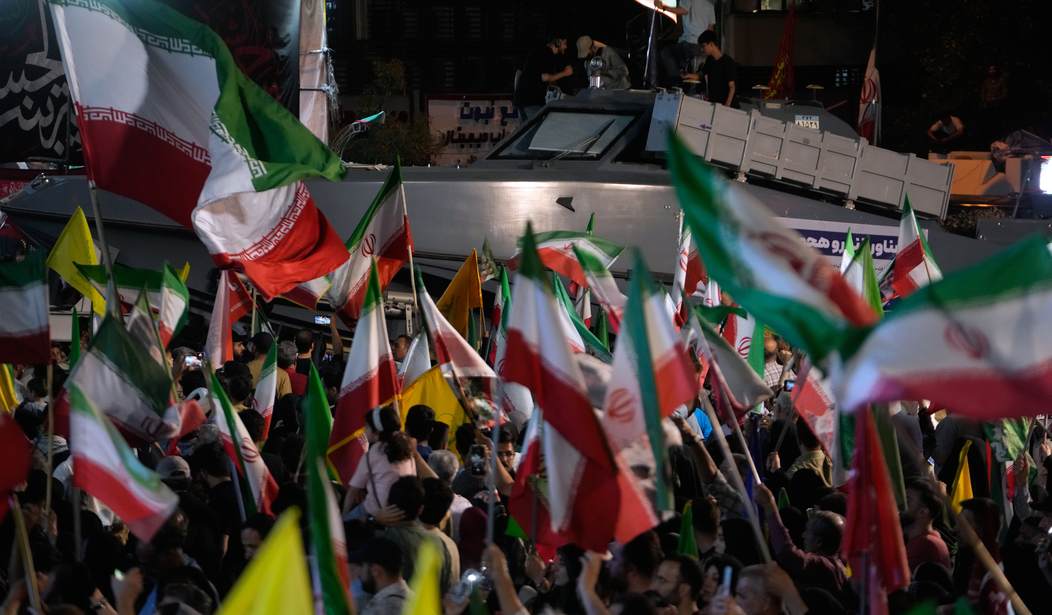
In a recent article for PJ Media, I detailed my reasons for taking exception to Donald Trump’s management of the Iranian crisis. Anyone who has read Trump’s books, especially The Art of the Deal, and observed his policy measures involving trade and tariffs, knows that he regards himself—with justification—as the magus of contractual arrangements and accords. In The Art of the Deal, he furnishes ten criteria for bringing about successful transactions. Chief among these are “thinking big, maximizing one’s options, raising leverage, knowing your market, getting the word out (Truthful Hyperbole), and delivering the goods. Tough but fair.” Trump’s record shows that he has rarely failed to apply these rules, almost always leading to auspicious results.
Where compromise is possible, I continued, “an agreement can be worked out. Where not, the art of the deal, as Trump understands it, is contra-indicated and surely dangerous.” The maxims of Sun Tzu, the 6th Century Chinese general and author, whose The Art of War on military science and strategy are pertinent, summed up the crucial issue. “If you know the enemy and know yourself, you need not fear the result of a hundred battles.” The question is whether Trump really knows the enemy and, indeed, really knows himself. As I concluded the article, Trump is engaged in a war, not in a business deal, but it is not clear whether in this instance he truly recognizes the difference, whether he knows the “market” (his fourth criterion) and has grasped his actual motives.
Trump appears to think that a deal can always be made and that he can win it or steer it to a satisfactory outcome. After all, he wrote the book on it, so to speak. In his first administration, he understood business but not politics, and was duly betrayed by ostensible allies like Mike Pence and Jeff Sessions and Anthony Fauci and many others. The second time round, he obviously understood both business and politics exceptionally well and surrounded himself with a dynamite entourage like J.D. Vance and Marco Rubio and Stephen Miller and Scott Bessent and Susie Wiles and a host of others. One notes how effective he has been in endorsing primaries. But I suspect he does not understand the Islamic mind, neither the Sunni nor the Shia hemispheres, and particularly not the Shia sense of determinism, adamant conviction, traditional warrant, religious adherence and ideological fatalism that flourishes in prelatic, ministerial and revolutionary Iran. That is the nub of the matter.
The Shia mind is also, in its way, an art, an ecumenical achievement. When you are taught to hate, kill and deceive from your first breath, when your mind is layered with a thick carapace indelibly inscribed with sacred text, when you are imbued with apodictic maxims of spiritual superiority that cannot be modified, when you are required by holy writ and social force to pray five times a day in any and every environment, and at the same time you are indoctrinated to believe that you are elevated not only above infidels but over the major branch of your Sunni coreligionists, then you are not a member of a belief system that is prone to making deals. If your enemies or interlocutors do not realize this, they are lost.
I do not believe that Trump is familiar with the work of Ali Shariati, acclaimed in Iran as a critic of what he and possibly a majority regarded as the oppressive regime of the Shah. Shariati inspired millions of Iranians, particularly radical students, with his religious and political speeches and writings of resitance to the monarchy, and of the beauty and necessity of shahadat, or martyrdom. “He gave new life to the core event of Shiasm,” writes Lesley Hazleton in After The Prophet, namely, the martyrdom of the Third Imam Hussein ibn Ali at the Battle of Karbala in 680 BC. After Mohammed, Hussein is the most revered figure in Shia symbology and tradition. Shariati’s work and inflammatory rhetoric prepared the way for the 1979 ascension of Ayatollah Ruholla Khomeini as supreme leader of the nation and representative of the Twelfth Imam, the Mahdi or messiah, still in occultation.
One cannot understand the radical, clerical and despotic nature of the Iranian leadership without a familiarity with Shariati’s work. One cannot understand Iran’s Shia mentality without delving into the meaning of the vast cycle of annual taziya or Passion Plays, the Ashura procession with its hatred of the character of the black-robed Sunni Caliph Yazid (stand-in for the Shah, for Trump), and the triumphant impact of what Khomeini called “the blood-stained banners of Ashura.” All this follows from Shariati hammering the seventh century into the Shia cerebellum, inflaming the students who took over the American embassy, and paving the road from Paris to Tehran for Khomeini, accompanied in time by the mullahs, the IRGC and the paramilitary Basij who, barring regime change, will remain in place no matter how war-bruised and economically impaired they may be.
I should add for the interested reader that Patrick Cockburn’s synoptic The Age of Jihad: Islamic State and the Great War for the Middle East is essential reading. Andrew Bostom’s work on Iran is equally indispensable. Islamic Eschatology: Awaiting Al-Mahdi by Edward Andrews is a curriculum between single covers for any serious policymaker who wants to size up the Islamic mentality or for any individual fascinated by the legend of the Twelfth Imam. David Goforth’s The Iranian Antichrist is a most emphatic warning about the nature of this diabolical figure. Emmanuel Sivan’s Radical Islam, which I have mentioned often in my articles and books, is sine qua non.
Novelist Joel Rosenberg published his Christian-influenced Iranian trilogy The Twelfth Imam, The Tehran Initiative and Damascus Countdown between 2010 and 2013, but they could have been composed this morning. His work is clearly based on Michael Patterson’s Iran: Persia and Biblical Prophecy, bristling with references to prophetic, end-time passages in Jeremiah and Ezekiel in which Persia (Elam; Magog) will attack Israel and reap God’s fierce judgment for its idolatry, violence and impiety.
One cannot read everything but one should not enter upon negotiations with Iran if one is ignorant of its history and politics and understands little of the theological, apologetic, mythic and eschatological roots of Shia Islam, its intersection with global politics, and the challenges posed by radical interpretations of its doctrinal principles and deeply sedimented faith. Common sense is not evenly distributed among people. In the Iranian case, research is pretty well obligatory.
I have just received a comment from a political friend who writes that he would be very surprised “if Trump doesn't have people in his orbit who understand Shia Islam's true nature and are planning accordingly.” My friend tends to believe that “Iranian ethnic groups, like the Kurds and Azeris, both of which hate the regime and represent roughly one third of the Iranian population, will be supplied, trained and assisted by the US and Israel (possibly Azerbaijan as well given its largely secular culture and long border with Iran). Whatever Trump says or ostensibly agrees to may just be his own form of taqiyya or deception.”
Why Trump would need to be practicing deception since he holds all the cards, as he is fond of saying, escapes me perfectly. Why Trump would accept the regime’s obvious stalling tactics and thus give it time to continue its missile and drone attacks on its Arab neighbors and Israel, and to repair and resupply its arsenal, is beyond me. My friend’s assessment is frankly whimsical if not a trifle quixotic, an aspect of the conservative belief in the basic rationality of mankind and the acumen of conservative’s best thinkers who are given to argue and convince by the application of reason. Something is intuitiverly lacking. As for Trump, he does not seem to have realized that the Shia disposition is not one that is amenable to a “deal” in the first place.
There are several words for “deal” or “to deal” in Arabic, mainly safqa, relating to “bargain,” bazaar, monetary exchanges, and so on. There are other words for “interaction” and treating “issues.” But that is neither here nor there. Shia does not deal in the sense that Trump appears to imagine. It imposes its will and follows its destiny, as did Hussein, irrespective of empirical consequences and tempting, if not welcoming, martyrdom.
It would be encouraging if Trump could see that his vaunted rules for dealing and persuading are not, in certain circumstanced, productive. For example, his thunderous threats to Hamas that he would rain fire upon them if they did not quickly release the Israeli hostages. It took a considerable interval for all the hostages to be returned. Trump’s fifth maxim—getting the word out, embellished by the use of “truthful hyperbole—an innocent form of exaggeration, and a very effective form of promotion”—was quite evidently ineffective. Trump decided that Gaza would become the “Riviera” of the Middle East. But few Western countries have thus far been willing to take in large numbers of asylum seekers from the area. CAIR calls the project “ethnic cleansing.” Egypt will not dismantle its impregnable wall and Hamas has refused to disarm while gearing up for another round of conflict with Israel. I note no postcards of sunbathers relaxing on the seashore.
I’m afraid that a confident and very smart American president has taken his own book far too seriously in the present imbroglio with a rogue regime. Unless I’m very wrong in my assumption, I suspect he does not see that the Iranian antagonist has no intention of absorbing the content of his book unless to reject the manual with contempt or to learn the rules in order to pre-empt and violate them. Shia Iran is neither a gambling nor a business counterpart that can be dealt with in any meaningful way. It must be demolished and replaced, not palavered into survival. I fear this may be one occasion in which Trump just doesn’t get it.
Editor’s Note: Thanks to President Trump and his administration’s bold leadership, we are respected on the world stage, and our enemies are being put on notice.
Help us continue to report on the administration’s peace through strength foreign policy and its successes. Join PJ Media VIP and use promo code FIGHT to receive 60% off your membership.

Join the Conversation
VIP members get the ability to comment on articles.