
By April 1945, Europe had endured enough destruction to exhaust the imagination. Cities lay broken, families searched for the missing, and soldiers who had survived years of fighting still faced the possibility of dying within sight of victory.
In that wreckage, American cavalrymen received an unusual mission. Beyond their lines, in German-held Czechoslovakia, stood hundreds of valuable horses and Allied prisoners who needed help getting out.
The operation became known as Operation Cowboy. Its name sounds almost too cheerful for the world those men lived in, but perhaps that’s why the story stays with us.
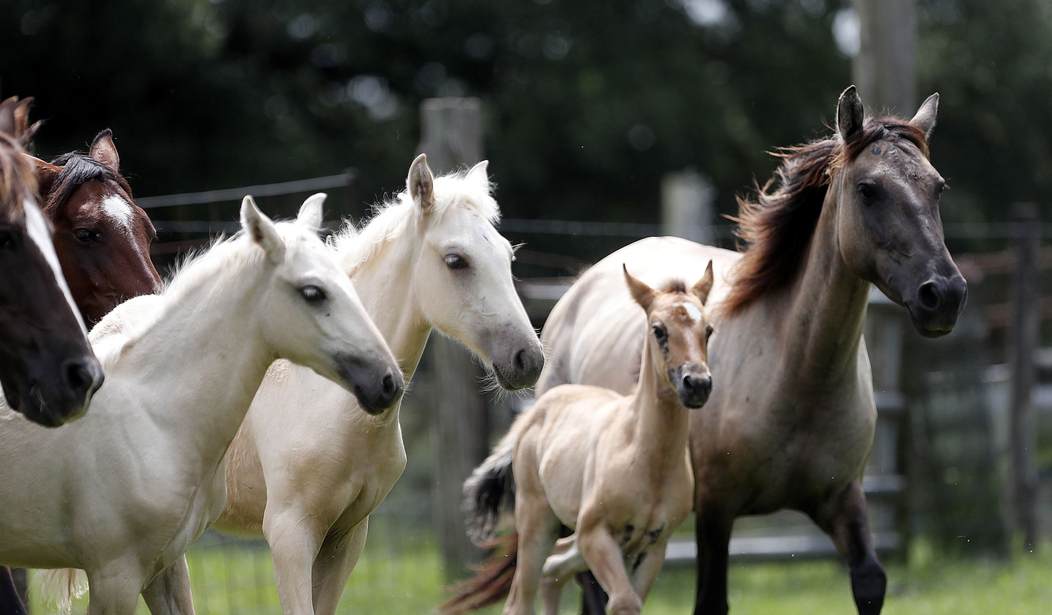
At Hostau, now Hostouň in the Czech Republic, the Germans had gathered a remarkable collection of horses, including Lipizzaners. The breed was closely associated with Vienna’s Spanish Riding School, where patient training produced the controlled leaps and movements of classical dressage.
From the Buffalo Bill Center of the West:
Operation Cowboy was successful because of the initiative of Intelligence Officer Thomas Stewart who assisted in persuading German troops to release hundreds of POWs and the prized horses,” Hoback explains. “Due to Stewart’s bravery in crossing into Nazi territory, Patton awarded him a German Drilling shotgun, which is now on display in this exhibit.”
The Lipizzaner is one of Europe’s oldest breeds of horse, developed exclusively by the Hapsburg monarchy of Austria; the breed is closely associated with the Spanish Riding School of Vienna. There, the best of the horses continue the iconic “Airs Above the Ground” movements of classical dressage—including highly controlled leaps and stylized jumps—even today.
Generations of breeding, care, and instruction stood behind those animals. A horse knew nothing about the borders armies had crossed, or the flags that had changed above its stable, but the people who cared for it understood how quickly war could destroy what generations had built.
As Soviet forces approached, caretakers feared the horses would be slaughtered for food. American cavalrymen serving under Gen. George Patton’s Third Army became their hope for safety.
ICYMI: A Rosary, an Old Friend, and One More Night Believing in the Brewers
That fear fed the desperate uncertainty of the war’s final days. The men at the farm needed to make arrangements with an approaching enemy, while American officers had to decide whether they could rescue them amid German forces that hadn’t all stopped fighting.
Capt. Thomas Stewart, an intelligence officer with the 42nd Cavalry Reconnaissance Squadron, helped negotiate with the Germans. His knowledge of horses and some German language skills made him useful for a task that required nerve as much as persuasion.
The eventual surrender brought horses and prisoners under American protection. Germans who cooperated in the rescue helped the Americans move the animals out.
There’s something arresting about cavalrymen in a mechanized war taking responsibility for a herd. They understood engines and armor, but their branch of service carried an older inheritance, one built around the partnership between a rider and an animal.
The rescue also required military force. A task force under Maj. Robert Andrews included armored scout cars, light tanks, and roughly 325 soldiers. German SS resistance remained a danger, and the operation involved fighting rather than an uncontested ride through a defeated country.
From the U.S. Army Historical Foundation:
To penetrate the German lines, XII Corps unleashed an artillery barrage to soften up enemy resistance. This allowed Andrews and his task force to breach the German lines and take control of the facility. While capturing the facility, the Americans now faced a rather difficult situation. There were far more than 325 horses at the facility, and as such, Major Andrew and his deputy, Thomas M. Stewart, decided to use the German soldiers at the facility along with nearby liberated POWs of many Allied nations to assist in the extraction of these horses and save them from certain death. All German troops who were to be armed had to pledge to serve under U.S. authority, which found little resistance as most feared the retaliation that was coming from the Soviet Red Army.
During the rescue of the horses, the farm twice came under attack by fanatical Waffen-SS troops, leading to casualties on both sides. Eventually, however, the approaching threat of the Red Army ceased further German resistance. Having lost men and valuable resources, Captain Thomas M. Stewart, now in charge of the task force as Major Andrew’s second-in-command, hurried the horses along in a desperate attempt to return to friendly lines. Many of the horses at the time were pregnant and, as a result, were often rather unwilling to cooperate with efforts to evacuate them. Cavalrymen mounted up on many of the horses, loaded them into vehicles, and, with the rest of the animals, herded them into a massive column formed by the U.S. task force and evacuated the precious Lipizzaners back to Allied lines.
It’s easy to let the horses’ beauty soften the story until the danger disappears. That would do the soldiers a disservice, especially the men who never came home.
Army commemorations identify Pfc. Raymond Manz and Technician 5th Grade Owen Sutton as the two American soldiers killed during the operation. Memorial stones honor them in the Czech Republic, where American troops and local people have gathered to remember the rescue.
Their names belong beside the horses’ photographs. Someone’s family paid a permanent price for a mission we can now admire from the safety of a comfortable chair.
I keep returning to the decision those men faced. After so much loss, they could still recognize a reason to act, take responsibility, and carry something living away from danger.
In April 2026, soldiers of the 2nd Cavalry Regiment returned for the operation’s 81st anniversary. They joined Czech communities in ceremonies that connected the regiment’s present to the people and animals its predecessors had helped save.
When I think about what victory meant, I want room for those horses, those freed prisoners, and those two American names. The men who brought them out were helping decide what kind of world would survive the war.
Europe had taught them how much could be destroyed, yet they still chose to bring something beautiful home.