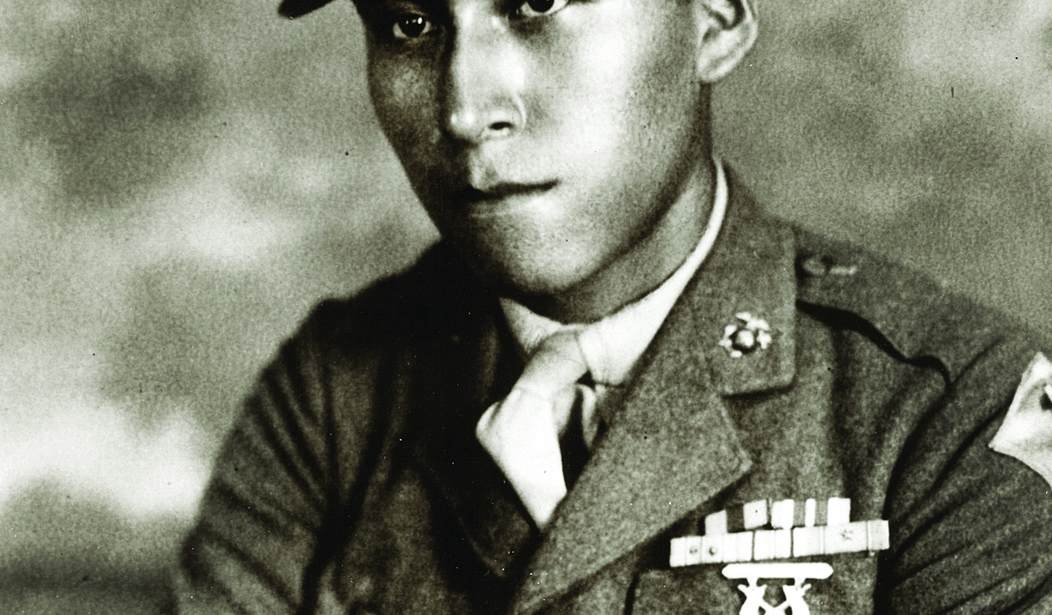

By the time Mitchell Red Cloud wrapped an arm around a tree, eight bullets had struck him. The Wisconsin soldier was bleeding badly on a Korean hillside, but he had no intention of leaving his post. Behind him, fellow Americans needed a little more time to live.
Before dawn on Nov. 5, 1950, Red Cloud stood watch on Hill 123 near Chonghyon, North Korea. He belonged to Company E, 19th Infantry Regiment, 24th Infantry Division. From a listening post ahead of the company, he spotted Chinese troops moving through brush less than 100 feet away. He sounded the alarm and opened fire with his Browning Automatic Rifle.
The war was barely four months old when Chinese forces entered the fighting.
From the Wisconsin Veterans Museum:
By the time Corporal Mitchell Red Cloud, Jr. wrapped his arm around a tree so he could remain upright, he’d already been shot eight times. The Korean War was in its early stages.
Red Cloud, a member of the Ho-Chunk Nation from Hatfield, Wisconsin, had been manning a hilltop observation post on the night of November 5, when he spotted 1,000 Chinese infantrymen quietly moving into position for an attack on his unit, E Company of the 19th Infantry Regiment.
The attacking forces pressed forward. Red Cloud fired at close range, slowing its advance while his company scrambled to defend its position. Chinese soldiers had also slipped behind American lines, killing men in their positions. His warning gave the survivors precious minutes to regroup and move wounded comrades out of danger.
Enemy fire struck Red Cloud, knocking him to the ground. Medic Perry Woodley reached him and tried to help, but the corporal refused assistance. As Woodley moved to other casualties, he heard Red Cloud’s rifle firing again.
Wounded and losing blood, Red Cloud pulled himself upright, wrapped his arm around a nearby tree, and resumed shooting at the enemy.
From the Wisconsin Veterans Museum:
At 3:20 AM, under the light of a full moon, the Chinese troops launched their assault. As the enemy charged from a brush-covered area less than 100 feet from him, Red Cloud sounded the alarm to his fellow soldiers and immediately grabbed his Browning Automatic Rifle (BAR).
Jumping up from his hiding place, he emptied magazine after magazine into the charging Chinese forces at point-blank range. The accuracy and intensity of his attack took the enemy by surprise, but they returned fire.
Two bullets in his chest barely slowed him down as he continued to fight, but eventually he incurred several other serious injuries.
More shots followed. He remained at the post until he was fatally wounded. His Medal of Honor citation credits him with preventing the enemy from overrunning the company and allowing time to reorganize and evacuate the injured. His stand gave soldiers behind him a chance to live.
The young soldier had known war long before Korea. Raised in Hatfield, Wisconsin, among the Ho-Chunk Nation, Red Cloud joined the Marines in August 1941, months before Pearl Harbor. He served with the Marine Raiders on Guadalcanal, contracted malaria, and declined a medical discharge. He later fought on Okinawa, where he was wounded.
War finally ended, and Red Cloud returned to Wisconsin. He married, became a father to a daughter named Annita, and tried civilian life. But in 1948 he returned to uniform, this time in the Army. He had already served in two of the Pacific War’s hardest campaigns. Nobody forced him to re-enlist.
On April 3, 1951, General Omar Bradley presented the Medal of Honor to Red Cloud’s mother, Lillian, at the Pentagon. His brother, Merlin, and cousin Sadie Leach were there, too. She received the nation’s highest award for battlefield valor without her son beside her. He had been buried in Korea, far from the wooded Wisconsin countryside where he had grown up.
Four years later, his remains came home. His family laid him to rest at Decorah Cemetery near Black River Falls. In 1957, the Army gave his name to Camp Red Cloud in South Korea, preserving his memory on the peninsula where he had died. Yet another honor awaited a daughter who had grown up without her father.
In 1999, Annita Red Cloud stood at a San Diego shipyard and christened the USNS Red Cloud, a Navy cargo ship named for him. Some of the soldiers who served with her father attended. The child left behind in Wisconsin had become the woman welcoming a vessel bearing her father’s name.
In 2025, the Ho-Chunk Nation marked 75 years since his death, honoring the warrior whose sacrifice remains part of its living history.
On Hill 123, Red Cloud asked for no monument. He held a tree because his legs could no longer hold him. Men behind him gained time to survive, while his mother, daughter, and nation inherited the memory of what those minutes cost.
Mitchell Red Cloud Jr.’s Medal of Honor citation:
Cpl. Red Cloud, Company E, distinguished himself by conspicuous gallantry and intrepidity above and beyond the call of duty in action against the enemy.
From his position on the point of a ridge immediately in front of the company command post, he was the first to detect the approach of the Chinese Communist forces and give the alarm as the enemy charged from a brush-covered area less that 100 feet from him.
Springing up he delivered devastating point-blank automatic rifle into the advancing enemy. His accurate and intense fire checked this assault and gained time for the company to consolidate its defense. With utter fearlessness he maintained his firing position until severely wounded by enemy fire. Refusing assistance he pulled himself to his feet and wrapping his arm around a tree continued his deadly fire again, until he was fatally wounded.
This heroic act stopped the enemy from overrunning his company's position and gained time for reorganization and evacuation of the wounded. Cpl. Red Cloud's dauntless courage and gallant self-sacrifice refects the highest credit upon himself and upholds the esteemed traditions of the U.S. Army.