







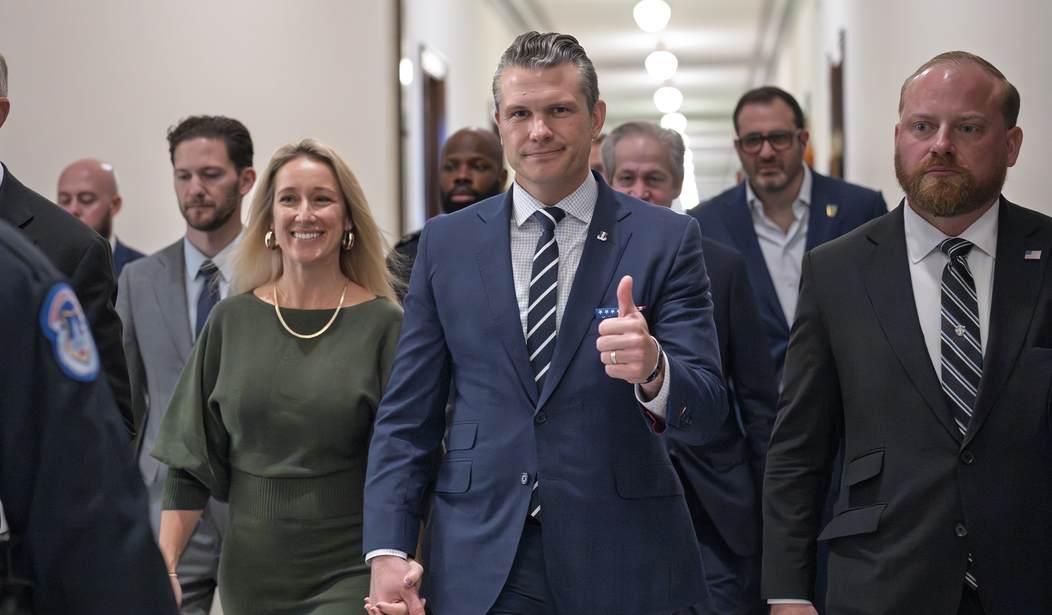
Three senior employees at the military newspaper Stars and Stripes are fighting for their jobs, and Secretary of War Pete Hegseth is getting the full press-freedom alarm treatment.
Publisher Max Lederer, editor-in-chief Erik Slavin, and Middle East reporter Lara Korte received separation notices charging them with insubordination. Their lawsuit alleges the firings were retaliation for defending editorial independence and for coverage critical of conditions aboard the USS Abraham Lincoln.
Government lawyers countered that comments made by Slavin and Korte were designed to undermine the agency employing them. The firings are paused until a Sept. 4 court hearing.
From Stars and Stripes:
The Pentagon agreed Friday to keep three Stars and Stripes employees on administrative leave for another week to allow the court to weigh in on their lawsuit alleging wrongful termination.
Erik Slavin, the editor in chief; Lara Korte, the paper’s Middle East reporter; and Max D. Lederer Jr., the publisher, filed the 45-page lawsuit the day prior against chief Pentagon spokesman Sean Parnell, the Defense Department, Defense Secretary Pete Hegseth and another public affairs official, Andrew Brey.
The lawsuit alleges their firings violated their right to free speech and were issued in retaliation for the news outlet’s unflattering coverage of conditions aboard the aircraft carrier USS Abraham Lincoln.
David Seide, an attorney on the case with the Government Accountability Project, said Judge Trevor McFadden asked Pentagon attorneys in a hearing Friday if the Defense Department could extend each staffer’s firing, which was set to occur two days later, so that he could fully understand the case. The Pentagon agreed to keep them on administrative leave for another week.
The next hearing is scheduled for Sept. 4 in Washington, where attorneys will argue before McFadden about imposing a temporary restraining order to halt the firings.
“The extension maintains the status quo,” Seide said.
Stars and Stripes operates as a commercial news outlet but is owned by the Defense Department, which also provides some of its funding. Its employees are federal workers paid through nonappropriated funds, a status that impacts access to some federal worker protections.
Of course any allegations of this sort deserve scrutiny; a military newspaper serving troops and their families should have the editorial independence Congress intended it to have.
The Referee Test starts with what came before.
In April 2021, the Biden White House excluded most military reporters from a conference call about President Joe Biden's decision to withdraw American troops from Afghanistan. The organization representing military journalists filed a formal protest, saying the exclusion violated the administration's own commitment to transparency.
From the Military Reporters site:
On behalf of the Military Reporters & Editors Association, I am lodging a formal protest of the White House’s decision to exclude most of the journalists who cover the U.S. military from Tuesday’s conference call with a senior administration official about President Biden’s decision to withdraw all U.S. troops from Afghanistan by Sept. 11.
The event was not announced publicly beforehand and it was limited to a small number of journalists. Given the enormity of President Biden’s decision and the potential strategic ramifications of ending the U.S. military’s presence in Afghanistan, and the lasting effect on the troops, veterans and families we cover, this conference call should have been open to all journalists.
Military Reporters & Editors represents a variety of journalists, many of whom have embedded with U.S. troops in Afghanistan, Iraq, and elsewhere. A good number of our members work for smaller media outlets that do not have permanent White House bureaus, so they were unaware of Tuesday’s briefing until after it had started.
Given the importance of local news in today’s complex media landscape, the White House should make every effort to include those reporters who have dedicated their careers to telling the stories of service members, military families, and veterans whenever any administration official talks to the press.
Quite frankly, the White House’s decision to invite so few reporters to participate in Tuesday’s news conference is not in keeping with the Biden administration’s commitment to transparency with the American public.
I look forward to discussing this matter further with the White House and National Security Council press offices.
Thank you.
Very Respectfully,
Jeff Schogol
President of the Military Reporters & Editors Association
The problem extended well beyond one briefing. A major 2022 press-freedom review found Biden had held fewer press conferences and given fewer interviews than Barack Obama or Donald Trump at the same point in their presidencies.
Reporters complained about limited access, tightly controlled background briefings, slow FOIA responses, restrictions at the southern border, and officials who insisted quotations receive approval before publication.
Here comes the Referee Test.
The review documenting all those problems is titled "Night and day." Biden's relationship with the press was still presented as an almost complete reversal of Trump's supposed hostility because Biden spoke more politely about journalists and restored regular briefings.
From the Committee to Protect Journalists:
In marked contrast, President Joe Biden, White House press secretary Jen Psaki, and administration officials have repeatedly stressed the importance of working with the news media to keep Americans informed. Reporters still have had issues with access to the president and some administration officials and information. But there have not been any vicious attacks on journalists as enemies of the people or accusations of “fake news.”
“The most obvious change is the change in rhetoric,” University of Georgia media and law professor Jonathan Peters told me. “What’s gone is rhetoric from the president or administration officials designed to delegitimize the news media.”
Overall, reporters told me, there have been significant improvements in the day-to-day informational relationships with the news media. Regular briefings for the press have been restored at the White House and the State and Defense Departments – essential elements for repairing the damage to press freedom in the U.S. and bolstering credibility when administration officials push for press freedom overseas.
At the Department of Justice, Attorney General Merrick Garland – at Biden’s direction – has stopped federal subpoenas of reporters’ telephone and email records to find government sources of classified government information, an unprecedented number of whom were prosecuted and imprisoned during the Trump and Obama administrations. There have been no new federal prosecutions of such sources to date under Biden. Instead, the Justice Department is investigating and prosecuting people who physically attacked journalists during the violent, Trump-inspired invasion of the U.S. Capitol in Washington on January 6, 2021. And it is investigating abusive treatment of reporters by police in Minneapolis, Louisville, and Phoenix.
Biden has also restored the editorial independence of the U.S. Agency for Global Media, home of the Voice of America, which the Trump administration had tried to turn into a propaganda agency. The website of the Environmental Protection Agency, largely scrubbed under Trump of reliable information about climate change and other environmental issues, has reinstated those resources.
Access was restricted, information was controlled, and reporters complained.
But at least nobody called them fake news.
Then there was Julian Assange.
Trump's Justice Department brought Espionage Act charges against Assange in 2019. Biden inherited the prosecution and made a choice: his Justice Department continued pursuing Assange's extradition for more than three years.
By February 2024, press-freedom advocates were warning that extraditing Assange could have "disastrous implications" for journalism in America and around the world.
As the two-day hearing of Wikileaks founder Julian Assange’s appeal against extradition from Britain to the United States opened in London on Tuesday, the Committee to Protect Journalists warned that extraditing Assange would set a dangerous precedent for media freedom.
“Assange’s lengthy legal battle could come to an end if the U.S. Justice Department halted its dogged attempts to extradite the Wikileaks founder and dropped all charges against him,” said CPJ CEO Jodie Ginsberg in New York. “Assange’s prosecution in the U.S. would have disastrous implications for press freedom both in the U.S. and globally.”
If extradited and convicted in the U.S., Assange’s lawyers have said that he faces up to 175 years in prison under the Espionage Act and the Computer Fraud and Abuse Act, although U.S. prosecutors have said the sentence would be much shorter.
The concern was simple.
Prosecuting somebody under the Espionage Act for obtaining and publishing classified material could create a precedent reaching ordinary national security reporting.
Biden's Justice Department finally resolved the case in June 2024. Assange pleaded guilty to one felony count involving the unlawful obtaining and disclosure of classified national defense information and returned to Australia.
Even near the end of Biden's presidency, access remained an issue. In September 2024, the White House press corps protested plans that would leave reporters with "no eyes or cameras" on Biden during bilateral meetings at a major international summit on American soil.
From the WHCA's site:
“My understanding is that the current posture of the administration is for the press to only see the leaders drive in with no eyes, or cameras on POTUS in this historic moment. I can’t remember a time where this president has had a bilateral meeting on US soil and the press and therefore the American people were blocked from seeing it.
“And the WHCA’s position is that shouldn’t be the case this time either. [We] have talked through different scenarios and possibilities for the pool to be able to cover these moments. While we understand that there are security concerns, it’s essential for the public to have direct and independent press accounts of the greetings at the very least.
“[Press staff] has also walked me through what’s happening at the high school and all of that sounds very in line with these kinds of summits, but I request the administration rethink its posture on the bilateral access to adhere to the long-established standards of press access for these kinds of events.”
Eugene Daniels, President, WHCA
None of the Biden record gives Hegseth a free pass. If government officials interfere with protected editorial independence, journalists should fight it, Congress should investigate it, and readers should know about it.
Consistency requires remembering the Biden years with equal clarity.
His administration restricted military reporters during the Afghanistan withdrawal, limited presidential access, controlled information, frustrated FOIA requests, and spent years pursuing Assange, with press-freedom groups warning of dangerous consequences for journalism.
Those facts existed inside a larger story about restored norms.
Hegseth gets the alarm bells; Biden gets the asterisk.
Welcome back to the Referee Test.
The media’s double standards become easier to see when somebody keeps the old clips and remembers the old rules. PJ Media VIP helps us keep doing exactly that. Join today and get 60% off with promo code FIGHT.


Join the Conversation
VIP members get the ability to comment on articles.