





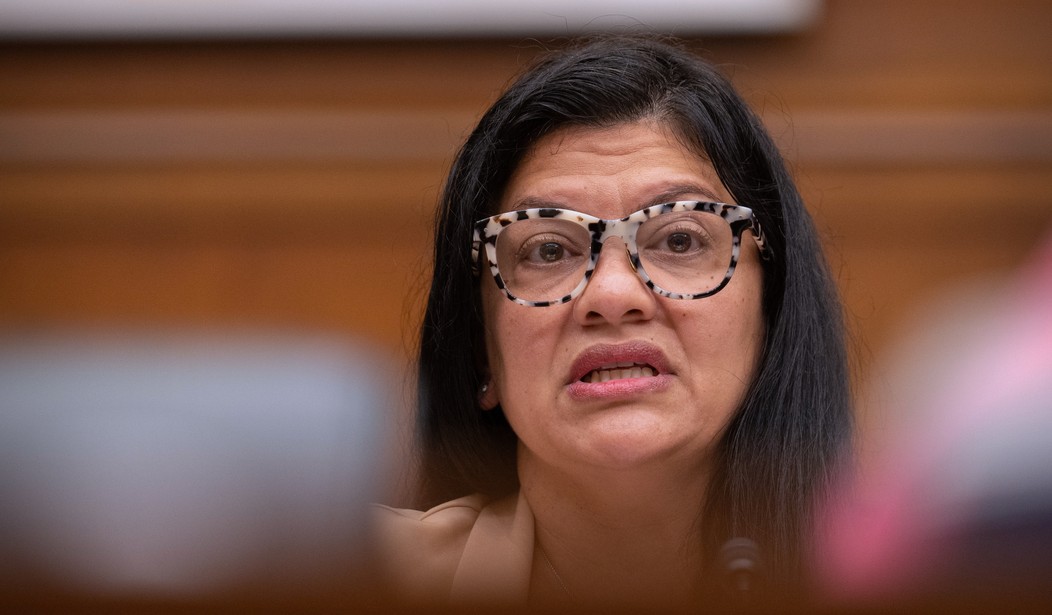
Rep. Rashida Tlaib (D-Mich.) lost another vote Tuesday, yet she still exposed something ugly about the House. A member of Congress can turn foreign policy into a running indictment of Israel, frame America as the enabler, and still sit in the chamber with a microphone, staff budget, and a national platform.
The House rejected Tlaib's updated Lebanon War Powers resolution, a measure aimed at limiting President Donald Trump's ability to use U.S. forces in hostilities in Lebanon without congressional approval. The vote failed again, with 22 Democrats joining nearly all Republicans against it.
Rep. Thomas Massie (R-Ky.) joined the Democrats in the failed measure. Being a long-standing critic of Israel, his decision was completely unsurprising.
Some reports listed the tally differently, but the political point was clear: even many Democrats wanted no part of Tlaib's latest foreign policy crusade. Tlaib represents Michigan's 12th Congressional District. Her office proudly identifies her as Congresswoman Rashida Tlaib of MI-12, and her district includes many people with deep ties to the Middle East.
A representative can speak for those families, mourn civilian suffering, and question military policy. A representative can also do all of those things without turning every crisis into another chance to accuse Israel of historic evil.
Tlaib's own March announcement described Israel's campaign in Lebanon as an “illegal invasion,” accused Israel of “war crimes” and “ethnic cleansing,” and framed U.S. support as the fuel behind it.
The Lebanon War Powers resolution she promoted targeted U.S. involvement in intelligence sharing, targeting assistance, and other support tied to Israeli operations.
Hezbollah, the Iranian-backed terrorist group sitting at the center of Lebanon's nightmare, received far less attention in her perverted moral universe.
House Democratic leaders saw the trap the first time around; House Minority Leader Hakeem Jeffries (D-N.Y.), Democratic Whip Katherine Clark (D-Mass.), and Democratic Caucus Chair Pete Aguilar (D-Calif.) said earlier in June there were no U.S. service members involved in combat operations or hostilities in Lebanon. From Clark's press release:
We stand with the Lebanese people, the government of Lebanon and the Lebanese Armed Forces in their efforts to live peacefully and defeat Hezbollah, a violent terrorist organization that is a sworn enemy of the United States. As demonstrated yesterday, House Democrats are committed to ending Donald Trump’s reckless and costly war of choice in Iran. We also do not support any effort by the Trump administration to entangle the United States in a war in Lebanon or other parts of the Middle East.
Currently, there are no U.S. servicemembers involved in combat operations or hostilities in Lebanon. In our view, the best legislative vehicle to keep U.S. troops out of Lebanon is the War Powers Resolution introduced by Rep. Rashida Tlaib yesterday, with full support and input from Foreign Affairs Committee Ranking Member Gregory Meeks. Accordingly, we will vote No on H.Con.Res.84 and look forward to working with Congressmember Tlaib to support and build consensus for H.Con.Res.108.
They also said they stood with the Lebanese people, the government of Lebanon, and the Lebanese Armed Forces in the effort to defeat Hezbollah.
Rep. Brian Mast (R-Fla.), chairman of the House Foreign Affairs Committee, called the revised measure less ridiculous than Tlaib's earlier version, while still calling it “significantly ridiculous.” From CBS News:
Tensions in southern Lebanon have threatened a final peace deal between the U.S. and Iran. Iran and Hezbollah have demanded the full withdrawal of Israeli forces from the region as part of the deal between Washington and Tehran to end the war. But an agreement signed last week between the Israeli and Lebanese governments to end the fighting in southern Lebanon links Israel's removal of forces from the area with Hezbollah's disarmament. Hezbollah, however, has refused to give up its weapons.
Tlaib said Monday during floor debate that the vote was about "immediately ending all U.S. participation in the Israeli government's violent assault against the people of Lebanon." She accused the Israeli government of carrying out an "ethnic cleansing and territory expansion" through its bombing campaign in southern Lebanon.
Democratic Rep. Gregory Meeks of New York, the ranking member on the House Foreign Affairs Committee, said the updated version "corrected the flaws" of the earlier measure.
"It will not infringe upon America's national security interests in Lebanon, while ensuring we stay out of another forever war that is not in our national interest," he said. "I will state for the record that, to my knowledge, United States forces are not currently engaged in any active hostilities in Lebanon with the Israeli military. Nonetheless, this resolution ensures that does not change without congressional authorization."
Rep. Gregory Meeks (D-N.Y.), ranking member on the same committee, argued the updated version fixed flaws in the first measure while still keeping the U.S. out of another war.
Even in opposition and support, the debate kept circling back to the same reality: Congress was arguing over a war America wasn't fighting on the ground.
Here's the more profound problem.
Tlaib's fury rarely sounds like caution about American war powers; it sounds like a settled hostility toward Israel, dressed up in the language of restraint.
When Israel acts against terrorist networks, she sees oppression; when America supports Israel, she sees complicity; and when Hezbollah hides inside Lebanon's tragedy, she seems eager to move the spotlight elsewhere.
Voters can send nearly anyone to Congress; the Constitution allows plenty of foolishness, plenty of grandstanding, and plenty of bitterness. The harder question is why a major American city and its suburbs keep sending back a lawmaker whose public posture so often looks less like judgment than grievance.
Tlaib's resolution failed, and the Republic survived another performative vote. The cost is still real; every time Congress treats her foreign policy rage as ordinary debate, it lowers the floor a little more. America doesn't need lawmakers who confuse hostility for courage, volume for principle, or contempt for moral seriousness.
The House stopped the resolution. Michigan's 12th District keeps the seat filled. Somewhere between those two facts sits the question voters should have to answer.
PJM readers know the fight over America’s future isn’t slowing down. VIP membership helps keep independent conservative writing alive, and right now you can get a discount with promo code FIGHT.



Join the Conversation
VIP members get the ability to comment on articles.