
Brian Walsh, associate professor of mechanical engineering at Boston University and head of the Space Physics and Technology Lab, has put forward one of the stranger ideas in space defense. His team calls it StormWall, a plan that places six or more spacecraft in geosynchronous orbit, loaded with chemicals such as barium, lithium, sodium, or calcium. From Space.com:
The concept, dubbed StormWall, uses computer simulations to show that reinforcing the magnetosphere could reduce the intensity of a major geomagnetic storm by more than half. If realized, the researchers say the system could protect vulnerable satellites, global communications networks, GPS systems, and electrical grids from potentially catastrophic disruptions.
“People have always thought, 'Space is huge, the sun is massive, we just have to sit here and take whatever it gives us,'” Walsh said in a statement. “But what we found is that we can impact it.”
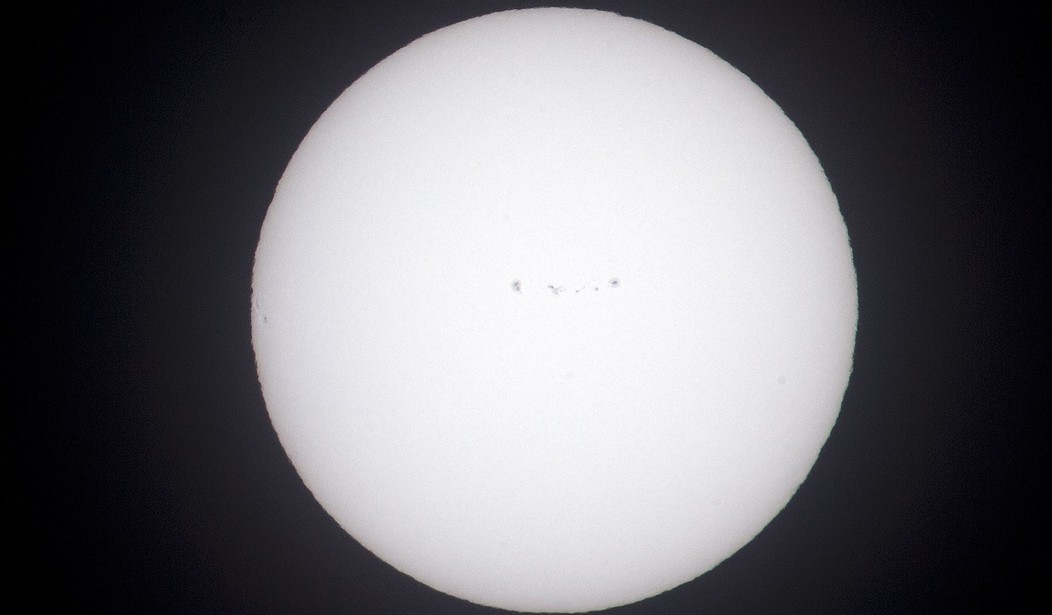
During particularly powerful solar eruptions, Earth's natural shield can be breached through a process called magnetic reconnection. When magnetic fields carried by the solar wind align perfectly with Earth's magnetic field, they temporarily link together. This opens a celestial pathway, allowing massive amounts of solar energy to pour into near-Earth space and trigger geomagnetic storms.
The StormWall concept is designed to interrupt this process. The system would deploy six spacecraft into geosynchronous orbit. Each satellite would carry stores of a “mass-loading ”material”—substances like barium, lithium, sodium, or calcium—that can be stored safely as a solid or liquid and vaporized on command.
When satellites detect a dangerous coronal mass ejection headed toward Earth, operators would release those chemicals into space. Sunlight would turn the material into plasma within minutes, adding mass near the sun-facing edge of Earth's magnetic shield.
Daniel Welling, assistant professor in the University of Michigan Department of Climate and Space Sciences and Engineering and director of the Center for Space Environment Modeling, helped run the simulation work. Zhenguang Huang, associate research scientist in the University of Michigan's space weather applications group, also contributed to the modeling.
Their paper argues that added plasma could slow magnetic reconnection, the process that lets solar wind pour energy into Earth's magnetic field and drive severe geomagnetic storms.
StormWall sounds like science fiction, but the basic physics draw from known space behavior. Earth already leaks some atmospheric particles into the outer magnetosphere. Walsh and his colleagues want to turn up that natural process at the right moment.
In a simulation based on the May 2024 Gannon storm, StormWall reduced the auroral electrojet index by more than 84% and cut cross-polar cap potential by 61%. The paper also projects that a much stronger storm could lose at least 50% of its punch under the right conditions.
The obvious benchmark is the 1859 Carrington Event, named for British astronomer Richard Carrington. Telegraph lines sparked, some operators received shocks, and auroras reached low latitudes, including places closer to the tropics than most Americans would expect. From History.com:
Many telegraph lines across North America were rendered inoperable on the night of August 28 as the first of two successive solar storms struck. E.W. Culgan, a telegraph manager in Pittsburgh, reported that the resulting currents flowing through the wires were so powerful that platinum contacts were in danger of melting and “streams of fire” were pouring forth from the circuits.
In Washington, D.C., telegraph operator Frederick W. Royce was severely shocked as his forehead grazed a ground wire. According to a witness, an arc of fire jumped from Royce’s head to the telegraphic equipment. Some telegraph stations that used chemicals to mark sheets reported that powerful surges caused telegraph paper to combust.
On the morning of September 2, the magnetic mayhem resulting from the second storm created even more chaos for telegraph operators. When American Telegraph Company employees arrived at their Boston office at 8 a.m., they discovered it was impossible to transmit or receive dispatches. The atmosphere was so charged, however, that operators made an incredible discovery: They could unplug their batteries and still transmit messages to Portland, Maine, at 30- to 90-second intervals using only the auroral current.
Messages still couldn’t be sent as seamlessly as under normal conditions, but it was a useful workaround. By 10 a.m. the magnetic disturbance abated enough that stations reconnected their batteries, but transmissions were still affected for the rest of the morning.
The world of 1859 ran on horses, lamps, rails, paper ledgers, and a thin nervous system of telegraph wires. In 2026, power grids, satellites, GPS, aviation, banking, farming, and hospitals all depend on electronics that a major geomagnetic storm could punish in a single day.
A modern Carrington-scale event wouldn't look like a bad thunderstorm; it could damage high-voltage transformers, disrupt satellites, scramble navigation, ground flights, and leave entire regions fighting blackouts for weeks or months.
Lloyd's has estimated a severe solar storm could produce enormous global losses. Older North American grid risk estimates put possible U.S. economic damage from a major solar storm in the hundreds of billions to trillions of dollars. From Lloyd's:
The global economic losses are modeled across three severity levels, ranging from $1.2 trillion in the least severe scenario to $9.1 trillion in the most extreme, equivalent to a reduction in global GDP of between 0.2% and 1.4%.
North America is identified as the region likely to be most financially impacted by the scenario, suffering a potential economic loss of $755 billion over the modeled five year period. However, the gap between the impact on North America and Europe is relatively small, with Europe calculated to take a $697 billion hit to GDP. Greater China and Asia Pacific have modeled impacts of $428 billion and $375 billion, respectively.
If this event happened today, it could cause damage to critical infrastructure such as energy grids and satellite networks, and disrupt power, navigation, communications, and financial systems that are relied upon daily by businesses, governments, and populations globally.
StormWall wouldn't stop a Carrington-class storm; even the paper's best-case scenario points to reduction, not immunity.
To me, it reminds me of the old Bill Cosby routine where he had things he would try when faced with death: jumping in a plummeting elevator just before it crashes into the sub-basement or sticking a finger in the barrel of a gun pointed at you moments before the other person pulled the trigger.
What do you have to lose?
A 50% cut could still leave a dangerous storm, yet reducing force by half could decide whether a grid bends or breaks. Think of a seatbelt in a crash; it doesn't repeal physics, but it gives us meat sacks a better chance of survival.
The risk sits in the unknowns. The simulation used a real 2024 storm, then scaled the idea toward larger events. Engineers still need to prove that released plasma can spread fast enough, cover enough of the magnetopause, and arrive before the worst solar wind hits.
Operators would have only hours at most to act once a major coronal mass ejection lines up with Earth.
Side effects need sober testing. The added plasma would likely clear from the magnetosphere in less than a day as solar wind sweeps it away. During that window, extra particles could trigger electromagnetic waves, including whistler and magnetosonic waves. Those waves might scatter high-energy particles trapped in the radiation belts. In some cases, scattering could reduce danger to satellites and astronauts. In other cases, nature may write a bill engineers didn't expect.
The larger political question may prove harder than the engineering: who gives the order to release chemicals into near-Earth space? Which country pays for the fleet? Who accepts blame if a release protects one region while satellites elsewhere suffer damage?
Space weather doesn't respect borders, and neither would a defense system parked above the equator.
StormWall deserves study because the sun doesn't care how modern people feel about risk. America can harden transformers, improve forecasting, shield satellites, and still need a last line of defense when the next great storm arrives.
Carrington-level storms may be rare, but rare doesn't mean imaginary. The telegraph age got a warning in sparks and fire. The digital age shouldn't wait for the same lesson in darkness.