





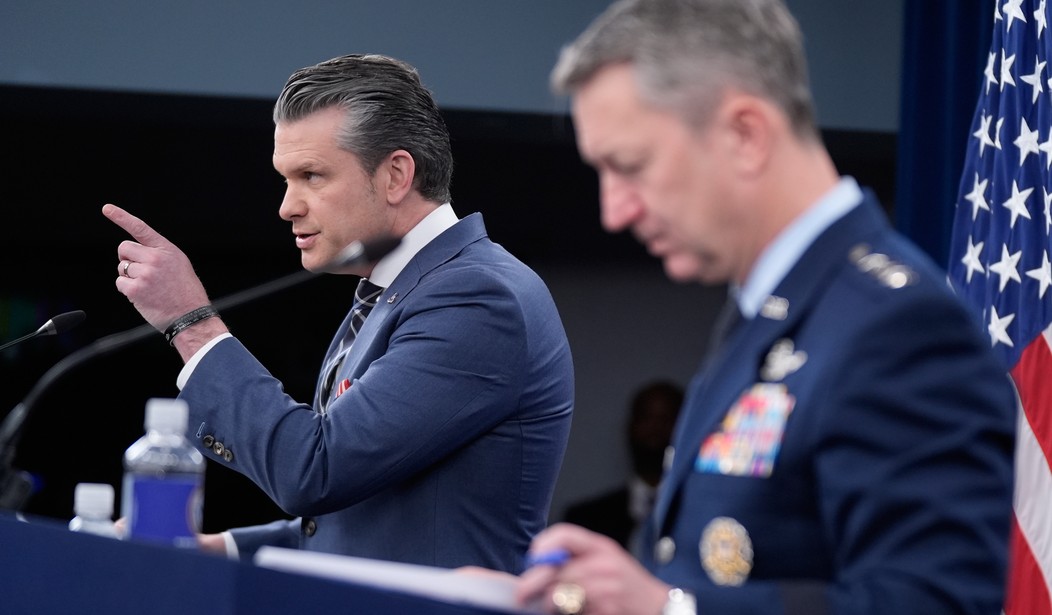
Defense Secretary Pete Hegseth asked Army Chief of Staff Gen. Randy George to step down and immediately retire. As the Pentagon's top civilian leader, Hegseth wants a command structure that aligns with the direction he shares with President Donald Trump.
One of the sources said Hegseth wants someone in the role who will implement President Trump and Hegseth's vision for the Army.
A senior Defense Department official told CBS News, "We are grateful for his service, but it was time for a leadership change in the Army."
George built a long military career after graduating from West Point and serving as an infantry officer. He deployed during the Gulf War and later served in Iraq and Afghanistan. He worked as a senior military assistant to former Defense Secretary Lloyd Austin from 2021 to 2022, then moved into the role of vice chief before taking over as Army chief of staff in 2023 after nomination by President Joe Biden. Or, more accurately, whoever was president that day. His term was set to run through 2027, which makes his departure's timing stand out.
The move fits a broader pattern; Hegseth has already removed over a dozen senior officers, including former Joint Chiefs Chairman Gen. C.Q. Brown Jr., Chief of Naval Operations Adm. Lisa Franchetti, Air Force Vice Chief of Staff Gen. James Slife, and Defense Intelligence Agency Director Lt. Gen. Jeffrey Kruse. Officials have offered little detail beyond a need for alignment with current priorities, a pattern that doesn't look random, just deliberate.
Speculation centers on whether Hegseth is clearing out officers tied to Biden's administration. George's connection to Austin places him in that category, a position the current leadership may hold. No formal explanation goes beyond the stated goal of aligning the Army with new priorities, an absence that leaves observers to try to connect the dots.
Gen. Christopher LaNeve now stands as the likely successor. LaNeve previously served as Hegseth's military aide and commanded the 82nd Airborne Division from 2022 to 2023. The Army hasn't confirmed a replacement yet, but internal signals point toward LaNeve as the front-runner, which would place someone close to Hegseth at the top of the Army's chain of command.
Hegseth quickly moved on to other Army matters as well; he reversed the suspension of aircrew who flew near musician Kid Rock's home in Nashville, posting on X that the pilots wouldn't face punishment or investigation.
Thank you @KidRock.@USArmy pilots suspension LIFTED.
— Pete Hegseth (@PeteHegseth) March 31, 2026
No punishment. No investigation.
Carry on, patriots. 🇺🇸 https://t.co/Zqhv1Zx1iG
Officials confirmed that the decision had no connection to George's removal. The leadership change stands on its own as part of a larger effort to reshape the Pentagon.
George visited the U.S. Military Academy at West Point just days before the announcement. The academy shared images of him speaking with cadets preparing to enter service.
This decision might be an attempt to have leadership that's fully aligned with current priorities. One negative of the move may be that the rapid turnover at the top might introduce uncertainty at a time when our military faces pressure from China and Russia. Not to mention the kinetic action against Iran.
The broader question centers on how far the restructuring will go. Hegseth has already blocked promotions and sidelined officers he viewed as out of step.
George's retirement places a four-star Army chief on that list and signals that even the highest ranks are subject to review. The official explanation stays brief and measured, but with each move, it becomes easier to see the broader picture.
The Army continues to push modernization efforts focused on high-intensity conflict, adapting to drone warfare and evolving threats. Leadership plays a central role in how quickly those changes take hold, and Hegseth appears willing to trade continuity for alignment, betting that a new command structure will move faster and operate more effectively under the current worldview.
George leaves with decades of service and a record spanning many conflicts and senior roles. The Pentagon moves forward with a different leadership structure, one reflecting a clear shift rather than just a routine transition.
It's going to be interesting to see what comes next, not just who fills the open position, but how far changes will extend and what they produce across the force.
If you want coverage that cuts through speculation and focuses on what decisions like this actually signal inside the Pentagon, PJ Media VIP delivers that level of analysis. Join today and take 60% off with promo code FIGHT.


Join the Conversation
VIP members get the ability to comment on articles.