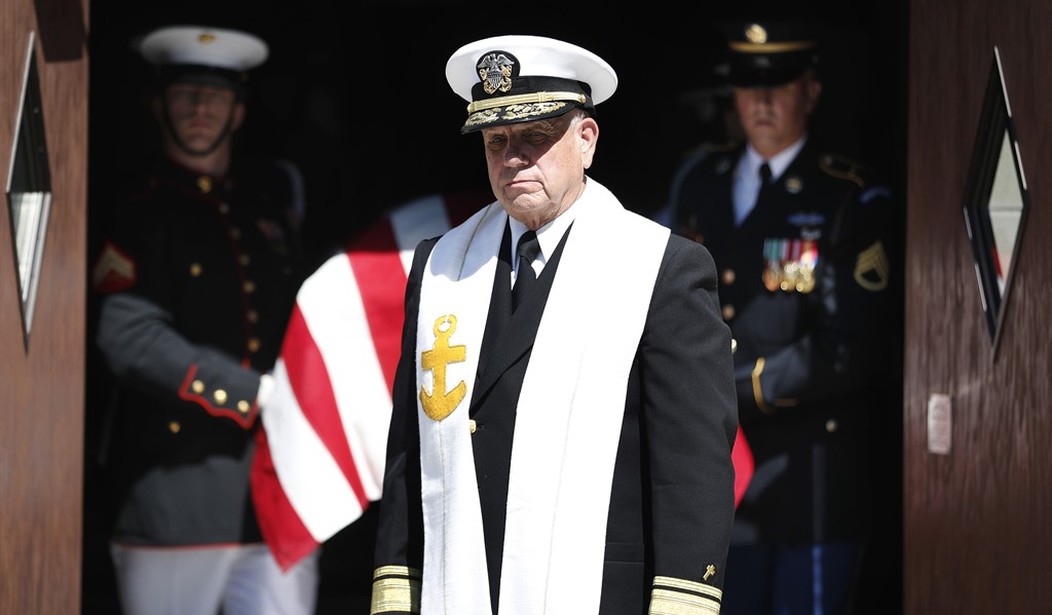

Defense Secretary Pete Hegseth directed military chaplains to remove rank insignia from their uniforms. The order applies across the Air Force, Army, and Navy. Chaplains keep their commissions as officers, but they now display only the insignia that marks their faith tradition.
Hegseth announced the change in a video on March 24, framing it as a way to put spiritual calling ahead of military hierarchy.
There’s a straightforward reason behind the move: junior officers and enlisted service members may hesitate when they need help but see a senior officer across the desk. A set of bars or stars carries weight, even in a counseling setting. Hegseth’s approach aims to strip that barrier away and make it easier for troops to speak openly about addiction, family strain, or struggles with faith.
The policy also reduces the number of recognized faith codes from over 200 down to 31. Officials say the change better reflects the beliefs most service members actually practice and removes clutter from a system that had grown too broad.
Chaplains have held a place in the military since the beginning, when Congress authorized the first chaplain in 1775 and assigned one to each regiment.
The U.S. military’s chaplaincy dates back to July 29, 1775, when the Continental Congress authorized one chaplain for each regiment in the Continental Army, and pay equal to that that of a captain, according to the U.S. Army Historical Foundation. Since then, chaplains have served on the front lines of every war and are often a key resource for troops coping with loss and personal problems, including deaths caused by accidents, suicide, and combat losses.
Chaplains also advise commanders and are part of a command’s leadership team. For Murray, removing the rank could prove to be a step backwards in terms of the input chaplains have on individual commands.
From that point forward, chaplains have stood with troops through every major conflict, offering guidance in moments that don’t neatly fit inside a chain of command.
Retired leaders see the issue from a different angle. Steven Schaick spent 35 years in uniform and rose from lieutenant to major general. He has said rank never kept airmen from seeking counsel.
“I only had 35 years as a chaplain—I started out as a lieutenant, and I ended up as a major general—and I did not ever notice that my rank was prohibiting people from approaching me,” Schaick told Air & Space Forces Magazine. “I found young Airmen intrigued to be able to talk to a major general.”
Chaplains traditionally wear their religious insignia on one side and their rank on the other. Schaick suggested that for some Airmen and Guardians, the more daunting insignia might have been the cross he wore on Active duty: It can be “as much of a hindrance as the rank, because non-religious people just don’t have a lot of reason to talk to a chaplain and that’s kind of been my experience.”
In some cases, younger troops felt drawn to speak with a senior chaplain. He also noted that religious insignia itself can create hesitation for those who don’t share the same beliefs, sometimes more than rank ever did.
Hegseth also stressed that the Pentagon is “not even close to being done” in taking steps toward “restoring the esteemed position of chaplain as moral anchors of the fighting force.”
Service members’ spiritual health “is equally important” as their physical and mental health, Hegseth said, complaining that previous administrations infected the Chaplain Corps with “political correctness and secular humanism,” changing and watering down the role’s core functions “until they were viewed by many as nothing more than therapists.”
“A warfighter needs more than a coping mechanism,” he said. “They need truth, big-T truth, they need conviction, they need a shepherd.”
Gerald Murray supports strengthening the chaplain’s spiritual mission, but he raised a concern about credibility inside the military structure.
Former Chief Master Sergeant of the Air Force Gerald Murray applauded Hegseth’s focus spirituality, saying it is important to the well-being of service members. But he disagreed with ordering chaplains to hide their rank.
“The identity of rank among the chaplains and the officership of chaplains gives credibility to a chaplain within the military organization,” Murray said.
Rank carries authority, signaling where someone stands within the system and granting access to senior leadership. Murray warned that removing visible rank could limit a chaplain’s ability to sit in on high-level discussions where decisions affect the well-being of troops.
Both arguments carry weight. Pride and perception shape how people seek help. Some service members may hold back if they believe they’re speaking to someone far above them in rank, while others value that authority and see it as a sign that the chaplain understands the pressures of command.
Chaplains operate in environments where stress runs high and time runs short. They sit with troops after loss, during deployments, and through personal crises that don’t pause for rank or protocol. They train as officers and earn each promotion along the way. Those insignia represent years of service and experience within the same system they support.
The change leaves that structure in place but removes part of its visible signal. Chaplains still advise commanders, follow military customs, and carry the responsibilities of their commissions. The difference now shows up in what others see at first glance.
The question moving forward is practical: Will more service members step forward and seek help? If the absence of rank lowers hesitation, the policy could improve access in ways that show up day to day. If it limits a chaplain’s influence within the command structure, leaders may face new challenges.
No one can predict the outcome with certainty. The policy shifts how chaplains present themselves, but it doesn’t change the core of what they do. They remain a steady presence for those who need guidance in moments that test both strength and belief.
The balance between access and authority sits at the center of the debate. Hegseth chose to test that balance in a new way. The military will see how it plays out among the people who rely on chaplains when the pressure is real and the need is immediate.