





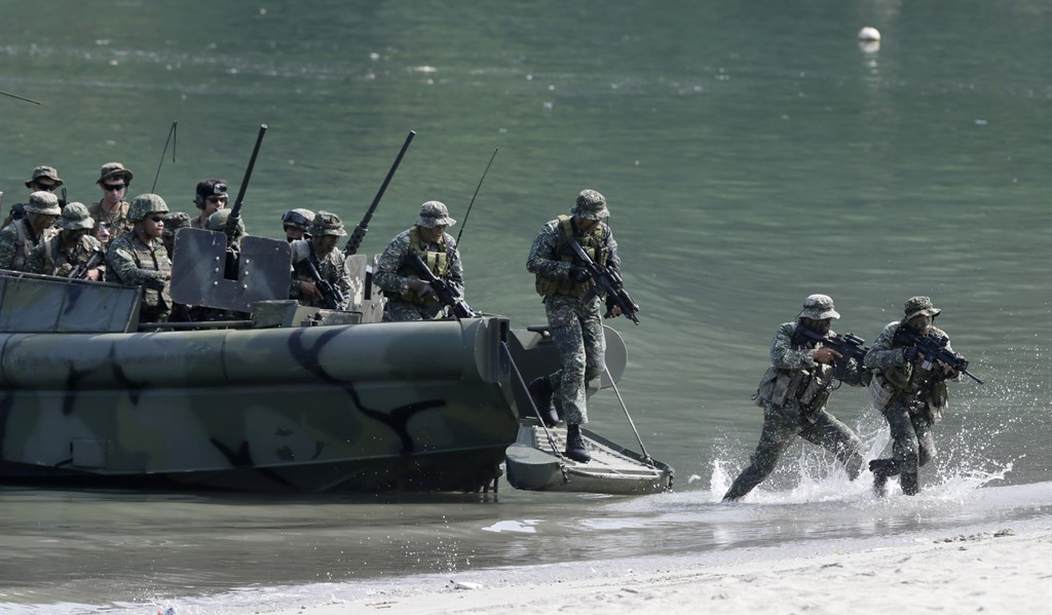
Two thousand Marines arrived aboard the USS Tripoli (LHA-7) in the Arabian Sea, adding real weight to American operations in Operation Epic Fury.
U.S. Sailors and Marines aboard USS Tripoli (LHA 7) arrived in the U.S. Central Command area of responsibility, March 27. The America-class amphibious assault ship serves as the flagship for the Tripoli Amphibious Ready Group / 31st Marine Expeditionary Unit composed of about… pic.twitter.com/JFWiPBbkd2
— U.S. Central Command (@CENTCOM) March 28, 2026
The ship serves as the flagship for the Tripoli Amphibious Ready Group and carries the 31st Marine Expeditionary Unit (MEU) based out of Okinawa, Japan. Secretary of War Pete Hegseth approved the deployment, placing a flexible, fast-response force within striking distance of key waterways.
The force includes the America-class amphibious assault ship USS Tripoli and amphibious transport dock ship USS New Orleans. The group’s arrival brings 3,500 sailors and Marines into the region, 2,200 of whom are from the MEU. Of those Marines in the expeditionary unit, 1,200 are ground combat forces. The newly arrived ships are also carrying several aircraft, including Marine Corps F-35B strike fighters.
The arrival comes amid Iranian actions in and around the Strait of Hormuz that have continued to threaten shipping lanes carrying roughly 20% of the world's oil supply. That choke point affects everything from global markets to the price families pay at the pump.
The Tripoli group changes how commanders can respond: Marines can launch raids, secure key maritime routes, or support air operations from a mobile base that doesn't rely on fixed land positions.
A second amphibious ready group carrying Marines is also inbound. The USS Boxer and its supporting ships left San Diego on March 18, carrying roughly 2,500 Marines from the 11th Marine Expeditionary Unit. Additionally, elements of the Army’s 82nd Airborne Division will deploy to the Middle East, bringing at least 1,000 soldiers.
This isn't about starting a new, extended ground war; it's about expanding choices. President Donald Trump built his campaign around avoiding endless conflicts, and voters backed that approach.
Leftist media and Democrats, pardon the redundancy, have already lined up to claim the deployment breaks that promise, an argument that ignores the situation. Iran escalated by constantly threatening critical shipping lanes and increasing regional instability; the United States didn't create this conflict, it responded to it.
The difference shows in how these Marines are being used. They aren't deployed for occupation or long-term nation-building; they're positioned to act quickly, apply pressure, and give decision-makers more control over outcomes.
That kind of presence shortens conflicts when correctly used; it doesn't extend them.
The Tripoli carries more than Marines; it brings F-35B stealth fighters, MV-22 Ospreys, and amphibious assault capabilities that allow forces to move without relying on established bases. That flexibility in a region where conditions quickly shift becomes critical. It provides commanders with options that range from targeted strikes to securing critical infrastructure without committing large ground forces.
Sailors and Marines aboard the Tripoli trained for exactly this kind of mission. They completed live-fire exercises and amphibious operations before moving into the region.
The 31st MEU recently participated in Iron Fist, an annual exercise the U.S. Marine Corps conducts with Japan. Before the drills in the Japanese islands, the 31st MEU “achieved full certification” in February, according to a U.S. Indo-Pacific Command news release issued this week.
Their arrival adds another layer to existing carrier groups, creating a broader, more adaptable presence.
Our far-left loons continue to frame any show of strength as a step towards another prolonged conflict, an argument that misses the point.
Strength, when applied with clear limits, prevents situations from getting worse. It raises the cost for adversaries who might otherwise push further. Iran's leadership now faces a different calculation.
The economic stakes aren't abstract. When the Strait of Hormuz faces disruption, energy prices shift, affecting transportation, food costs, and heating bills across the country. Securing that route protects more than shipping lanes; it protects everyday stability at home.
The Marines on the Tripoli represent a controlled response to a real threat, allowing leaders to act without overcommitting. That balance reflects the approach voters supported, avoiding unnecessary expansion while still addressing the problem in front of it.
The arrival of the Tripoli doesn't signal a new war; it signals readiness, telling our allies that the United States remains committed and engaged, while informing Iran that further escalation carries consequences.
Those options mentioned earlier? They just became a lot more serious.
If you’re looking for clear, direct analysis that doesn’t get lost in spin or watered-down language, PJ Media VIP is where that conversation happens. You’ll get deeper coverage on stories like this, along with insight that cuts through the noise and focuses on what actually matters.
Use promo code FIGHT to get 60% off and join here.


Join the Conversation
VIP members get the ability to comment on articles.