





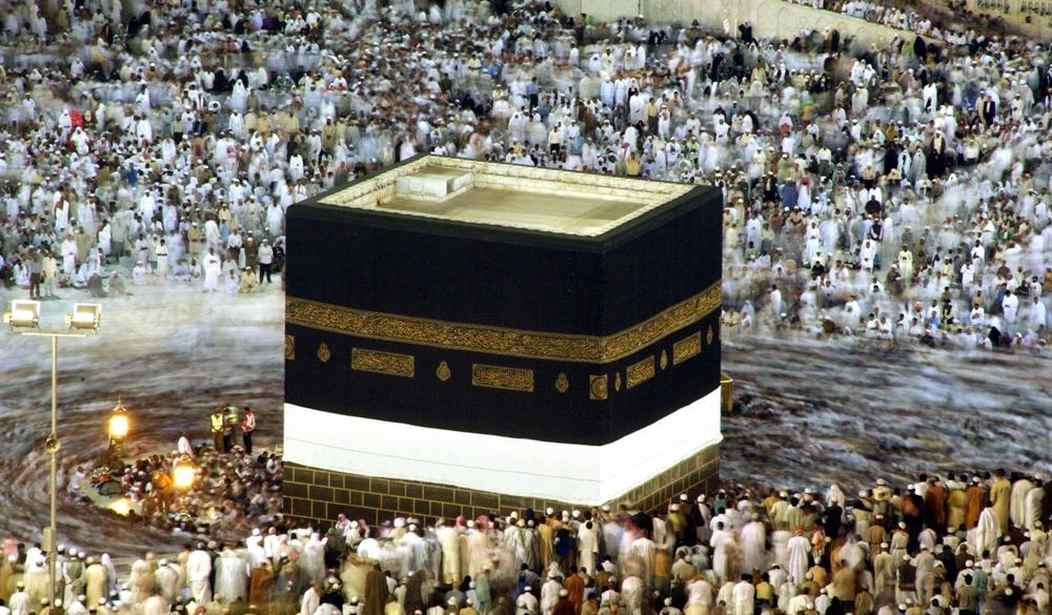
Many Muslim countries today are rich due to an accident of geology: the discovery of oil. But before the world ran on internal combustion engines, what made the great Islamic societies wealthy and powerful? The answer is darker than the black gold that enriches many of them now.
The Qur’an commands Muslims to fight even the “people of the book” (that is, Jews, Christians, and a few other groups): “Fight against those who do not believe in Allah or the last day, and do not forbid what Allah and his messenger have forbidden, and do not follow the religion of truth, even if they are among the people of the book, until they pay the jizya [a head tax] with willing submission and feel themselves subdued.” (Qur’an 9:29) The subjugated people were known as dhimmis, protected people, in the Mafia sense of paying protection.
Muhammad’s second successor as spiritual, political and military leader of the Muslim community, Umar ibn al-Khattab, told the Muslims to be sure to collect the jizya, for the Muslims depended upon it: “I advise you to fulfill Allah’s Convention (made with the Dhimmis) as it is the convention of your Prophet and the source of the livelihood of your dependents (i.e. the taxes from the Dhimmis.)”
This advice has been heeded throughout Islamic history. Islam teaches no work ethic, as The Tragedy of Islam: Failure and Excuses explains in detail. It was characteristic not only of Arabs but of Muslims in general to find manual labor distasteful, and even to consider work to be a curse, something that slaves and non-Muslims ought to do, but that the Muslims, “the best of peoples” (Qur’an 3:110) should try to avoid.
The ideal Islamic state thus has Muslims living on the backs of non-Muslims, while discriminating against the non-Muslims so severely that the host cannot indefinitely continue to support the parasite. And so Islamic states inevitably go into decline and have to wage more jihad to find more non-Muslims to support them.
This can be seen clearly in the rise and decline of one of the most successful Islamic states in history, the Ottoman Empire. The last Islamic caliphate, the Ottoman Empire was once the world's most fearsome power — but it depended upon the jizya. By the middle of the sixteenth century, when the Ottoman Empire was at its height and was striking terror in the hearts of Christians all over Europe, the tax on Jews and Christians was its largest revenue source.
This was the period during which the empire was at its political height: steadily expanding into Eastern Europe while threatening Central and Western Europe as well, and at the same time becoming a formidable naval power. The sultan Suleiman the Magnificent conquered Belgrade in 1521 and Rhodes the following year. In 1529, he besieged Vienna, but had to withdraw, not because Ottoman forces had been bested on the battlefield, but because his supply lines were stretched to the breaking point. He did, however, take Algiers that year, and Tripoli in 1551.
However, taxes have consequences, and high taxes can have catastrophic ones. In the Ottoman Empire, the parasite killed its hosts: the empire grew great on the confiscated wealth of the subjugated Jews and Christians, but once the Jewish and Christian communities were bled dry and impoverished, the great empire went into an irreversible decline. By the seventeenth century, the jizya was no longer the empire’s principal source of income.
Related: Grateful Migrant Repays His Hosts in Barcelona
Why did the jizya decline in importance? The answer is simple: one cannot get blood from a stone. The laws of the dhimma required that Islam’s supremacy be constantly maintained. While individual Jews and even some Christians were able to attain great positions of power and influence and amass great wealth, for the most part their communities were gradually and steadily impoverished as they continued to pay the jizya year after year, while facing, as subject people, reduced earning possibilities.
The Ottoman Empire was thus caught in a downward spiral that had a precise and specific cause: Islam. Its teachings about how Allah blessed and rewarded warfare and conquest to expand the domains that his divine law ruled had provided the impetus for the empire’s growth and expansion. Once it was established, however, Islam offered no worldview that could sustain it other than further growth, for the empire depended upon the taxes that the subject people paid into the treasury.
As The Tragedy of Islam shows, the self-serving and short-sighted rulers of modern Europe, ignorant of and indifferent to these historical facts, are busy setting the stage for this history, from the conquest to the subjugation to the taxation, and the concomitant Islamic imperial growth and then decline, to repeat itself. None of this had to be repeated. But the left would not be deterred from its mission of destroying the West’s Judeo-Christian foundation.
Forsake the lies, embrace the truth: Become a PJ Media VIP today — you'll get all the content and none of the ads. Use code FIGHT for 60% off.


Join the Conversation
VIP members get the ability to comment on articles.