
Now, it's the new year. It would be kind of cheesy to come up with an AI version of "Auld Lang Syne" here.
And worse, I couldn't find one.
The stars aren't moving. WE'RE moving.
Locking the camera to the stars instead of the horizon changes everything.
— Curiosity (@MAstronomers) January 1, 2026
It’s actually kind of terrifying to see the Earth spinning beneath us like this. 🌍🌌pic.twitter.com/yGEKZa6orK
As usual, Andrew McCarthy gets a lovely shot in. I swear I should charge him.
Here's my final image of the year- a detailed true color portrait of The Great Orion Nebula. Visible to the naked eye to the entire world during winter months, this is a gorgeous target for astronomers of all skill levels.
— Andrew McCarthy (@AJamesMcCarthy) December 31, 2025
Happy new year! pic.twitter.com/049ZaOmkaW
On target.
We're ending 2025 right on target! 🎯
— Hubble (@NASAHubble) December 31, 2025
The Bullseye Galaxy is about 2.5 times the size of our Milky Way, and has nine rings — six more than any other known galaxy: https://t.co/XUFzFXBx5I
And now it has the distinction of being our X audience's favorite 2025 Hubble image! ⬇️ pic.twitter.com/jem9dqZdzq
I think I may have done this one before, but it's gorgeous, so what the hell.
A little cosmic sparkle for 2026!
— NASA Ames (@NASAAmes) December 31, 2025
This glimpse of Westerlund 1, a super star cluster in our galaxy was captured by @NASAWebb.
It’s made up of stars between 50,000 and 100,000 times the mass of our Sun, all packed within a region less than six light-years across.
This cluster… pic.twitter.com/13djc3QBgh
I look at these pictures, think back to Astronomy 101 in 1975, and can't imagine this is another galaxy.
📷 This NASA/ESA @HUBBLE_space Telescope image shows the N159 star-forming complex in the Large Magellanic Cloud, a dwarf galaxy that is the largest of the small galaxies that orbit our Milky Way.
— European Space Agency (@esa) December 29, 2025
🔗 https://t.co/YzqaxBvE9N pic.twitter.com/QhdbHobaQv
And this is a whole bunch of galaxies.
There's glitter on the floor after the party 🍾
— NASA Marshall (@NASA_Marshall) January 1, 2026
Celebrate the new year with this @chandraxray image of the “Champagne Cluster."
This galaxy cluster was named for the date it was discovered - Dec. 31, 2020 - and its bubble-like appearance.
READ MORE: https://t.co/HHAEBJ2YKD pic.twitter.com/2K9Ehm56JP
Okay, this is just one galaxy. But from the inside.
The Milky Way from the Himalayas pic.twitter.com/3whlRPWEO4
— Night Sky Today (@NightSkyToday) January 1, 2026
This one seems unbelievable, but Grok insists it's real.
Northern lights 🌌🌃✨💫 #purenature pic.twitter.com/a1h6oFa6nf
— Pure Nature (@purenature_1) December 28, 2025
Nice neighborhood.
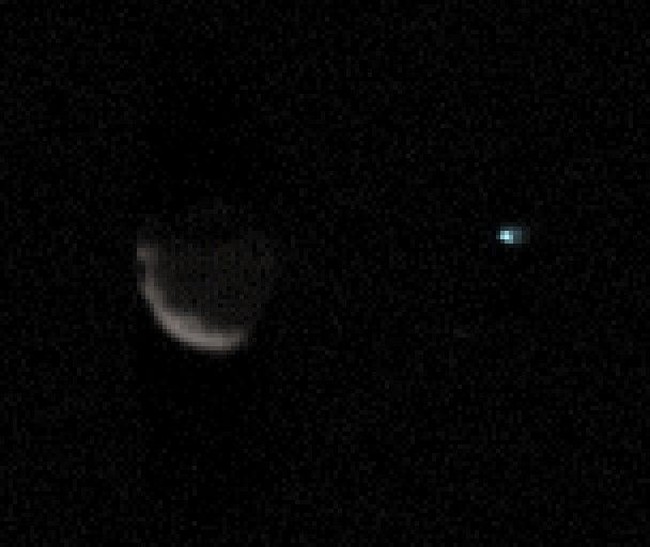
So cool. If you zoom in on the upper right, you see a little crescent. That's the Martian moon Phobos.
— Corey S. Powell (@coreyspowell) December 31, 2025
Zoom in again and you'll see a star next to Phobos. That's Earth!
Seen from Mars by NASA's Curiosity rover.https://t.co/OJ1TjvkU3C pic.twitter.com/TCPJGcXPeN
Here's a close-up. See the blue dot? That's us. Say "cheese."
Nice views.
Swiftly flow the days: As we approach the end of one year and the beginning of another on Earth, the Curiosity rover paused to send a postcard from Mars. The image combines one panorama taken after sunrise and another taken before sunset. pic.twitter.com/Zgvp7UQIsi
— NASA Mars (@NASAMars) December 30, 2025
Very quiet neighbors.
Shocking that this somehow goes under the radar (as always) but by far the biggest space news of 2025 is that Mars most likely had or has life. That is now the mainstream simplest interpretation of the evidence.
— Ken Kirtland IV (@KenKirtland17) January 1, 2026
Not talked about enough! pic.twitter.com/oTfBPLiXpQ
And in closing...
— i like food (@messedupfoods) January 1, 2026
And that's Sky Candy — not Space Candy, no matter what you've heard — for this week. As always, I love comments. Look for more Sky Candy next week.