
“This day is called the feast of Crispian.” Today, Sunday, October 25, is the feast day of two ancient Christian martyrs whose feast day is now irrevocably connected to a medieval battle and the English-language theater.
Like Mark Antony, the 15th-century King Henry V of England is most famous in the English-speaking world for a speech written by another man years after his death. It was a speech that William Shakespeare, the playwright, particularly centered around a Christian feast day.
And it is rather interesting that the saints on whose feast Henry won his decisive victory over the French were most famous for evangelizing in Gaul, what we now call France.
Angelus News provides the following short biography for the ancient martyrs honored on October 25:
Sts. Crispin and Crispinian [or Crispian] were twins and martyrs in Rome in the third century. Together, they worked to bring the Word of God to Gaul, preaching in the streets of Soissons during the day, and making shoes at night. The brothers were known for their charity and piety, and many were converted through their example and their renunciation of worldly possessions.
In 286, Crispin and Crispinian were arrested under the rule of Emperor Maximian Herculeus. They were tortured, and eventually beheaded for their faith.
Crispin and Crispian truly lived out the Gospel commands to charity in their lives, to spreading the gospel, and to suffering courageously for their faith. They gave everything for Christ. That is why they have inspired Christians for more than a millennium. Among those inspired by the martyrs was William Shakespeare, who penned a speech for one of his historical heroes centered around the “feast of Crispian.”
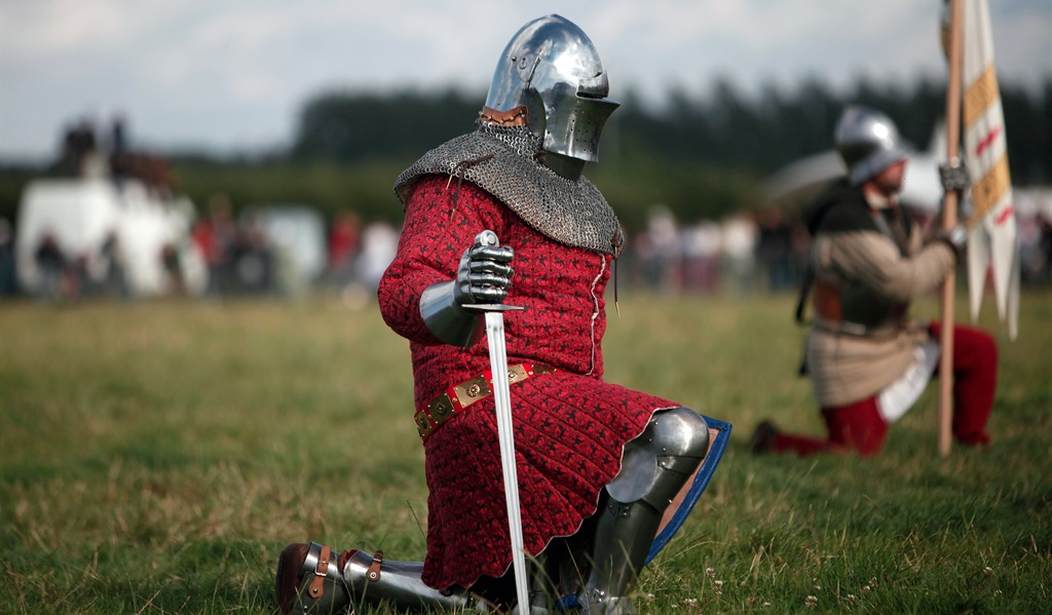
Before it was a scene in a Shakespearean play, the Battle of Agincourt was a real historical event — on Oct. 25, 1415, Henry V of England and his army faced off against the French to decide whether Henry would be named heir to the French crown.
Read Also: Disney’s Dumbo Turns 85: How the Film Saved a Studio and Fought Prejudice
At that time, rulers and peasants alike acknowledged the importance of asking saints to intercede with God for them, in line with the heavenly intercession described in the book of Tobit (12:12) and Revelation (8:3-4), and the admonishment of James to pray for one another because of the power a just man’s prayers have (5:16). The Shepherd of Hermas in the first century and Clement of Alexandria, born in the second century, both referred to the intercession of saints and angels. Therefore, it is not surprising to find that Shakespeare’s sources indicated the English army at Agincourt believed Crispin and Crispian were helping them.
After all, the odds against the English in terms of troop numbers were anywhere between two-to-one and five-to-one, according to Britannica. Had it not been for the English longbows with their far range and Henry’s maneuvering on the terrain, the French would almost certainly have carried the day. At the end of the battle, the English had lost only about 400 men while the French had lost about 6,000. In other words, what should have been a fairly easy French victory turned into a brutal French defeat. Henry V carried his point of becoming an heir to the French throne and married the French king‘s daughter Catherine, with whom he had Henry VI.
Naturally, Shakespeare and many other Englishmen were very proud of Agincourt. When Shakespeare wrote his play Henry V, he made Agincourt the great climax. Below is Kenneth Branagh’s exceptional portrayal of Henry V in the famous Crispin’s Day Speech, which you can also read in full here.May this Crispin’s Day be a day of blessings for you and your families.