







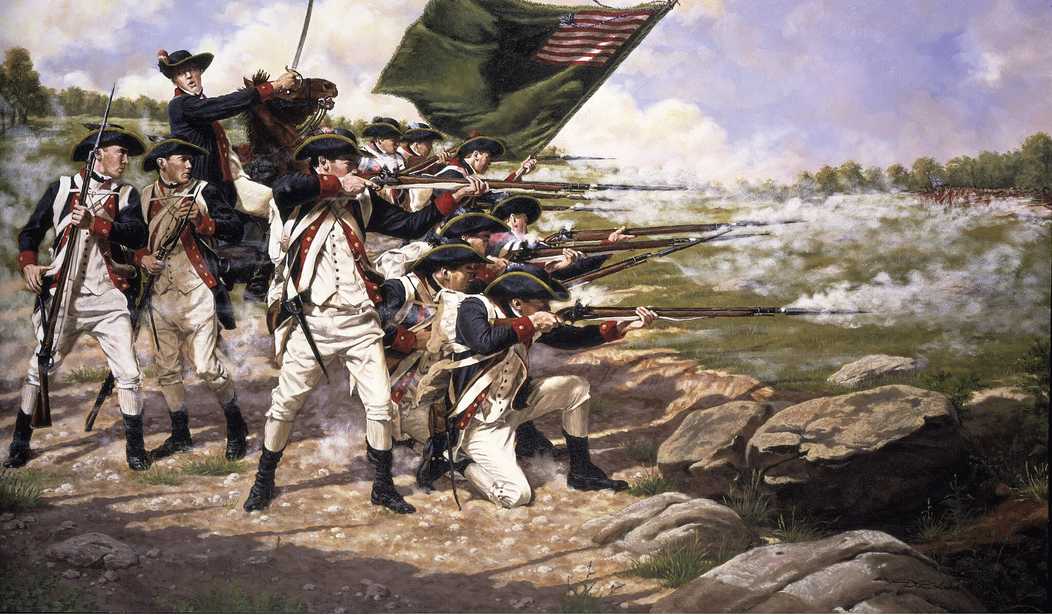
It was the Patriots versus the Raiders, and I’m not talking about football. Small-time pirates were terrorizing Patriot civilians in the area of Long Island that summer and fall of 1779, and the Continental Army finally came to the rescue of the victims.
When George Washington appointed Major Benjamin Tallmadge as director of military intelligence in 1778, Tallmadge created the famous Culper Spy Ring that kept the Army informed of British movements in New York. But besides being a clever spymaster, Tallmadge could also be a successful officer in the field. His surprise attack on a group of Loyalist raiders Sept. 5, 1779, was an example of him combining secretive preparations with battlefield daring.
Historian Tara Ross explains the background of the counter-raid, that while there were incidents of Patriots sometimes attacking Loyalists, the Loyalists were particularly active in stealing and destroying. Indeed, Loyalists were often especially vindictive toward Patriots, because the American Revolution was a civil war also, and the colonists who wanted to remain English subjects were virulently opposed to the independence movement. Ross says whale-boating crews were adept at rushing into a shallow area, striking the land target quickly, and slipping away again in a hurry. There had also been official British raids into Connecticut.
The Patriot counter-raid was supposed to be part of a larger operation to capture Fort Franklin, because that British fort was protecting the whale-boating pirates. Gen. Washington wanted to capture that fort on a strategic part of Lloyd's Neck on Long Island Sound. By the way, in case you're wondering, the fort took its name from Ben Franklin's son, who was a Loyalist politician. The Revolution had many such split families — it really was a civil war.
New York native Tallmadge knew he had to deal with the Loyalist raiders first, however, before he could possibly take on the fort. He wrote the commander-in-chief that the Loyalists "conduct most villainously towards the Inhabitants of Long Island, by lying on the Roads & robbing the Inhabitants as they pass... [They] land on L. Island & plunder the Inhabitants promiscuously.” Washington was not deaf to this plea.
Ross explains that Washington wanted Tallmadge to attack Loyalist encampments, and then, he hoped, launch a surprise attack on the fort. Ultimately, only the first half of the operation would succeed, but even that much was very important for surrounding Patriot enclaves.
Read Also: ‘Like Spiderman’: Man Dives in Drive-Thru Window to Stop Stick-Wielding Wacko
Late on September 5, Tallmadge took around 130 men and launched his attack from Connecticut, crossing the Long Island Sound to land at Lloyd's Neck. He and his men were so stealthy that the "large band of marauders" in the Loyalist encampment had no idea the Patriots were there until the attackers were right on top of them, according to Ross.
“Our attack was so sudden and unexpected,” Tallmadge wrote, “that we succeeded in capturing almost the whole party—a few only escaping into the bushes, from whence they commenced firing on my detachment, which gave the alarm to the garrison.”
Tallmadge had unfortunately lost his opportunity for a surprise attack on Fort Franklin, but he did burn the Loyalist encampment, destroy the boats they'd used for their raiding expeditions, and make it safely back to Connecticut with his Loyalist prisoners. Tallmadge and his men had, at least temporarily, crushed the Loyalist raiding threat to local Patriots.
Editor's Note: President Trump is fighting to renew America in this 250th birthday year.
Help us fight back against anti-American propaganda and foreign invasion. Join PJ Media VIP and use promo code FIGHT to receive 60% off your membership.



Join the Conversation
VIP members get the ability to comment on articles.