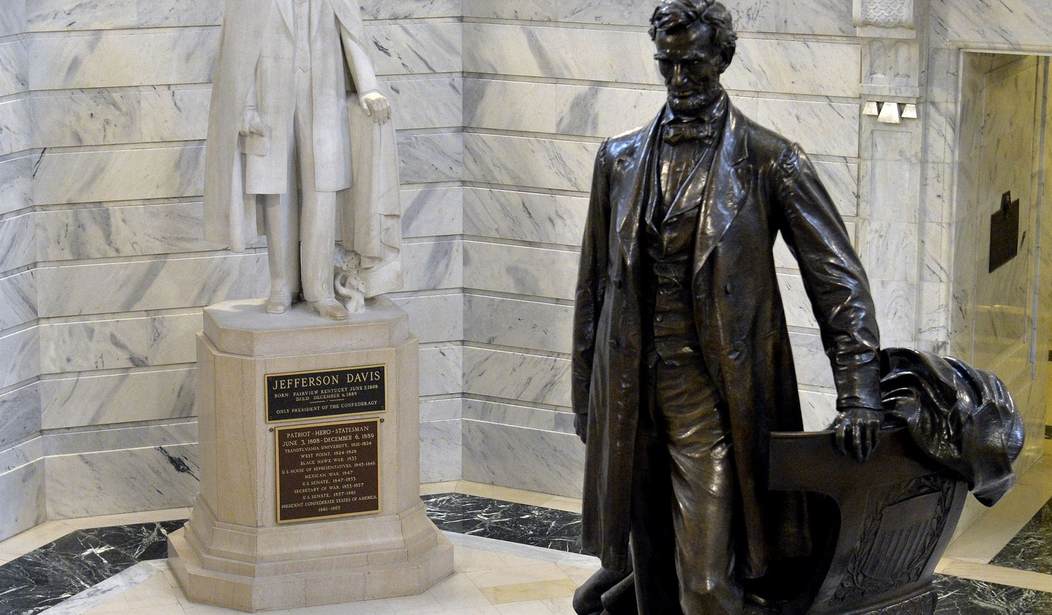
On Jan. 1, 1863, President Abraham Lincoln issued one of the most important documents in U.S. history: the Emancipation Proclamation. “Everyone seemed to feel a new sort of exhilarating life,” said John Hay, Abraham Lincoln’s personal secretary, describing Unionists’ reaction to the Proclamation. "The President’s proclamation had freed them as well as the slaves."
The Democrats/Confederates had always been loud and proud about their fanatical devotion to slavery and its role in triggering their rebellion after the election of Republican Abraham Lincoln. But more than a year into the Civil War, the Republicans and Unionists were beginning to admit what they had not all at first acknowledged — namely, the war was about slavery, and until and unless slavery were abolished, America would self-destruct. We could not survive as a nation whose founding documents proclaimed liberty as a God-given right to every man while simultaneously enslaving thousands of men, women, and children because of their race. Lincoln knew the war effort had to change, and his answer was the Emancipation Proclamation.
In September of 1862, Lincoln promised to free all slaves in states that remained in rebellion as of the new year. While the word "slave" never appears in the Constitution — a reality that had been a source of satisfaction to abolitionist Founders — there was debate as to whether the president had the constitutional authority to free slaves in non-rebel states, hence the limits of the Emancipation Proclamation. Lincoln would later pour himself into the effort to pass the 13th Amendment abolishing slavery finally and forever, as the magnificent movie Lincoln documented. But Lincoln was not the only Civil War leader to issue an 1862 proclamation.
Confederate President Jefferson Davis, in December 1862, issued a proclamation that has been largely buried, because it exposes the cruelty and moral bankruptcy of the Confederate cause. Amid exaggerated and outright false accusations against the Union, Davis made it crystal clear that the Civil War was about not only slavery. He ordered that "all n[*]gro slaves captured in arms be at once delivered over to the executive authorities of the respective States to which they belong to be dealt with according to the laws of said States [i.e., enslavement or execution]. That the like orders be executed in all cases with respect to all commissioned officers of the United States when found serving in company with armed slaves in insurrection against the authorities of the different States of this Confederacy."
Read Also: The Only Canine Coast Guard NCO and His WWII Deeds of Daring
This proclamation was later formalized into law by the Confederate Congress as the Retaliatory Act, which called for the execution of white Union officers leading Black troops and the enslavement or execution of captured Black soldiers. That act was the 1863 response to the Emancipation Proclamation, and it explicitly said it was a reaction to the Union effort to "overthrow the institution of African slavery."
In practice, the Confederate Army treated every black Union soldier — and even many black civilians — it encountered as "slaves in revolt." The free black population of Pennsylvania was devastated by the Confederate military enslavers under Gen. Robert E. Lee, who enforced the Retaliatory Act. U.S. Grant reportedly stopped prisoner exchanges in disgust at the act's enforcement. The culmination of the racial hatred was the Fort Pillow Massacre, when Gen. Nathan Bedford Forrest, later the KKK founder, slaughtered hundreds of surrendering black and white Union soldiers and bragged of it afterwards, to the plaudits of his fellow Confederates.
This is the backdrop of the Emancipation Proclamation. It is the forgotten history that some Americans were never taught, and that others willfully deny or rewrite. No wonder Lincoln's words rang throughout America and the world that New Year's Day 157 years ago:
I do order and declare that all persons held as slaves within said designated States [in rebellion], and parts of States, are, and henceforward shall be free; and that the Executive government of the United States, including the military and naval authorities thereof, will recognize and maintain the freedom of said persons... And I further declare and make known, that such persons of suitable condition, will be received into the armed service of the United States to garrison forts, positions, stations, and other places, and to man vessels of all sorts in said service.
And upon this act, sincerely believed to be an act of justice, warranted by the Constitution, upon military necessity, I invoke the considerate judgment of mankind, and the gracious favor of Almighty God.
It was the first step toward the full civil rights that all Americans should have had from the founding of our nation, but which evil men had reserved to a select few. As we begin this year, the anniversary of America's independence, we should reflect not only on the Founding generation that won freedom first, but all the heroes since who fought and died to realize the Founding vision in its full glory.