





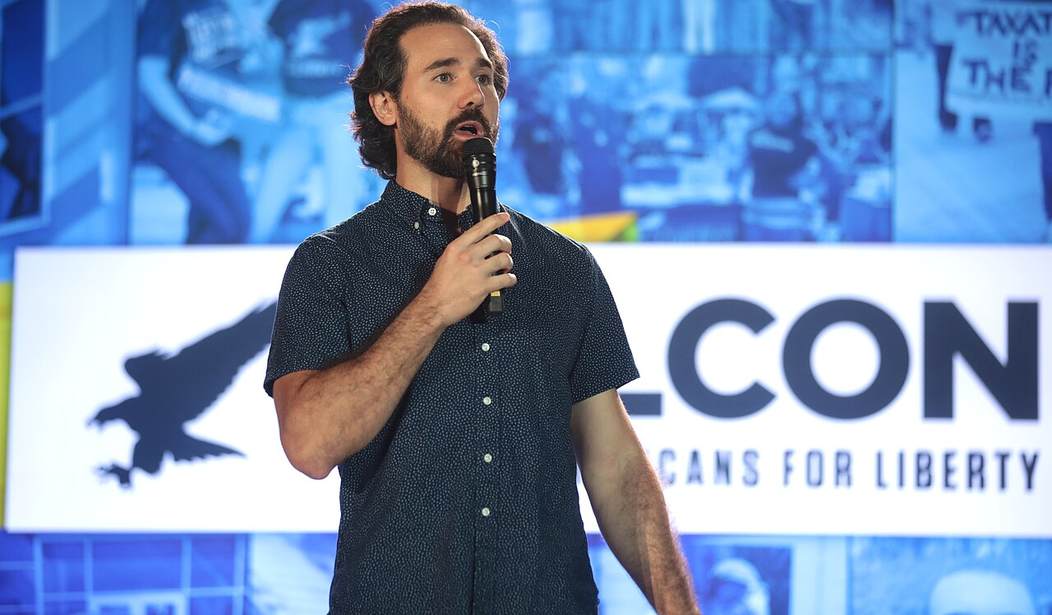
It's increasingly become one of those questions that gets asked when a new member joins the society of common sense and logic, a.k.a. the political right.
"What radicalized you?"
As though every deeply held conviction begins with anger instead of experience. But ask enough people who have grown skeptical of where our culture is headed, and most can point to a moment when something changed. A moment when they stopped assuming freedom was permanent and started realizing it survives only if people are willing to defend it. For comedian Lou Perez, that moment came on January 7, 2015.
On a recent episode of Dangerous Laughter with AJ Rice, Perez reflects on the terrorist attack against the French satirical magazine Charlie Hebdo, where twelve people were murdered for drawing cartoons. It wasn't simply an attack on a publication. It was an attack on the idea that no belief, no institution, and no ideology should ever be beyond criticism or satire.
What has happened in the aftermath over the next decade may have been even more revealing. Rather than standing shoulder to shoulder behind the principle of free expression, much of the conversation shifted toward whether the cartoonists or others that share in their spirit of satire had gone too far. The victims started to find themselves on the wrong side of the mainstream’s debate. Cartoons and social media posts became the controversy. The simple principle that bad ideas should be answered with better ideas, not bullets or the power of the state, suddenly became negotiable.
Listening to Perez recount that moment, it's easy to understand why it became a turning point. Perez, who might best be described as a good-natured free speech jihadist, has spent years arguing that comedy isn't merely entertainment. It is one of the last places where society can still tell uncomfortable truths without asking permission. Those themes run throughout his conversation with AJ Rice and are explored further in his outstanding book, That Joke Isn't Funny Anymore: On the Death and Rebirth of Comedy.
The interview isn't really about stand-up comedy. It's about courage. George Carlin understood that. So did Lenny Bruce. Neither built a legacy by telling safe jokes. They challenged conventions, mocked the powerful, and refused to accept that certain ideas should be placed beyond criticism simply because someone declared them sacred.
Comedy has always been civilization's pressure valve. It exposes hypocrisy faster than a policy paper and dismantles pomposity more effectively than a political speech. That's precisely why authoritarian movements have always feared comedians. The powerful can tolerate criticism. They have a much harder time surviving ridicule.
That reality makes today's cultural climate impossible to ignore. Every year the list of forbidden topics seems to grow. Comedians are expected to navigate an ever-changing maze of approved language and acceptable targets. Social media outrage has become an industry unto itself, complete with online mobs eager to demand apologies, de-platforming, or professional ruin over a joke taken out of context.
The effect isn't simply fewer laughs. It's less honesty. Listening to Perez, one uncomfortable question lingers long after the interview ends. What if Charlie Hebdo wasn't just a terrorist attack? What if it was also a warning?
Imagine a society where artists quietly decide certain subjects are no longer worth touching. Imagine comedians instinctively censoring themselves before they ever step onto a stage. Imagine publishers declining books because controversy has become bad for business. Imagine citizens deciding it's safer to stay silent than risk losing a job, a platform, or a reputation. Now imagine that happening so gradually that most people barely notice.
Now come to the realization that we are already there.
Freedom is rarely confiscated in one dramatic moment. More often, it's negotiated away through a series of small compromises. One canceled performance. One controversial speaker. One social media account removed. One joke deemed too offensive. One exception becomes another until self-censorship no longer feels like surrender. It simply feels normal.
Looking across parts of Europe, it's hard not to wonder where those compromises ultimately lead. Debates over speech, religion, immigration, and national identity have become increasingly contentious as feckless European leadership has led to an attack on traditional culture via mass migration by people who have been raised in societies that discourage free speech. In several countries, governments have taken a more active role in regulating expression, even going so far as to arrest citizens over benign social media posts, raising difficult questions about where the line between maintaining public order and limiting free speech should be drawn.
It starts with arresting people over criticizing unrestrained migration by individuals from incompatible societies and then slides down a slippery slope to where a harmless joke posted online could bring an unexpected visit from armed authorities. Western democracies have become so afraid of giving offense that they quietly abandon the very freedoms that once distinguished them.
It isn’t dystopian fiction; it’s modern Western Europe.
History rarely announces itself while it's happening. Perez never argues that the answer is anger. He certainly doesn't argue for violence. Because we aren't the side that does that.
The answer is something far more powerful: refusing to surrender the principles that made free societies possible in the first place. The freedom to laugh. The freedom to offend. The freedom to question authority. The freedom to ridicule bad ideas without fearing that someone, somewhere, will decide the joke itself has become unacceptable.
That's why conversations like this resonate well beyond comedy clubs.
It's about recognizing that censorship almost never arrives wearing a uniform. More often, it arrives wrapped in good intentions, justified as safety, tolerance, civility, or protecting people from harm. It advances by inches instead of miles, until one day people struggle to remember what they were once free to say without asking permission.
Lou Perez reminds us that comedians have always been among society's earliest warning systems. They notice absurdity before everyone else. They challenge consensus before it's fashionable. They ask uncomfortable questions while the rest of us are still pretending there aren't any.
Perhaps that's why comedy remains one of the last honest art forms. The joke isn't the threat. The willingness to silence it is.
Editor's Note: Do you enjoy PJ Media's conservative reporting that takes on the radical left and woke media? Support our work so that we can continue to bring you the truth.
Join PJ Media VIP and use promo code FIGHT to receive 60% off your membership.
Join the Conversation
VIP members get the ability to comment on articles.