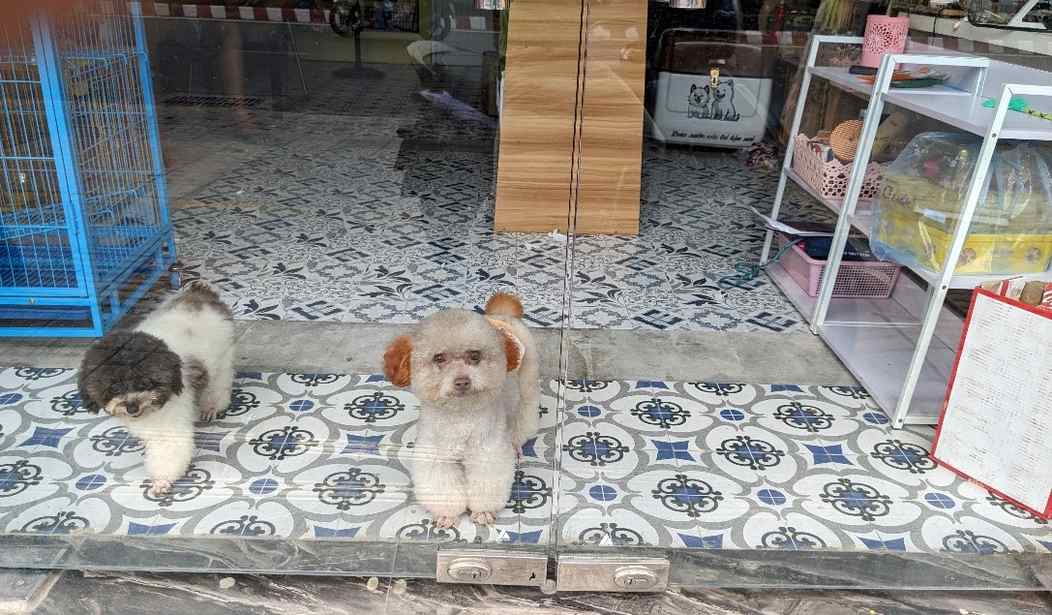

The Southeast Asian, but particularly the Vietnamese, relationship with man’s best friend is, to put it mildly, confusing to the Western mind.
Recently, an exceedingly friendly Vietnamese guy, whose accommodations my wife and I rented for a time in the middle of nowhere about an hour outside of Saigon, had a pair of beautiful golden retrievers.
On the one hand, these animals were always groomed to the hilt with shiny fur, very evidently well-fed and cared for.
On the other hand, they remained day and night cooped up in this relatively tiny pen; I never saw them let out to exercise their legs except for once. The landowner, by all appearances, who has a huge property and nice cars, had the resources to build some kind of enclosure for them.
Why did he not?
You’d have to ask him.
(Not that it would prove a fruitful exercise, why being a pointless question in this part of the world, a lesson I learned and relearned repeatedly, which is a recurring theme in my memoir.)
Related: My Gold-Standard Expat Memoir: Back and Better Than Ever With the Second Edition
Again, the guy clearly put a lot of effort into his dogs’ appearances, so I have to surmise it’s not out of malice or neglect.
Another regional peculiarity is that the Vietnamese have a peculiar affinity for dying their toy dogs’ hair all shades of neon, for some reason that will likely forever remain elusive to me.
I snapped this photo of a Lhasa Apso (or whatever it is) as an exhibit.
 And, of course, the elephant in the room: Dog meat is still commonly sold alongside beef and chicken in markets across Vietnam, most particularly in the north of the country.
Via Animals Asia (emphasis added):
Every year across parts of Asia, millions of dogs and cats are stolen and sold into the cat and dog meat trades. Many are beloved companions, taken from family homes. Others are gentle strays – used to human kindness – snatched from the streets. All face terrifying journeys and brutal deaths in unregulated markets and roadside slaughterhouses.
Crushed into wire cages, often stacked on top of each other, the animals are denied food, water and rest. Many die from heat, shock or injury before they reach their destination. Those who survive often face being killed in extremely cruel ways that are designed to enhance the tenderness of the meat.
Related: Existential Angst in 'Nam (50 Years Late)
When I lived there, a market I went to regularly in Lao Cai, Vietnam, right on the border with China, regularly had very identifiable dog body parts like paws on display for sale.
Poachers will sometimes nab family pets from the yard; I heard such accounts firsthand from victims. Unlike in Thailand, it’s quite rare to see stray dogs on the streets, presumably because they get caught up in the dragnet.
Once, I was riding my motorbike down the street and stumbled upon a dog barbecue right on the roadside in the middle of Lao Cai. I took a picture, which is pretty graphic and which I won’t share here.
When I taught English in Vietnam, I would sometimes ask my high school students in my gifted English class — the ones capable of having a conversation of that type — their thoughts on dog meat.
The universal consensus, without fail, was revulsion. As I had seen myself, the dog-eating appears to be much more of an older person's tradition.
It’s possible there are a few reasons for that.
For one thing, I was a white Westerner asking students worldly enough to understand foreign norms. Asians, being notoriously polite and interested in saving face, probably would be inclined to hide their dog-eating proclivities even if they had them.
The truer reason, though, I believe, is the influence of the West, and therefore the importation of some Western liberal values, on Vietnamese culture, primarily through pop culture.
So maybe Hollywood’s good for something, after all.