



Irene a real threat from Carolinas to Maine — especially in NYC
It’s time for folks in New York City — and more broadly from the Delmarva to Cape Cod — to recognize that a hurricane with genuine potential to produce severe devastation is mere days away. (In North Carolina, it’s closer to hours away; bad weather will begin early Friday. But I think folks there already know that.)
It’s still not at all clear exactly where in the northeast Irene will go. (Here’s a video from The Weather Channel presenting the different scenarios, and another video explaining the steering factors that will determine which scenario happens.) But for everyone in the threat zone, and most especially for folks in the highly vulnerable Big Apple, the time to prepare is now. That includes being prepared to leave, at least if you’re in a low-lying coastal area and/or evacuation zone. You need to be ready to potentially leave town as early as Thursday night or Friday morning, when I expect evacuations will begin if the track forecast doesn’t decisively shift eastward in the next 24 hours. (Side note: Although the storm would not hit until Sunday, with no serious adverse impacts likely until Saturday night at the earliest, I predict the New York Stock Exchange will be closed on Friday, barring such a track shift, in order to facilitate evacuations and begin clearing out Lower Manhattan. You heard it here first.)
It’s also time for NYC’s local officials to stop pretending that a Category 1 hurricane strike is the “worst-case scenario” for their city. That sort of false reassurance, masquerading as a warning, is deeply unhelpful. The simple fact is, most people aren’t going to be scared, still less spurred to action, by the words “Category 1 hurricane.” Of course, I wouldn’t advocate unnecessarily scaring people if a potential Cat. 1 was truly all we were dealing with — but it’s not. It’s been clear all day today that something far worse, while perhaps still unlikely, is very much within the realm of realistic possibility for New York City… and that’s only become clearer this evening. Take a look at the latest prediction by the GFS model, the most reliable and accurate American computer model in existence:
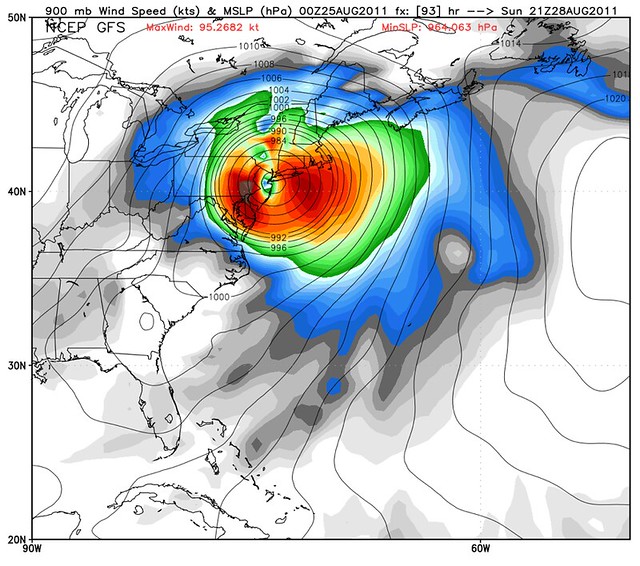
Holy hell. That map is downright terrifying. (It’s even worse when viewed as an animation. Hat tip: Ryan Maue.) It represents something pretty darn close to the true worst-case scenario, the New York nightmare that experts have feared for years — a Category 2 hurricane, perhaps even a low-end Cat. 3, making landfall in New Jersey, and pushing a severe storm surge into New York harbor, with devastating effects.
I emphasize again that this is just one possible scenario among several, and probably not even the most likely. But such scenarios are always unlikely, right up until the point when they’re about to happen — at which point it’s too late to prepare for them! So everyone needs to prepare as if they’re going to suffer a direct hit, and not just by a minimal hurricane, but by a monster. (And if that preparation proves, in retrospect, to have been unnecessary, breathe a sigh of relief and know that you were right to prepare for the worst, not blithely assume the best.)
What I just said applies to everyone in the threat zone — basically, the entire East Coast from the Carolinas to Maine, though what proper “preparations” mean will vary greatly based on local conditions — but my focus here is on Gotham. That’s not because New York is the most likely landfall target (the most recent GFS run notwithstanding, Long Island and Cape Cod are at least as likely, and of course Cape Hatteras is the most likely, and will experience Irene first), nor because New Yorkers are intrinsically more important than anyone else. Rather, I’m focusing on New York simply because it — like New Orleans, Miami and a handful of other American cities — is unusually vulnerable to hurricane devastation, and also unusually unprepared for it. Quoting from the Wall Street Journal last year:
To learn about New York City’s last direct hit from a severe storm, you’d need to look all the way back to 1893, when a so-called “West Indian Cyclone” carried sailing ships to Sixth Avenue, created a river on Canal Street that briefly connected the East River and the Hudson, swept much of Coney Island into the sea and entirely destroyed a barrier beach called Hog Island that once lay south of the Rockaways in Queens.
When–not if, say experts–it happens again, a storm will find both New York and Long Island far more populated than the last time. In the city, a hurricane’s storm surge would cause sudden, extensive flooding, submerging much of Lower Manhattan and crippling the subway system and tunnels.
The powerful winds would uproot thousands of trees, down power lines and send debris flying in all corners of the city. And those winds could shatter windows on skyscrapers, especially in the taller buildings that would bear the brunt of powerful gusts that occur at higher elevations. The canyons of Manhattan could magnify the winds, and would be a deadly place for anyone caught beneath the raining glass.
Flooding may be more extensive in Brooklyn and Queens, and not just in Brighton Beach and the Rockaways. The city’s official map of hurricane evacuation zones warns that JFK and LaGuardia would see serious flooding in even a Category 2 storm; a Category 3 could send several hundred thousand residents from Dyker Heights and Canarsie, East New York and Laurelton in search of higher ground. So would people living in Mott Haven and Hunts Point in the Bronx, in East Harlem, and in coastal parts of Staten Island. …
In the most dire projections, a direct hit on New York City could cost upwards of $100 billion.
More from the International Business Times:
The single biggest effect New York City would see from a major hurricane is the storm surge. This is the term for water pushed toward the shore by high winds, and it can rise many feet above sea level and inundate entire neighborhoods. In the New England Hurricane of 1938, the storm surge from the East River flooded three blocks of Manhattan, even though the center of the hurricane was many miles away, pummeling eastern Long Island. The Norfolk and Long Island Hurricane of 1821 made landfall in the city itself — in Jamaica Bay, Queens — and the 13-foot surge inundated more than a mile of Manhattan from Battery Park to Canal Street. …
New York Harbor is narrow, which means that water rushing northward from the storm surge, with nowhere to go, would build up very high — as high as 30 feet, or the third floor of some buildings, according to past warnings from the city’s Office of Emergency Management. According to an evacuation map posted on the city’s official Web site, aside from Lower Manhattan, many low-lying parts of the other four boroughs would also be at risk, including LaGuardia Airport and J.F.K. Airport, which are located right by Flushing Bay and Jamaica Bay, respectively. All of this would be compounded if the storm surge happened at high tide. …
Every New Yorker has seen how messy subway stations get in heavy rain: dirty puddles form on the platforms, water streams from openings in the ceiling onto the tracks, and trains are frequently delayed. Now imagine even heavier rain, plus a storm surge that sent water from the rivers and harbors crashing into the stations through the stairwells, ceilings and tunnels. It would not even take a worst-case scenario to bring the entire New York City public transportation system to a standstill. In the short term, this would eliminate any chance of last-minute evacuations; in the long term, it could extend the economic damage of a hurricane even beyond when office buildings reopened. If the subways were flooded with saltwater rather than just rainwater, the salt “would corrode the switches and cripple the system for months or years, and disable much of the communications infrastructure in Lower Manhattan,” the Wall Street Journal reported in 2010 based on an interview with Nicholas Coch, a coastal geology professor at Queens College. …
Residents don’t necessarily understand “how many days and weeks after a hurricane that their lives will be completely changed,” Scott Mandia, a physical sciences professor at Suffolk County Community College on Long Island, told National Geographic News in 2006. “People who live away from the water think a hurricane will mean one day away from work, then back to normal. There will be an economic shutdown for a few weeks, if not a month.” He was referring to the impact of a hurricane on Long Island, but the impact on the Financial District would be even worse. A big storm surge could paralyze that part of the city for weeks, depending how severe the flooding was, how quickly the water receded and how much infrastructural damage it left behind, and the consequences of that would be far greater than just lost wages.
If it isn’t already obvious from reading that, it’s long past time for New Yorkers to drop any misconceptions that their city is somehow invulnerable to a crippling hurricane strike. While I emphasize again that it’s still possible that Irene will veer off to the east, or will spend too much time over land before hitting NYC and/or be too weak to cause devastation — hurricane forecasting is an uncertain business — the threat of a severe impact is very real. This is no mere hypestorm.
For those who remember me from Katrina, I’ll say that the “Get the Hell Out!” moment hasn’t arrived yet. But if we get to tomorrow night and things haven’t changed in the forecast… it may.
For now, Irene is still churning through the Bahamas. The mighty storm is going through an eyewall replacement cycle right now, preventing further strengthening — in fact, truth be told, she’s probably a bit weaker (temporarily) than the 120 mph sustained winds that the National Hurricane Center is officially listing — but once that cycle is complete, Irene is likely to pick up steam. She’s forecast to become a Category 4 hurricane tomorrow. She’ll weaken again before landfall, but the longer she stays as a Cat. 3 or Cat. 4, the bigger the storm surge she’ll push out ahead of her, worsening the eventual impact wherever she hits.
Bottom line, this is no time for complacency. Thursday is the last day for preparations before things will begin to get frantic. If you’re in the threat area, take advantage of it. That goes for folks in the local media as well: in an eerie similarity to Katrina six years ago, we’re coming up on the lazy final weekend in August; come Friday, many people will start tuning out the news if they don’t already know they need to pay attention. So tomorrow is the day to really drive home serious and genuine this threat is. No hype, no nonsense, just the God’s honest truth — that Irene is a serious threat to be reckoned with.





You are crazy if you think they are going to shut down the exchange on Friday. I am not saying they shouldnt but there is no way they will.
Maybe Im wrong. But I think Bloomberg Cuomo will place some calls and make it happen, if forecasts continue to look dire. Friday is a day for preparation evacuation, not business as usual. Saturday, or even Friday night, its too late to start; too many people in harms way. Big decisions tonight.
Brendan,
1) Could you point me to where you note the worst threat is from winds and storm surge? I think winds is the NE quad and Storm Surge is the NW quad, but I dont trust my memory.
2) High tides for NYC (Brooklyn Bridge) are SUN 2:10AM, 2:20PM, MON 2:56AM, 3:11PM. What time is projected for landfall (understanding that it is highly variable at this point, but for many who remember Gloria, it hit at low tide which minimized the impact of the surge).
3) How does the forward speed compare to Gloria – which was a fast moving storm. There, obviously, is a difference between a storm that sprints through your neighborhood (I remember going out in the eye of Gloria) and one that sits overhead for a while.
Thanks!
-John (NW New Jersey, in the mountains – but family on Long Island NY)
My mom was married in NYC the week before the 1938 hurricane hit NYC and then took out New England. (Mom is from the Brockton, MA area.) So she remembers. The ferries to NJ were washed up into the streets of NY. Some sales clerks drowned in the basement of their department store in Providence when downtown was flooded. (Get out of your below ground apartments, New Yorkers.)
I grew up in the 50s experiencing hurricanes on Cape Cod just about every year before we went back to school in September. Went out and watched the eye go over on one.
Wont waste space here describing trying to get home from Cape Cod and having the Merritt Parkway and Wilbur Cross closed.
Hate to sound like one of those back in my day … folks — but the people born after the 50s living in the northeast have no idea what might get them.
I think the deal on a couple was they hit at high tide.
Sorry Brendan, the times I gave in the prior comment are for LOW tides. HIGH tides are SUN 8:31AM and 8:40PM.
-John
Anyone else looking forward to New Yorkers begging for help from flyover country after decades of sneering at us?
I was working in New York in 1985 (if I recall correctly) when Hurricane Gloria crossed the middle of Long Island as a Category 2 storm. I worked for the rapid transit system, and I spent the day in our command center monitoring events as the hurricane hit. We had 70 MPH+ winds in downtown Brooklyn, but no severe or widespread flooding. In fact, it was rather anticlimactic, after the New York Post headline Glorias Evil Eye! and such (the eye was supposed to pass over Manhattan, but literally at the last minute the hurricane veered to the east. They do that).
So, while I acknowledge the need for preparations, I think your predictions of utter devastation are a bit over the top.
Could this be Mayor Bloombergs Katrina? For sure hell be peeved at all the salt in the water. All snark aside, though, this could be ugly.
Not a chance the exchange will shut down – thats silly talk.
Also, per Rita and Ike – if the city did not start evacuating yesterday, forget it. You cant evacuate large cities in less than 4 – 6 days; especially cities that have never tried it before.
Katrina veteran here. Plan to flee if possible. Its no fun to stay.
If not, get a generator and plenty of fuel, especially if you are outlying and have a well. No running water for extended periods is hell. If you have central A/C, buy a window A/C. Wont work as well, but much easier to hook up to a generator. At least a weeks worth of food. If the food you have requires cooking, how are you going to do that? Radio, lots of batteries. Flashlight, ditto on the batteries. Waterless soap. Firepower. Sudden changes in the supply system change peoples ideas on property rights. And there aint enough cops to go around.
Bottom line – plan on a sudden vacation to Tuxedo or Scranton or some such place. DO NOT be there for this. YOUVE BEEN WARNED!!
If this storm does have a significant impact, it will be interesting to compare the pre and post storm reactions of the local, state and federal governments(Katrina vs Irene, Bush vs Obama).
I would hope that FEMA is doing a better job this time around in coordination because they should have evaluated the Katrina storm and changed/improved the disaster plan. But, will they?
It will be interesting to see the pre-planning efforts of charities and companies. I know that some Red Cross trucks and volunteers have already left Oklahoma for the east coast.
I remember waking up and looking at the GFS model after Katrina broke into the Gulf and thinking Holy Hell.
A day later, Brendan Loy and the NWS were both warning that a Cat 5 Katrina was heading for NO and everyone needed to get their act together.
While MI and AL took it seriously, and Texas called out the National Guard and staged huge convoys, LA dithered and as a result NO flooded and the people of NO abandoned their elderly and sick to die in the floods following the failed levies.
It was the storm surge concentrated by a direct route to the Gulf that flooded NO and it will be the storm surge that does in NYC – if it can be properly focused.
Right now the models show that the storm surge will be properly focused on NYC.
Wake up people.
We live southwest of the Houston TX metro area. We evacuated for Hurricane Rita – no gas, no food, no clean bathrooms within a normal three hour driving radius of Houston. What would normally take 1 hr. 45 minutes to drive to College Station, TX took 8 hours. Leave today. We decided to stay home for Hurricane Ike, catagory 2 for our house. We made preparations, which included walkie-talkies for five families in our neighborhood so we could talk to each other. The important thing to remember about Hurricane Ike is the storm surge came in faster and larger than all the meteorologists predicted, caught everyone by surprise, including those that lost their lives on Boliver Island. The storm surge that hit the Boliver went inland 14 miles. The Weather Channel has the Storm Stories about Ike. If I lived in New York City, I would be leaving right now.
Could you please provide a timetable for any further updates? For example, could you commit to updating every 14 hours or so, giving your best guess as to track and intensity (with it understood this is not science and perhaps at best impressionist art). Thanks
I live in the center ring of that disaster of a map. Luckily (or not) we had planned to go to Harrisburg, Penn. for the weekend. Unfortunately, we have to drive back into the teeth of the thing on Sunday.
Ill be taking my bug out bag, a case or two of water, my rifle, and some ammo. Plenty of clothing, but unfortunately I cant stock up on my medications as NY and most of the country have ridiculous regulations.
Hopefully none of that will be necessary, but Id rather take it and not need it…
I understand the focus on NYC, but outside the flooding/storm surge alert area this could still be very dangerous in areas that are in no way prepared for it. If the scenario in that map came to be, it looks like the I-95 corridor from DC to Trenton could be enduring some serious winds up to 100mph for several hours Sunday night. I dont think any of those areas are well-prepared for that, and thats not even including the heavy rain on already-saturated ground. Its even raining again today from a different system. Bad news all around with this one.
To Heather Radish—–
You wrote, Anyone else looking forward to New Yorkers begging for help from flyover country after decades of sneering at us?
What a very ignorant thing to say. First of all, not ALL New Yorkers sneer at people from other parts of the country. I certainly dont, and I never have. My fathers from the Bronx (and a very nice guy!), and my mothers from a small town in Western Pennsylvania on the Ohio River, as was her father, as well. My mothers mother came from Cleveland. Is that good enough for YOU??? You can stereotype people all that you want, but stereotypes are for ignorant people. If you want to be that way, fine. I just want to say also that New York City has been extremely helpful to other areas that have been in distress. Off the top of my head, Hurricane Katrina comes to mind, when many, many people from the FDNY (NYC Fire Department) went down there to help out. Also, New York City has donated lots and lots of snow plows to the city of Buffalo during many of their serious snow emergencies. I can go on and on and tell you other things that New York City has done to help other people in other parts of the country, but I doubt that that would change your prejudicial thinking, as it appears that you are pretty set in your ways in YOUR sneering at New York City. I dont know ANYONE who sneers at so-called flyover country; what the heck are you talking about? Yes, we do have a lot of jerks here, but Ive lived everywhere from Portland Maine to Richmond, Indiana to Martinsburg, West Virginia to the Wyoming Valley in northeastern Pennsylvania, and Ive met jerks EVERYWHERE. Do I like living in New York City? No. I, personally, am extremely unhappy living here and Id like to get out because there are just too many people which makes it a very difficult and impersonal place to in which to live. But if youre actually looking forward to other peoples suffering, then you couldnt be too much of a human being, and youre evidently no better than the people that you put down. You are a hypocrite and are very a very ignorant on top of that. I wouldnt wish havoc on whatever part of the country where you live; the fact that you would wish havoc on the part of the country where I live indicates a flaw in your character and possibly even in your morals.
Glen
Thanks for the comments, everyone. I addressed some of them indirectly in my a href=http://pajamasmedia.com/weathernerd/2011/08/25/irene-clearing-up-some-misconceptions/ rel=nofollownew post/a. I dont have much time to respond here, but a couple of quick hits…
Johnedko, the worst surge is in the right front quadrant of the storm. So, for instance, a storm moving due north into a south-facing shore (say, Long Island), the worst place to be is just east of the eye. For a storm moving due west into an east-facing shore (like Florida – a scenario not in play here), the worst place is just north of the eye. With a storm almost paralleling the coast, as this may do by sliding into the Delmarva region, its a little trickier, but generally you dont want to be in that right-front quadrant, because the winds rotate counter-clockwise around the center and push the water on shore. So, for instance, it would better for folks in the Delaware Bay region if the eye hits just north of the bay than just south of it. (Although, tell that to the folks on the Jersey shore.) You dont want the right-front quadrant funneling water into a bay or harbor. Thats bad news.
On tides, see Dr. Masters (linked in my new post). Hes got lots of good stuff on tides. Generally, its too early to know how exactly the landfall timing will line up with the tides, but theres serious potential for problems, both because of astronomical high tides and because — to answer your third question — this is an unusually slow-moving storm for this latitude, so the surge will be a problem for a while, increasing the odds that there will be a high tide at some point, somewhere, while its happening.
Stuart, I cant provide a timetable, but I will update as frequently as I can, within the constraints of work and family life. You can also check my a href=http://www.twitter.com/brendanloy/ rel=nofollowTwitter feed/a between updates. And my latest post also provides links to a lot of other sources you can check.
Sean, I completely agree. Dr. Masterss post does a great job talking about the treats all up and down the mid-Atlantic. I am frankly just starting to realize myself what a bad situation it could be there. We should have a better (though still imperfect) idea by tomorrow morning where this is going, but it could be bad in a lot of places.
I wonder if anyone has any idea of how cruise ship operators usually respond to this kind of weather situation. My family has plans to sail from NYC to Bermuda on Sunday at 4 PM. We live in Philadelphia, so if we were to stick with our original plan, we would be driving up I-95 with the storm on Sunday morning. Yikes. The cruise line is NCL, and at present they have made no announcement about canceling the sailing. I guess its too early to make a call like that. Must. Be. Patient.
Under virtually any scenario realistically in play, I would be absolutely stunned if any cruise ship departs New York this weekend. Not happening.
Brendan-
Thanks for the feedback. Also congrats on wife and babies (I have done exactly the same myself, 3 girls) I followed you through Katrina. Thanks for the links to other bloggers as well – some I have some are new. I also like Spaghetti Models – lots of charts.
Caroline – I would check the below website. If you are on the Gem (scheduled Sunday) – my bet is she will be out in the ocean doing donuts and will load on Monday. The Jewel might get out on Saturday. But I cant see any cruise ship being in NYC harbor for this – that is the worst possible place for a ship of that size. Any ship with an engine will be at sea – as far away as possible.
The link shows changes to itineraries already made. I would call NCL and bug them, you could also call the Port Authority of NY/NJ.
http://www.cruisecritic.com/news/news.cfm?ID=4583
-John
Thank you for the link, John. My husband has already called NCL, and the woman he spoke to was surprisingly cavalier about the whole thing. I like the idea of sailing out on Monday, assuming that NYC isnt underwater by then. In any case, I realize that a lot more is at stake in this event than my vacation plans. Must keep it all in perspective. Thank you Brendan for the excellent coverage of this storm.
If Irene hits NYC, it should make Krugman happy. Just think of all the windows that will have to be replaced!
What are the chances that the hurricane wont veer and instead hit SC like Hugo did in 89?
Yes and since these are blue states look for disaster areas to be declared with no delay. Unlike the fires that are still burning in Texas when not only did Obama refuse to declare Texas a disaster area but immediately gave Mexico $2 billion for their fires as a slap in the face for Texas.
Caroline – I hope you do end up with a nice cruise. My coworker is going out on Saturday at 4pm – I bet her they would sail due East for awhile. I also asked her to consider a car service instead of parking her car on the pier. Somehow, I dont think the car would be there when she got back.
-John
Ahhh, another Godzilla, run for your lives
Lived in NW Houston when Ike hit Houston. Actually slept through it. LOL But the next few weeks were awful. Didnt have power for 4 days and I was one of the lucky ones. Modern life came to a stand still. The city was pitch black at night. I read by candle light at night and cooked canned food on the propane grill on the patio. Stores were bare before the storm hit and were for days after. Gas was hard to find for your car. When roads were cleared of debris or finally drained, many of the traffic lights didnt work so it was a risk to drive.
But the worst of it all is for those who chose to leave before it hits. With both Rita and Ike, the HOURS on the freeways was torture from what I hear. People stalling because of no gas, cars overheating, the lack of bathrooms, no food along the way, mind blowing boredom. If youre gonna leave…do it NOW.
Glen- agree with your comments to Heather Radish. I have family and friends all throughout the NYC/Metro area, many staunch conservatives who love America. Heather – thanks for wishing them ill – your comment is low and not worthy of people who truly care about humanity.
Ive been absent for some time, but now I remember why I used to love this blog. Thank you, Ill try and check back more frequently. How frequently you update your website?
@ #17
What is *your* problem ace? Do you have a low sloping forehead or something?
not ALL New Yorkers sneer at people from other parts of the country.
I remember seeing a clip of some conseratives trying to march in NY once. I havent seen so much hissing and finger pointing since a code pink convention. Not all ace, just most!
On topic: The author is correct, better safe than sorry. This from someone who works disasters and has seen my of them.