



Next Time The Fire
I usually do a nine eleven post. It has now become fashionable to apologize at the beginning of these. I have no intention of doing so. No, I have not gotten over it. No, I don’t think I ever will.
Nine eleven was not a sudden, cataclysmic devastation of the sort that comes out of nowhere, tears your life apart and leaves you to rebuild and get over it. Nine eleven was a sudden cataclysmic devastation that came out of somewhere and left us to deal with rebuilding and with moral and emotional questions on how to prevent its like again within the limits of the future.
The difference between the two should be obvious but it doesn’t appear to be. Take Hurricane Hugo for instance. It marched from the coast, up the beach roads to Charlotte NC where I lived at the time. It changed our landscape within a night. We were fortunate in that our little cul-de-sac neighborhood lost power only for the 11 hours. But people lost houses, people lost lives, and people lost livelihoods. One of our favorite antique markets was made into kindling, destroying the livelihood of the family who owned it. It was, at the time, a sudden, devastating tragedy. Afterwards, we got T-shirts that said “I survived Hurricane Hugo.” I don’t know what eventually happened to those, because, you see, we got over it within a year or so. What else was there to do? It was the weather. You can’t say “this will never happen again.” Or rather, you can, but who will listen? The weather will do what the weather will do.
Nine eleven is a different kind of tragedy. It was brought about by men – by the will of men, the brain of men, the malice of men. Nine eleven was preventable – if we’d known it was probable (our security can’t prevent “possible” – we’d have to have the whole country in uniform for that.) More importantly, further nine elevens should be preventable by men and women of good will and with a bright enough brain.
Have they been prevented? Oh, please. Of course, yes, we’ve prevented a few of them mostly through intelligence work, and a few more by our determination to be a mob, not a flock. This is good. But mostly, mostly, we’ve hamstrung ourselves with stupid kabuki travel theater, have turned on each other over what brought nine eleven on and have accused each other of unspeakable (and unimaginable) nonsense.
The one thing that Hugo and 9/11 had in common, the one thing that made me fall in love with America and continue to be madly in love with it (I wasn’t born here, but I got here as fast as I could) was the… empowerment of the individual. Barely had the wind stopped blowing, after Hugo, and our neighbors gathered, helping each other cut down trees that threatened to fall, helping each other patch roofs and, later on, when our electricity came back and other people’s hadn’t and didn’t for days, my husband and I spent the next several days making ice and taking it in coolers to our friends, and cooking massive hot dinners, where friends could come and have a meal. Our showers too were used around the clock. Everyone else had similar experiences.
If you’re shrugging and going “of course” pat yourself on the back. You’re an American. In most countries, you’d stand around waiting for the “qualified aid personnel” and then complain if the aid was late, instead of taking your hand to what was there and doing what you could.
Nine eleven – well, I know people who crossed the country to help search the ruins, and I think ALL of us wanted to. Instead, we did what we could, even if it was just becoming a check in point for friends in NYC or donating blood.
But the different nature of the disasters revealed itself almost immediately. No one in Charlotte stood around scratching their heads and saying “Why did Hugo attack us?” But almost immediately there were people beating their chests over 9/11 and going “it’s our fault. It’s all our fault.”
Again, this is a very American thing to think – almost endearing in its Americanism.
read the rest at According To Hoyt

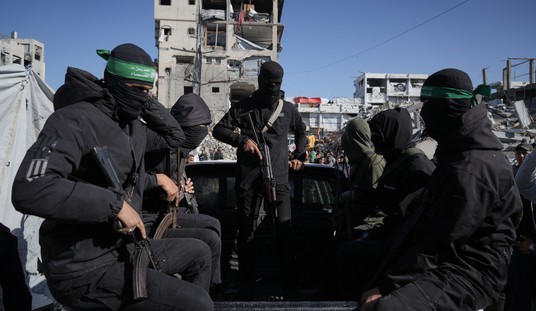


…sadly since no one wants to say the muslims did it ..we are doomed to repeat this again.
I read something by a Sci-Fi author, probably Heinlein, that said the response to any attack should be immediate and disproportional.
The fascinating thing about warfare today, whether “normal” or “asymmetric,” compared to the wars of, say, the era after the Westphalian accords and before the Congress of Vienna, is how outraged we are when they begin. Prior to about 1815, wars were formally declared before hostilities began. Battles were actually scheduled, and the place of battle agreed upon by the warring parties. Civilian populations were not involved…usually, neither in risk-taking nor emotionally.
Today’s wars outrage us all. We get no “notice” about the inception of hostilities, and thus no time to brace ourselves. We’re all “on the field of battle.” Owing to the deprofessionalization of most national armies, many civilians have relatives in harm’s way, even in states that don’t practice conscription.
Our sense of outrage, of having been violated, is what makes us demand a disproportionate response to an attack. I once felt that was an impulse that should be restrained, tempered with cool consideration. Since 9/11/2001, I feel that way no longer.
“Civilian populations were not involved…usually, neither in risk-taking nor emotionally.”
That would be news to the thousands of villagers who were tortured and slaughtered during the Crusades, the Thirty Years’ War, the Ottoman Wars, the French and Indian War…
Not familiar with the Westphalian Accords of 1648, Heather? You have some reading to do. I chose that as the starting point of the cited period for good reasons.
As for the French and Indian “Wars,” they were an anomaly, but then, they weren’t between sovereign states that had accepted the Westphalian pacts.
With respect, the Peace of Westphalia (which, yes, occurred before 1815 which you cite as your starting point) was the formal result of the end of the Thirty Years War – formal in that the actual end of the war was the exhaustion of Central Europe after arguably the most devastating (in proportional terms) war in history, where large sections of Germany suffered 50% casualties. It took Germany almost 200 years to recover.
Those polite little wars of which you speak included troops being quartered in civilian homes, wholesale theft of stock & provisions which drove refugees into cities, making them even riper for siege and pestilence, scorched earth campaigns on both sides (like in those tidy little Napoleonic wars), the invention of the word ‘guerilla’ in the Peninsular campaign (& for good reason), &c. Then there is the Balkans, which have always generated more history than can be consumed locally. Animosities still exist in Europe hundreds of years after their precipitating events.
I take your point, though, and agree with your conclusion to the extent that a disproportional response is often the best, but should be tempered not necessarily in magnitude but in well planned & executed strikes. This is certainly understood in the Arab mind (I lived amongst them for years), & while it may require a prolonged conflict, that is the only way that crusades of this type – which is what they understand it to be, no matter how politically incorrect the term may be – are to be waged.
We cannot win a war by surrendering. The Islamic Supremacists have declared it, & they are content to take the hits with the expectation that we will weary of it eventually.
I dunno if he said exactly that, but he did express pretty much those sentiments in Starship Troopers
It’s just the whole American thing… Have we lost our way here? Seems that way too many that post here and elsewhere are too conceited to even think that we may have been right in our response to terrorism or to even be think that we were right to think and act as we have. If that is really true, then we have progressed way past our recovery.
Possibly it is a teaching thing – our wonderful anti-American teachers cramming the anti-American rhetoric down out throats… or maybe it is the Unions trying to cram socialism down our throats, I don’t even know for sure these days, but I DO know that the children of today are very different from the past and have little respect or allegiance to the country today.
Something is VERY wrong now..
I weary of how the popular culture has to portray us as victims. I rather celebrate those who fight back.
http://plbirnamwood.blogspot.com/2011/09/remember-remember-11-september.html
“In most countries, you’d stand around waiting for the “qualified aid personnel” and then complain if the aid was late, instead of taking your hand to what was there and doing what you could.”
New Orleans, by that definition, is another country.
The same image occurs to me from Hurricane Andrew in 1992, which swept through south Florida & continued on to nail Louisiana. I took a volunteer crew from Texas to help clean up Berwick, Louisiana and found the typical ‘roll up your sleeves & build it again’ attitude. It was refreshing after my viewing of the events in Florida (which received the lion’s share of the media attention) that included seeing an able-bodied woman complain about how the ‘government’ wasn’t responding adequately, & her main point was that there were dead dogs lying about, with the attendant disease-prone possibilities. I remember thinking, “Well, Sweetie, I hate to focus on current events in your area, but you’ve just been practically wiped out. You need to pick up a shovel & get to work.” Too many people in that situation are encouraged to sit back & revel in their victimhood. I’m sorry, but there’s some personal responsibility you have to assume, because in those times, you’re on your own.
We spoil our children and then are shocked when they act spoiled. We spoil large chunks of our population and then are shocked when the act spoiled. Human nature responds well to carrots and sticks, all carrot and no stick or all stick and no carrot causes big problems. Today, unions get too many carrots and small business owners get too many sticks. It does not surprise me that we as a country are confused about carrots and sticks when it comes to national issues.
This is why when I hear Obama speak, when I see the direction he wants to take the country in, such anger wells up inside me .
Watching the specials on 911 like the ABC one about the firemen, I see exactly what your talking about. A kind of ability to get it done, a pride, an honor that doesn’t exist anywhere else in the world.The beauty that exists in the way the fireman honor their dead. And then you contrast that with Obama’s hatred of his own country, because that is what the leftist hates, the ability to survive and overcome without the Obama’s of the world giving them a handout or telling them what to do.
Ayan Hirsi Ali wrote something in her Nomad book that has always stuck with me, it’s the essence of this article, she describes visiting an old ghost town and marveling at the technology of the 1800′s.
“The ghost town vividly illustrated the difference between my grandmother’s traditions which insist on keeping things as they are, and American traditions which continually innovate. The American mind seeks, new better and more efficient means of cooking, washing and finding fuel, the most basic and most universal activities of human life. I can’t think of anything useful a Somali man or woman ever invented to make the cycle easier.”
Perhaps it’s because as she illustrates later in the book an aunt sees a puddle in the apartment and tells Ayan not to soak it up that “allah will will it away”
She ends her chapter on America by saying:
“But unlike Europeans, Americans feel instinctively that large scale government intervention is wrong, is at best an emergency measure. In an ideal world Americans would form their families and firms, build their homes and workplaces, buy and sell their goods and services, go to a Pizza place on Saturday and church on Sunday, and generally get on with their lives with the minimum amount of state interference.”
And Obama is President of THAT country, hard to believe!
Of course, yes, we’ve prevented a few of them mostly through intelligence work, and a few more by our determination to be a mob, not a flock.
I really like that: “be a mob, not a flock”. And I recognize that you mean it in the most American sense, not of anarchy, but of bravely coming together to help and protect each other. Mind if I steal the phrase?
