Ron Radosh

By Ron Radosh

Bio

Get Updates From Ron Radosh

Now that the Glenn Beck old time Christian revival meeting at the Lincoln Memorial is over- and yes, with a minimum of 350,000 attending- one moment of unintentional humor has all but been passed over and gone unnoticed.

When the rally began, and right before Beck was to speak, the audience heard a substantial excerpt of music, that continued to play as he came on stage.  And it continued to be played at various times throughout the event.

That music was none other than Aaron Copland’s Fanfare for the Common Man, written by him during the period of the Communist Popular Front of the 30’s and 40’s, when Copland was not only a man of the political Left, but an actual- although secret- Communist Party member.

The main point about the composition is made by historian Sean Wilentz, in his new book, Bob Dylan in America, to be published soon by Doubleday. Wilentz writes:

The title contains an obvious paradox. Fanfares, rooted in the music of the court, are supposed to herald the arrival of a great man, a noble. Copland’s Fanfare, however, heralded the noble groundlings, grunts, and ordinary men- not just their service and sacrifice in the war, but their very existence and their arrival in history. The title had more specific political connotations as well- for Copland borrowed it, as he later informed [Eugene] Goossens, from a widely publicized speech, ‘The Century of the Common Man,’ delivered  earlier in 1942 by the New Dealer most closely identified with pro-Soviet and Popular Front politics, Vice President Henry Wallace.

The composition, Wilentz continues to point out, was “a subtly esoteric piece of music written for the democratic masses as well as to honor them.”  The composer Virgil Thomson, a contemporary critic of Copland, commented that the work was evocative of “the speeches of Henry Wallace, striking in phraseology but all too reminiscent of Moscow.”  Thomson’s comments were in line with the repudiation of pro-Communist Popular Front culture that came from the anti-Stalinist Left around Partisan Review, The New Leader, and other sophisticated cultural figures who were espousing modernism and more than dismissive of CP culture. As Wilentz concludes, Fanfare “fit in perfectly with what [Clement] Greenberg had been denouncing since 1939 as ‘kitsch’ and what Dwight Macdonald eventually defined as ‘mid-cult;-a style…that ‘pretends to respect the standards of High Culture while in fact it waters them down and vulgarizes them.’”

These critics were opposing what they saw as the subordination of art to politics—and to left-wing pro-Communist politics.  And for Copland, as Wilentz writes, the new simplicity he espoused was “inevitably bound up with his Popular Front political loyalties of the 1930s and 1940s.”

Now there is certainly nothing wrong with using Copland’s wonderful music to frame an event. But this is the same Glenn Beck who last year, as Steven Heller who teaches at the School for Visual Arts wrote, “As one of the many justifications for why the Obama administration is leading us headlong into Socialism and Fascism, Glenn Beck has turned to the history of propaganda art. In a recent broadcast,…[he] takes Rockefeller Center’s vintage public art and architecture to task for promoting Communism and Fascism through murals, friezes, and engravings bearing symbols that subliminally project vile values.”  Beck, he continues,  “deconstructs works that include workers and farmers, hammers and sickles, iron-fisted leaders, and swords beaten into plowshares, equating the ‘progressive’ mass art of the 1930s with the so-called subversive art of Obama.”

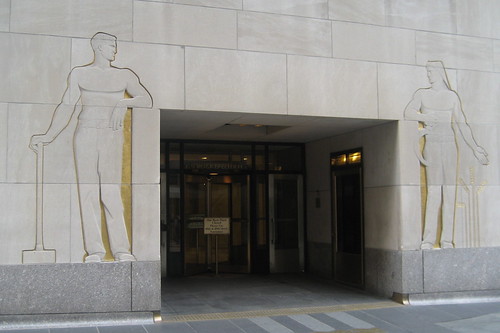
And art critic Richard Lacayo, points to Beck’s dismay at same carved bas-relief figures you can see at Rockefeller Center. Called Industry and Agriculture, they flank the entrance to Rockefeller Plaza at its south end. What is the problem with them, Lacayo asks? His comment: “One of the figures, Agriculture, holds a sickle. Meanwhile Industry leans on a hammer. Hammer. Sickle. Hammer and sickle! They’re not actually touching, much less crossing, but never mind — they’re secretly suggesting the communist symbol.” He adds this comment:

Let’s put aside for a moment the fact that sickles and hammers were symbols of agriculture and labor long before the communists hit upon the idea of combining them as their symbol. And that workers and farmers were a standard theme in Art Deco. I had actually always thought that the “hammer” Industry leans on was a shovel, buried partly in soil represented by the dark grey stone base of the building. That’s why the figure always looked less to me like a symbol of militant labor than a WPA road worker on a break. (At the feet of Agriculture grass grows from the same grey “soil”.) The Rockefeller Center website also describes the thing as a shovel. But images can be ambiguous and you can read it either way.

 I happened to be watching Beck’s show and saw his actual presentation, and you can watch it here.  Lacayo and Heller’s summary of Beck’s case against the art is accurate, as you can see for yourself. As I recall, Beck was stunned as he recounted how on walking with one of his staff past the building, he commented how amazing it was that we take such propaganda for granted, and don’t realize what is being put over on an unsuspecting public.

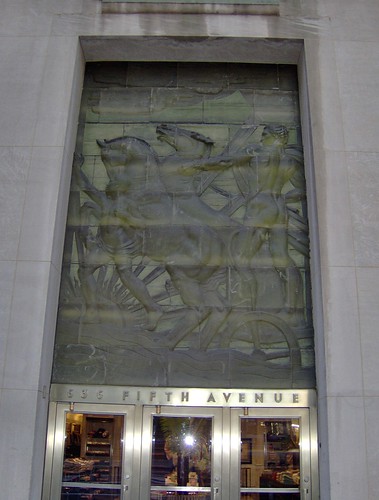
Beck also noted on that same program that a glass wall sculpture by an artist named Attilio Piccirilli, that is found at the entrance to one of the Rockefeller Center buildings, is a “a fascist tableaux of youth leading humanity towards a bright future and ends up identifying the charioteer as Mussolini.” As Lacayo accurately writes- and I hope you read his account- the story is much more complicated. The bottom line is the following:

The fact is, the most important single figure behind the decorative program of Rockefeller Center wasn’t Joe Stalin or Benito Mussolini, neither of whom were consulted. It was John D. Rockefeller, Jr., the millionaire oilman who built the place, and for one reason — he hated modern art. (The famous irony, of course, is that his wife Abby loved it, and was a founder of the Museum of Modern Art.)

Because Rockefeller didn’t want anything too modern at his big project, the sculpture and carvings all around the Center are almost entirely representational, and mostly in the muscular neoclassical style that had been adopted by aesthetically conservative artists all over the world in the 1930s, including the Soviet Union, Fascist Italy and the good old U.S.A.

Beck, to make it clear, saw in these works of art the secret code of communist and socialist propaganda foisted on the tourists and citizens of New York who never knew what was being imposed on their unsuspecting eyes. “Gee,” he commented, “who’s having indoctrination next week?” He then stated: “This is propaganda, hidden in plain sight. In plain sight!”  It was hidden, he told his audience, but you can see it “if you look.”

Well, I ask the following? If Beck was right about the hidden message of this communist and fascist propaganda propagated by the Rockefellers—-what subliminal hidden message came through the cascade of Copland’s Popular Front symphonic compositions put upon the unsuspecting ears of the few hundred thousand present at his rally, and the scores of others watching it on C-Span?

Could it be that Glenn Beck’s razor eye for propaganda is slipping, and that someone on his staff played a trick on him— picking Popular Front culture as the front piece of his long planned rally? Could the Communists of the past have managed to hoodwink even Glenn Beck? We’re waiting for an answer.


PJ Media appreciates your comments that abide by the following guidelines:

1. Avoid profanities or foul language unless it is contained in a necessary quote or is relevant to the comment.

2. Stay on topic.

3. Disagree, but avoid ad hominem attacks.

4. Threats are treated seriously and reported to law enforcement.

5. Spam and advertising are not permitted in the comments area.

These guidelines are very general and cannot cover every possible situation. Please don't assume that PJ Media management agrees with or otherwise endorses any particular comment. We reserve the right to filter or delete comments or to deny posting privileges entirely at our discretion. Please note that comments are reviewed by the editorial staff and may not be posted immediately. If you feel your comment was filtered inappropriately, please email us at story@pjmedia.com.

18 Comments, 17 Threads

  1. 1. terry quinn

    Ron, we’re making this way more complex than necessary.

    I’ve been listening to classical music for about 55 years. Didn’t know that Copland was a Communist, & don’t much care. Same way I didn’t know Shostakovich was secretly protesting Soviet oppression. Aural art does not lend itself to direct correlation as do visual arts. If Copland thought he was “getting to us,” he failed in my case. Still staunchly American & capitalist.

    Whatever Copland thought as he composed, the idea of elevation of the “Common Man” resonates in American Conservatives clearly. We all have a role to play in making a great society. (Oops, another slip: TQ must be a closet Johnsonist.)

    Best regards, y chill,

    TERRY

  2. 2. John Strephano

    That’s an awful lot of words for such a minor observation.

  3. 3. David Thomson

    Glenn Beck does substantially more good than harm. If nothing else, millions now understand the extent of the destruction caused by the administrations of Woodrow Wilson and Franklin D. Roosevelt. The latter man especially did not save capitalism during the Great Depression. Beck has fortunately turned Amity Shales and Burton Folsom into heroes. Ron Radosh should someday get invited to discuss the Communist infiltration of the U.S. government. Nonetheless, I am not thrilled regarding Beck’s misguided adulation of Martin Luther King, Jr.

    The assassinated civil rights leader was becoming a marginalized figure by the time of his murder. Many Americans thought he was going off the deep end. King was a convinced socialist who opened the door to nonviolent radicals like Richard Cloward and Frances Fox Piven. I am compelled to look at the evidence—and after doing so I must conclude that Rev. King was overall a negative force in American history. It was mostly downhill after his great accomplishments in the deep South in the early to mid 1960s. The last few years until his death on April 4, 1968 were unbelievably damaging.

  4. Could it be that Beck simply isn’t as concerned about the historical connection of Copeland and the Communists as he is about what he sees as actual visible symbolism?

  5. 5. Black Bart

    I have a feeling you don’t care much for Mr. Beck. At least his use of the instruments of the opposition.

    You ask: ” Could it be that Glenn Beck’s razor eye for propaganda is slipping, and that someone on his staff played a trick on him— picking Popular Front culture as the front piece of his long planned rally? Could the Communists of the past have managed to hoodwink even Glenn Beck? We’re waiting for an answer.”

    Maybe the answer is he just appropriated Copland’s Fanfare For The Comman Man, for the comman man, the country class.

    That said, I appreciate your sketch of history. There is a certain narrative thread from then to now that uses the symbols you describe. What you do when you recount the people, events, the arguments of that era is preserve that thread. This is important because to understand how we got into this current mess we need to understand the battle of philosphies that took place in the past.

  6. 6. Morton Doodslag

    “Now that the Glenn Beck old time Christian revival meeting at the Lincoln Memorial is over…”, I guess it’s time for America’s Christian-hating snobs to start their hate-fest…

  7. 7. Lawrence

    Is it possible to seperate the art, music and dance from the politics? It appears Americans do it all the time.

    I like Diego Rivera but I don’t have to buy his confusing left-wing politics. I like the Philip Johnson, the architect, but I don’t appreciate or endorse his Nazi symthaties during WWII.

    Therefore, yes, Aron Copland, composer from Brooklyn, Communist fellow-traveller or maybe secret member, wrote outstanding modern music. I like “Fanefare” but I can keep my appreciation of his music seperate from his politics.

    More imprtantly, Beck has now completed the building blocks of a New Right-wing extremism. He has added Christian fundamentalist religion, that “good old-time religion,” to his advocacy of lizzare-faire Manchester-style economics; hysterical anti-socialism; anti-immigration and foreigner bias and “down home nativism.” Fr. Charles Couglin, Jr., the 1930s pro-fascist radio priest, Sen. Joe McCarthy and Robert Welsh would all be proud. What we see is the modern version of the anti-immigrant Know Nothing Party, the Anti-Messonic Party, the American Party unfold before our eyes.

    Can we enjoy Beck for his humor and separate out his politics? Hopefully.

  8. 8. Gary Ogletree

    Beck does great work, but he is sloppy. He often refers to dope smoking hippies as modern progressives, ignorant of the great divide that once existed between libertarian, don’t tread on me, San Francisco and Stalinist Berkeley. I remember a Grateful Dead show where a huge American flag was unfurled when the boys went into US Blues. And some of the crowd picked up the trash of others at the end, just like the Tea Party. Beck has his own template just like the ruling class media. But we owe him for systematically exposing the totalitarian socialist make up of the administration and the rampant corruption practiced by the progressive Democrat elites. One show only on all of TV with an occasional spillover to FOX. I won’t fall on my knees and pray at Glenn’s call, but I sure enjoy a lot of his revelations and guests.

  9. 9. David Thomson

    Aaron Copland’s Fanfare for the Common Man is a beautiful piece of music. I have no hesitation in “stealing” it back from its Communist creator. The intellectually immature Copland failed to comprehend that Communism has no interest in the common folk except for turning them into slaves. Heck, I might even be doing him a favor. I am also not going to go out of my way to hurt anyone’s feelings over their misunderstanding concerning the true legacy of Martin Luther King, Jr. There is no way that I am going to lie on behalf of the cause—but I sadly concede that I have done far more studying on King than the typical American.

  10. 10. John A. Jasilli, Esq.

    While techinically true, this article is beside the point. Personages and their work, such as Copland, Guthrie, even MLK, etc. have been accepted into the mainstream of American culture for their good points. No one cares (statistically speaking, and excluding historians) about the political leanings, obscure, secret, whatever. Negatively this could be ascribed to ignorance. But there are times & places where politics would be grounds for censorship and exclcusion.

    More interesting is that members of MLK’s family were speaking guests at Beck’s rally. Where are the race-baiters and Beck-haters now?

  11. 11. Tallgrass

    Personally, I think Glen should be sentenced to walking around the Lincoln Mall 1000 times the score of “Fanfare for the Common Man” stuck to the middle of his forehead, escorted by a National Park Ranger, of course.

  12. 12. GlenBe

    http://www.ynetnews.com/articles/0,7340,L-3945665,00.html

    Obama, we’re not suckers

    Op-ed: Obama may mortgage America’s future, but we won’t let him do the same to Israel

  13. 13. Gary Ogletree

    You know Jane Fonda may be seriously deluded, but I should get mad at Cat Ballou? No Way.

  14. 14. Professor Guvinoff

    Is it just me? When Sarah Palin came to the stage, I thought I heard strains of Aaron Copland again, but this time they were from Candide’s Overture, which I though was rather appropriate, as both Beck and Palin in my view represent the unpretentious and authentic American, learning in the mold of the self-made man, in striking contrast with the self-important academic.

    I thought this was not facetious at all, only judicious.

  15. 15. Hank

    Ronnie et al. There’s also the irony in the fact that after
    Rockefeller got rid of the murals by Oroszco, he hired Hugo
    Gellert to replace them with grizailles of heroic workers, much in
    keeping with Gellert’s Communist sympathies. Ronnie: contrary to
    one of your critics I’m glad you dwelt on this irony. It is often the repthe
    little things of “superstructure’ (may I say pace Stalin?) which
    make up the flavor of the zeitgeist, and thus represent a true
    representation of reality and/or history.

    • Prologue

      And in the Detroit Institute of Arts, a gem itself, you will find Diego Rivera’s murals of Henry Ford’s factory. They are beautiful.

  16. 16. Lawrence in New York

    Hey, Ron.. Brace yourself… He likes the music. Ron, you have more litmus tests that a dozen allergists.

  17. 17. johnnyblaze36

    Somebody should inform Mr. Radosh that he makes a glaring error in the very first sentence of his article when he calls the Restoring Honor Rally a “Christian Revival”. It’s obvious you didn’t watch it or you would have seen the 240 members of the black robed regiment standing right directly behind Beck. You must have also missed the fact that Jesus Christ wasn’t mentioned a single time at the rally. It’s fine to dislike Glenn Beck but it is not fine to be completely dishonest in your analysis, unless your goal is to come off looking like a complete ass.

Leave a Reply

Click here to subscribe to the Daily Digest, to stay up to date with the latest at PJ Media. (You will be sent an email asking you to verify your email address. If you have previously subscribed, no verification email will be sent.)