



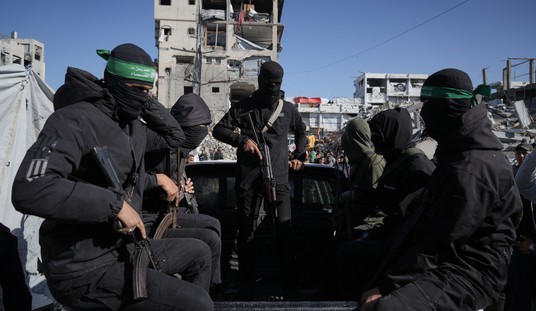
Sectarian violence in Syria between Sunnis and Alawites is worsening by the week. Now that a non-violent movement for reform and change has molted into an armed insurrection, Bashar al-Assad’s Shabiha militia is shooting and hacking even children to death.
Syria is part of a pan-Arab nation, according to the Assad family’s cynically adopted Baath ideology, but the truth is that Syria is hardly even a stand-alone nation. Like Lebanon and Iraq, it’s a disastrous mess of a place riven by sect and ethnicity. With its fractious collection of Sunnis, Alawites, Christians, Kurds, and Druze, it’s more of a geographic abstraction than a coherent nation-state. It’s very unlike Egypt and Tunisia that way, both of which have coherent identities transcending sect, region, and tribe.
Until recently, the sectarian monster has spared Syrians the grisly communal bloodletting Lebanon and Iraq know only too well. That’s not because Syrians are inherently more tolerant or enlightened, but because the monster was locked in the basement by a total surveillance police state. It’s out now and running loose in the streets.






Next question, will the Iranians send in large numbers of Revolutionary Guards to shore up Assad?
Bob, I don’t know Arabic but this is supposedly footage of some Iranian pilgrims who took a wrong turn on their way to Karbala and ended up in Homs:
http://www.youtube.com/watch?v=hlgPMlklJSU&feature=youtu.be
You be the judge? And by the way I understand those IDs they are flashing are Iranian military IDs.
What happens to all of the advanced missiles and chemical weapons? I have to wonder if Israel does not have a plan for destroying or securing those if the situation becomes more unstable.
Last week IDF had a major paratrooper exercise. While Hezbolla is the most likely scanario for paratroop deployments, Israel did land troops behind the lines in Lebanon in an attempt to cut off Hezbolla lines of supply and retreat, they could also be practicing for a scenario where they need to secure key WMD sites in Syria. Just a thought.
“Until recently, the sectarian monster has spared Syrians the grisly communal bloodletting Lebanon and Iraq know only too well. That’s not because Syrians are inherently more tolerant or enlightened, but because the monster was locked in the basement by a total surveillance police state. It’s out now and running loose in the streets. ”
So are things about to go from bad to worse? And would Iraqi (& Turkish) kirds intervene?
1: (Bob) Nope. But we’ll likely hear a lot of angry words in Assad’s defense. After all, Terhan invested a lot of time and money in Damascus.
2: (Craig) Wait’ll they get a load of the North Koreans. We’ll know the jig is up when they and the Sov…uh…Russians do their traditional last minute bug-out.
3: (Spin) All IDF Para Brigade operations in 2006 were by helicopter insertion or part of ground forces.
4: (rbj) Yes. Extremely unlikely, (& very possible at least in limited border areas, especially those already under traditional dispute).
THE
USUAL
PLEASE,
R
“And by the way I understand those IDs they are flashing are Iranian military IDs.”
I gather almost all Iranian men keep their ID cards after completing military service, as a reliable form of identification. The cards are stamped to say that service was completed.
Could be, Don. But neither one of us has any way of knowing if that’s true or not. But being ex-US military was enough to get an Iranian-American charged as a spy in Iran recently and he wasn’t even found in the vicinity of atrocities in progress. Are you claiming IRGC Quds is not in Syria? Or just claiming that these guys are not them? If you’re just saying we should give them the benefit of the doubt, that’s not our call to make is it?
Minorities in Syria. The Syrian Durzi serve in the Syrian Army in all ranks and as a “fighting nation” play an important role in it. Some of the “local revolts” were in the what was used to be called “Jabal Druze”, or near it,
but the role of the local Durzi in those was not clear. The Golan (Under Israeli rull) Durzi were, up to few weeks ago, generally pro-Assad. Lately Jumblat the head of the Majority of the Durzi in Lebanon, and a member of the pro-Hizb. coalition was making anti Assad noises, while Arselan the leader of his opposition was making reserved pro-Assad noises. It seems that the Durzi as a whole are not yet sure of the future of the revolt. The Christians in Syria, as a whole, are not anti-Assad, they see the fate of the Christians in Iraq, Egypt, Gaza and Turkish north Cyprus and are very scared. While the Kurds, the Allawites, the Durzi and obviosly the Sunni can protect themselves with weapons the Christians as a community can not (as individuals may be, but a rifle here and a pistol here can not do much) and they remember the old levantine saying: “after Saturday come Sunday”. There are no Jews in Syria at all. After more than 2000 years, the oldest community in Syria, of Saturday observers, has been 100% ethnically cleaned. Who is next?
Just so that you will know in what kinds of a world we are living. IRI is telling the whole world that it is constructing nuclear plant for generating electricity. There is a shortage of electricity in Lebanon. The IRI ambassador to Leb. is informing the Lebanese that his country has a surplus of electricity and is exporting 25.000 MW. It can offer extra 6.000 MW to Lebanon, that is erecting an electric line through Iraq and Syria. If that is the situation what do they need nuclear power stations for?
http://www.dailystar.com.lb/News/Politics/2012/Jan-28/161386-iran-says-willing-help-lebanon-with-power-shortages.ashx#axzz1kn2WcZ00
Rani, it will take at least 10 years for them to demolish all the Sunni neighborhoods in Iraq and Syria to make room for those power lines and by then of course they will have the nuclear power plant online. That’s obviously what Ghadanfar Roknabadi was referring to. The part about them having a surplus now and being able to deliver the power Lebanon needs in a short amount of time was most likely misinformation inserted onto the journalists laptap by a Mossad Trojan Horse program.
Sectarian strife in Syria has already started and is about to escalate. The much feared scenario of Civil War is now an ugly reality. In the short term Assad’s forces have the upper hand, but it is also obvious that the new kid on the block known as the Free Syrian Army is getting weapons and support and has been getting bolder which passing day by launching attacks on government forces. This is perhaps the first indication that the bloodbath is about to increase and eventually plunge the whole country into a war zone. I do not see the sunni powers in the region allowing Assad to dominate their counterparts in Syria any longer nor do I see the international community agreeing to a unified strategy given given Russia’s current stance…in other words things are about to get much worse.
Way too many Arabs being killed these days.
It ain’t fair. In fact, it’s downright disproportionate.
Time to redress the balance:
http://debka.com/article/21689/
File under: Anything I can do, I can do better.
These are sleepness nights at the New York Times editorial staph. Editor Jill Abramson has assigned Thomas “Stormfront” Friedman, Roger Cohen, and Nick Kristoph to prove that Israel is behind the killings in Syria. Maureen Dowd has been tasked to interview Asma Assad (the fuhrers wife) to show that Syrian women are free and can participate in death squads just like men can. Gay studies professor Sarah Schulman will be tasked into converting Damascus into a gay paradise
Article about the crackdown on “occupy oakland” after they attacked City Hall and a convention center yesterday:
http://www.bbc.co.uk/news/world-us-canada-16779213
Top photo they are holding a giant sign that says “Cops Move OUT, Commune Move IN” and the in the photo below they are burning an American Flag.
Yup! They surely do represent 99% of Americans! Right? Don’t they?
Somebody is sponsoring those folks. Somebody with an agenda and a lot of money decided to round up a bunch of homeless people along with the chronically unemployed and chronically disgruntled (related conditions?) and give them something to do with their free time. I can’t think of any other explanation because that particular nuttiness on display in those photographs doesn’t even represent the views of very many college students in the United States. It’s a free country and they can do what they want as long as they stay on the right side of the law but it’s egregiously offensive for them to be styling themselves as “the 99%” when they aren’t even “the 1%”. There isn’t anyone more unpopular in the United States than communists and anarchists. To tie it in to Syria, imagine the ant-Assad revolutionaries were “zionists” and claiming to represent the Syrian people? It’s ridiculous on its face.
Craig – Here’s another article on the Oakland funsters: http://www.sfgate.com/cgi-bin/article.cgi?f=/c/a/2012/01/28/BASI1N00ER.DTL
Speakers exhorted the crowd to fight economic inequality. The first speaker, Roxanne Dunbar Ortiz, took perhaps the most pointed stance, urging the crowd to fight the rich.
“Passionate, organized hatred is the element missing in all that we do to try to change the world,” said Ortiz, a retired professor from Cal State East Bay. “Now is the time to spread hate, hatred for the rich.”
I’m guessing she was talking about Nancy Pelosi, John Kerry, George Soros and other such rich people. “Off with their heads!”, said the Queen of Hearts.
Change the world with hate? Well, now. That’s something new, isn’t it?
http://www.youtube.com/watch?v=kjxSCAalsBE
When the moon is in the Seventh House
And Jupiter aligns with Mars
Then peace will guide the planets
And love will steer the stars
This is the dawning of the age of Aquarius
The age of Aquarius
Aquarius!
Aquarius!
Harmony and understanding
Sympathy and trust abounding
No more falsehoods or derisions
Golden living dreams of visions
Mystic crystal revalation
And the mind’s true liberation
Aquarius!
Aquarius!
When the moon is in the Seventh House
And Jupiter aligns with Mars
Then peace will guide the planets
And love will steer the stars
This is the dawning of the age of Aquarius
The age of Aquarius
Aquarius!
Aquarius!
Wait. Cancel that!
http://www.youtube.com/watch?v=zhXUutpELRA
Pounding the world like a battering ram
Forging the furnace for the final grand slam
Chopping away at the source soon the course will be done
Leaving a trail of destruction that’s second to none
Hammering anvils straining muscle and might
Shattering blows crashing browbeating fright
Fast devastating and desolisating the curse
Blasting the cannons of truth through each man of this earth
Rapid fire between the eyes
Rapid fire terrifies
Rapid fire before you die
Rapid fire
Wielding the axe comes the one culmination
That’s always certain to bring down the curtain on greed
Sifting the good from the bad it’s the age of a rage
Of the dogs which must fall to the just and be free
Now grate for the vandals who sampled and trampled
Till this place conditioned brought forth demolition to war
The slipping and sliding corrosive subsiding
And withered and wained till the world seemed all drained fills the bay
Rapid fire between the eyes
Rapid fire terrifies
Rapid fire before you die
Rapid fire
Pounding the world like a battering ram
Forging the furnace for the final grand slam
Chopping away at the source soon the course will be done
Leaving a trail of destruction that’s second to none
Yeah, second to none
A second to none
Fixed now.
I’m guessing she was talking about Nancy Pelosi, John Kerry, George Soros and other such rich people. “Off with their heads!”, said the Queen of Hearts.
I think there are gonna be a lot of leftist college professors looking like a deer caught in the headlights if this ladies dreams ever pass into reality too. But that’s life, isn’t it? One day you’re advocating for social justice and the next day Bubba the backwoods country fuck has you bent over a tree stump.
10. Craig. I agree, exept for the Mosad bit. No need to insert anything. All I wanted to show is that these people are so deep in their own lies, the power line across borders, the surplus electricity etc. They all: the leaders, the people, the media lost all ability to seperate facts from hashish visions.
Michael: “…Syria is hardly even a stand-alone nation. …it’s more of a geographic abstraction than a coherent nation-state.”
—Way wrong here, Michael. The peoples along the Damascus-Homs-Hama-Allepo axis of the country share a *very* cohesive culture, irrespective of religious group. It is also a very delicate and beautiful culture. If you had ever been there before, you would see what I mean.
), and unfortunately with more poverty (and more slumy areas) than Lebanon, but in many ways, a much richer history. I think you would like it nearly as much as you like Lebanon. There is a reason why Syria gets 10 million visitors a year (more even than Tunisia, I think). It is extremely inexpensive to travel through.
Definitely more socially conservative (definitely a less “scenic” nightlife
“Like Lebanon and Iraq, it’s a disastrous mess of a place riven by sect and ethnicity. With its fractious collection of Sunnis, Alawites, Christians, Kurds, and Druze,….”
—They are not that fractious. Iraq is in another galaxy as far as *that* is concerned. What you are saying here is inconsistent with what I saw of interethnic relations in Syria. Maybe I will be proven wrong in this, but I am cautiously optimistic that sectarian tension will calm down relatively rapidly in Syria, in the hoped for aftermath of the Assad regime. There will be nothing even remotely comparable to the bloodletting in Iraq, Lebanon, or in the former Yugoslavia.
—Regarding the strife in Homs, if you look on a map of Syria, this city is centrally located on the north-south populated spine of the country, and it is the departure point from this axis of the main highway to the coastal cities. It is due to this strategic location, that many Syrian security personnel (the most important such agencies are, of course, Allawi-dominated) have been based in this city.
Is the violence being visited upon Allawi individuals and families in Homs (and thus far not elsewhere, with comparable levels of frequency and ugliness) sectarian, per se, in nature, or is this violence better described as revenge attacks, in retaliation for securtiy forces brutality (with counter-retaliatory attacks directed back at Sunnis)? This is a very important question and distinction.
—Just to say so ahead of time, it will be a few more days before I will be
getting back here to comment very much, due to being busy with school, but I pop my head in once in a while to quickly read
18. sammyman
“They are not that fractious. Iraq is in another galaxy as far as *that* is concerned. What you are saying here is inconsistent with what I saw of interethnic relations in Syria. Maybe I will be proven wrong in this, but I am cautiously optimistic that sectarian tension will calm down relatively rapidly in Syria, in the hoped for aftermath of the Assad regime. There will be nothing even remotely comparable to the bloodletting in Iraq, Lebanon, or in the former Yugoslavia.”
I would take the time right now to debunk all of the garbage coming from your keyboard on this post, but I promised my wife I would take her to see the new Katherine Heigl chick flick.
Sammy: Iraq is in another galaxy as far as *that* is concerned. What you are saying here is inconsistent with what I saw of interethnic relations in Syria.
That has been true with the Assad regime in power, but will it still be true after it’s gone? I wouldn’t count on it.
But maybe. We’ll see.
Sammyman: —Way wrong here, Michael. The peoples along the Damascus-Homs-Hama-Allepo axis of the country share a *very* cohesive culture, irrespective of religious group. It is also a very delicate and beautiful culture. If you had ever been there before, you would see what I mean.
Maybe the part along that axis and extending to the Syrian coast should be broken off and merged with Lebanon then, and everything east of that axis merged with Iraq. Should help balance the demographics of both countries, no?
Not that I’m agreeing with Michael. Personally, I’m not really into arguments that start with people asserting countries are not truly valid nation-states but your emphasis on the cohesiveness of one particular part and one particular subculture in Syria didn’t do much to defeat MJT’s claim, even if true.
MJT: That has been true with the Assad regime in power, but will it still be true after it’s gone? I wouldn’t count on it.
The minorities of Syria don’t seem to be counting on it either, considering the way they are sticking with Assad despite everything that’s happened.
The only Arab countries with a strong national identity are Tunisia and Egypt.
All others–all–are fractured by sect, ethnicity, tribe, or some combination. Iraq is fractured along all of those lines, as is Syria.
All others–all–are fractured by sect, ethnicity, tribe, or some combination.
So is the United Kingdom
Why exclude Egypt? You forgot about the Copts? What about the Bedouins? As for Tunisia, it is even more heavily Berber than Libya is. The only Arab country more Berber (does that even make sense?) is Morocco. I suspect you broke Tunisia out from the rest just because you like Tunisia, Michael. Understandable, but hardly fair
Craig, I didn’t break Tunisia out of the pack because I like it.
Read the short article below:
—
Roman Africa
by Robert D. Kaplan
The economic and political fault lines that separated Carthage and Numidia are the ones that separate Tunisia and Algeria—and the Romans drew them
…..
From the parapets of Le Kef, on a rocky spur in northwestern Tunisia, one can see deep into the mountains of Algeria, whose border is a short distance away. A fort of some kind has existed here since Carthaginian times, 2,500 years ago, and the ocher ruins of ancient cities are all around. Dominating the view to the southwest is Jugurtha’s Table, a massive mesa atop which the Numidian King Jugurtha held out against a Roman army from 112 to 105 B.C. But it is the modern town of Le Kef—and also the political tension along the Algerian border—that demonstrate the relevance of antiquity to contemporary politics in Arab North Africa.
Le Kef, a town of 50,000, is no fundamentalist enclave or Third World disaster zone. Its women are assertive and dress in fashionable Western clothes. It has a large Internet café, cash machines, new apartment blocks, elegant street lighting, dependable plumbing and electricity, and reforested hillsides. The taxi drivers use meters and wear seat belts. Nearly everyone I met had been to France or Italy, and the road to Tunis, the capital, two and a quarter hours to the east, is busy with traffic. But no one I met in Le Kef had ever been to Souk Ahras, a town of Le Kef’s size in Algeria, although it is only an hour’s drive away. “There is nothing in Algeria—anyway, it is too dangerous,” a local businessman told me last January, referring to the Algerian civil war, in which Islamic extremists hijacked buses and murdered the passengers. Tunisia’s Culture Minister, Abdelbaki Hermassi, says, “Our reference groups are the French and the Italians, not the Algerians and Libyans.”
Despite its long borders with Algeria and Libya, Tunisia “is an island,” explains Oussama Romdhani, the director of the government’s information agency. Much of the frontier is desert, and the land crossings are used mainly by Algerians and Libyans, who come to buy consumer products, including alcohol.
Since the days of ancient Carthage the area that makes up present-day Tunisia has been like this: an oasis of urbanity, relative prosperity, and stable government jutting out into the Mediterranean, close to Sicily, and yet squeezed between vast tracts of unruly tribal territory. Though lacking the oil and natural gas of their Libyan and Algerian neighbors, Tunisia’s 9.6 million people are by some estimates 60 percent middle class, with a poverty rate of only six percent. Yearly economic growth rarely falls below five percent, and inflation hovers around three percent. The World Economic Forum rates Tunisia the most competitive country in Africa, whereas Algeria does not even appear on its list of twenty-four African economies. Although many developing countries waste money on grandiose projects, Tunisia devotes a quarter of its budget to education.
“People say our success is because of this policy or that policy, or because we have been fortunate to have good leaders,” Romdhani says. “Though that is all true, there must be something deeper going on.” The explanation for Tunisia’s success begins with the fact that modern Tunisia corresponds roughly to the borders of ancient Carthage and of the Roman province that replaced it in 146 B.C., after a third and final war between the two powers. “Africa,” originally a Roman term, meant Tunisia long before it meant anything else. Archaeologists have uncovered 200 Roman cities in the fertile farmlands of northern Tunisia, where the vast majority of the population lives. North Africa was the granary of the Roman Empire and produced more olive oil than Italy. The Romans built thousands of miles of roads there, and also bridges, dams, aqueducts, and irrigation systems; one aqueduct alone, still partially visible near the town of Zaghouan, carried 8.5 million gallons of water daily to Carthage, fifty-five miles to the north. Fifteen percent of Rome’s senators came from Tunisia. Not only the Romans but also the fifth-century Vandals and every conqueror since, including the French in the nineteenth century, made the fertile north of Tunisia their base in North Africa.
In contrast, Algeria and Libya have virtually no history as organized states before the arrival of colonial mapmakers; they connote not nations so much as vague geographical expressions. The ancient cities of Thagaste (the modern Souk Ahras) and Hippo Regius (the modern Annaba), in eastern Algeria, were always oriented toward Carthage, where Saint Augustine, born in Thagaste in 354, went to study; through much of history the cities of western Algeria were linked politically to the Berber kingdoms of Morocco. Libya is almost all desert, with the exception of the cities of Tripoli and Benghazi, which traditionally have had little in common: Tripoli, the capital, usually had close economic ties with present-day Tunisia, and Benghazi was aligned with Egypt. The diatribes of the Libyan leader Muammar Qaddafi about Arab unity are attempts to mask Libya’s own disunity. The fourteenth-century historian Ibn Khaldun wrote in his Muqaddimah (Introduction to History) that the areas that are now Algeria and Libya were rarely stable. Consider the situation today: After a bloody war of independence from France, Algeria became a Soviet-style state in the 1960s. A brief experiment with democracy in the early 1990s collapsed into civil war and anarchy, from which the country has only partially recovered. Qaddafi’s thirty years of misrule have created no institutions in Libya except those of terror. Meanwhile, from 1956 through 1987 President Habib Bourguiba’s success at building a relatively secular Westernized state in Tunisia earned him the appellation “the Arab Atatürk”—a reference to modern Turkey’s founder. Bourguiba’s successor, Zine el-Abdine Ben Ali, by dramatically expanding the middle class through enlightened dictatorship, has earned comparisons to Lee Kuan Yew, of Singapore.
unisia’s borders extend far beyond its fertile north, and it is in those far reaches where problems of development arise. In the archaeology museum at Chemtou, near Le Kef, where the Romans quarried for marble, there is a map showing the fossa regia—”demarcation ditch”—that the Roman general Scipio dug after defeating Hannibal in 202 B.C. The ditch, the remains of which are still visible, runs from Tabarka, on Tunisia’s northwest coast, southward and then sharply eastward to Sfax, another Tunisian port. Even today that line has meaning. The Tunisian towns and villages beyond the fossa regia have far fewer ancient remains and—more significant—are poorer. There men and women wear traditional head wraps; unemployment seems higher, judging by the number of men hanging out in cafés; bus stations often have no posted timetables. The feeling is more like North Africa and less like Southern Europe.
In antiquity Numidia lay beyond the demarcation ditch, an undeveloped region that included eastern Algeria, southern Tunisia, and western Libya. Beyond Numidia there was little except scattered settlements. Indeed, although Roman settlements dotted Africa’s Mediterranean coast from Morocco to Egypt, the only concentration of them was within the fossa regia: the heart of modern Tunisia and its economy.
“Because urbanization in northern Tunisia has always been more extensive, going back to ancient Carthage,” Abdelbaki Hermassi explains, “sedentary life is older here, and tribal identity based on nomadism correspondingly weak. Thus the centralized state is more deeply embedded.” Regimes in Algeria and Libya never succeeded in weakening tribal identities, so governments there have been feeble unless they resorted to cruelty. President Ben Ali—who, incidentally, occupies a palace overlooking the ruins of Carthage—must make a special effort to integrate Tunisia’s south through road building, telephone lines, and the like. “In Roman times you could ignore the periphery,” Hermassi says. “Today we need to draw in the shadow zone beyond Roman settlement that is within our borders.”
Just as the settled farmers of Carthage and Roman “Africa” were constantly threatened by the semi-nomadic pastoralists of Numidia, Tunisians today feel threatened by the instability all around them. Thus they put great store by the fact that in 1995 Tunisia became the first Arab country to sign an association agreement with the European Union. For Tunisians the future leads, as it has since antiquity, to Rome.
22. Michael J. Totten
“All others–all–are fractured by sect, ethnicity, tribe, or some combination.”
—Yes. But there is Catholics-and-Protestants-in-Belfast “fractured” and there is Catholics-and-Protestants-in-Glasgow “fractured” (where, in the latter case, the worst violence occurs during soccer matches—on the field). And there is Iraq….
“The only Arab countries with a strong national identity are Tunisia and Egypt.”
—I would add Oman, for whatever importance that has.
—And, I would definitely add Syria as well. There is a very strong distinctly “Syrian” culture that transcends sect. It is a very attractive culture, as well.
I may well end up looking like a lunatic, and hiding in a hole—or more likely a watering hole—but this is what I am maintaining, reputation be damned….
21. Craig
“Not that I’m agreeing with Michael. Personally, I’m not really into arguments that start with people asserting countries are not truly valid nation-states but your emphasis on the cohesiveness of one particular part and one particular subculture in Syria didn’t do much to defeat MJT’s claim, even if true.”
—Craig, roughly 60% or so of Syria’s population is located within a 50 mile “braket” of this axis. It is the heartland of the nation and culture.
—Apart from cleaving most of the West Bank from Israel, to form either the basis for an independent Palestinian state, or to unify with Jordan, and to get Morrocco out of Western Sahara (the Sahrawi Republic), I am not a big fan of gerrymandering any borders in the greater ME region. There are many cases which could be made, but virtually all will create more problems than they solve. Except for the West Bank and Western Sahara….
24. Michael J. Totten
Did you read Kaplan’s book on Tunisia and Sicily? Do you recommend it?
I ordered “In the Wake of the Surge”, btw, and I am looking forward to reading it—though I may have already told you this.
You’ve been to Tunisia. Is travel there doable on $100 US per day? I already have the plane ticket taken care of, if I can manage the daily travel and lodging costs on my college student budget—cousin is a pilot for KLM.
Micheal, I’m sorry, but that read like a sales pitch for how westernized Tunisians are and how they care so much more about Europe than they do about Arabs. Whether that’s true or not, it has nothing whatsoever to do with Tunisia’s coherence as a nation-state or lack thereof.
As for the claims about the days of Carthage when it was ruled by Phoenicians and later by Romans: Yes? So what? What’s the relevance? Syria was also once ruled by the Romans, and the Phoenicians originated someplace in present day Lebanon. Damascus is possibly the oldest continuously occupied city in the world, and Baghdad was the center or near the center of some of the world’s oldest civilizations. There’s nothing “special” about Carthage except its prominence in European history and so this also seems like a romanticized tale that seeks to tie Tunisia to Europe.
And by the way: I’ve actually read a little bit about Carthage in ancient times, and my opinion is it wasn’t so great! There was a lot of craziness and some freakishly weird shit going on in Carthage and I’m not talking about rebellious teenagers sneaking out to smoke hash in their parent’s backyard.
Sammyman: I am not a big fan of gerrymandering any borders in the greater ME region. There are many cases which could be made, but virtually all will create more problems than they solve. Except for the West Bank and Western Sahara….
I’m not either and I’m also not a fan of people who claim that the “colonial powers” did such a horrible job with drawing the borders and how they were motivated by malice and so on and so forth. In most cases, if somebody actually does the work to research it they find that there actually is a strong historical basis for nation-states roughly where the current ones exist (such as the case MJT just laid out for us from Kaplan’s book for Tunisia). In a few cases people got royally screwed (like the Kurds and the Armenians) but that happened long ago, not when the the Ottoman Empire was split up.
By the way, Tunisians got along better with the Romans than the British did:
http://en.wikipedia.org/wiki/Boudica
Better than the Germans did, too:
http://en.wikipedia.org/wiki/Battle_of_the_Teutoburg_Forest
I guess maybe Tunisians make better Europeans than the Europeans do
Sammy: You’ve been to Tunisia. Is travel there doable on $100 US per day?
Definitely. Tunisia is not very expensive and at times startlingly cheap.
When are you going?