






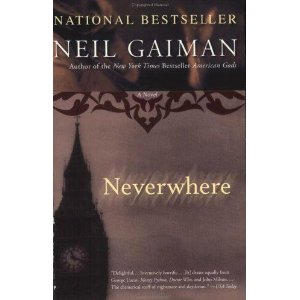
Novel: Neverwhere

I’m not a big fan of fantasy novels. I want to like them—I like the covers—but somehow the minute I get to the first character named something like Argon of Goodweald or Brax the Trog, I lose interest. I can sit through a movie like that happily enough, but a book takes a lot more time and effort and I want it to somehow resonate with life, real life, my life.
But there are, of course, exceptions. For one reason and another, I recently found myself reading two children’s books by the popular fantasy author Neil Gaiman: Coraline and The Graveyard Book. I thought they were both terrific and actually think Coraline might be a classic (by which I mean a book that will be read after everyone alive when it was written has died. As opposed to, say, an essentially crappy rock song still occasionally played in elevators). So I thought I’d try one of his adult books. Couldn’t get very far into American Gods. Then picked up Neverwhere.
Neverwhere had its start as a BBC television series that aired in Britain in 1996. I lived there at the time but never got into it. The book is an adventure story set in the magical London Below, which is in the underworld of the London tube. The plot is powered by a series of imaginative puns on the names of underground stops. So, for instance, there’s an angel at Angel, a dark bridge at Knightsbridge (Night’s Bridge) and so on. The hero, Richard Mayhew, is a rather classically hapless Englishman who gets swept out of his dreary life into a world of enchantment and danger after he helps a refugee from this magic world. Gaiman later adapted the series into a novel.
And it’s delightful. A very pleasurable, sometimes funny, sometimes moving read with some very fine moments. The first half is especially good and so’s the ending, but it’s fun throughout. Plus, unlike so many British novelists, Gaiman manages to get through the entire story without one surly remark about Margaret Thatcher. The book wasn’t as superb as Coraline, but it certainly made me want to see if I could find some other novels like it: novels that go outside the realm of reality while still somehow remaining emotionally relevant to our lives. Feel free to leave suggestions.
Meanwhile, if you haven’t tried Neverwhere, I recommend it.





Well, I could suggest one of my own novels, the latest of which is “West Oversea”: http://www.amazon.com/West-Oversea-Norse-Mystery-Adventure/dp/0979673682/ref=as_li_tf_cw?&linkCode=waf&tag=brandbooks-20
Historical fantasy based on actual events and characters. The names are odd but authentic. And it’s endorsed by Hunter Baker, whose “The End of Secularism” you liked.
If you want a free review copy, contact me personally.
I make so bold as to add the link to the book trailer: http://www.youtube.com/watch?v=82L6m73Yu3g
Just finished reading Flashback by Dan Simmons. It’s a dystopian novel set 25 years in the future. Excellent fantasy rooted in reality that seems scarily possible.
If you can find it (and unfortunately that’s a big if), try “Veronica,” by the poet Nicholas Christopher. Fits perfectly the classic definition of surrealism: The eruption of the marvelous into everyday life.
And considering what you do for a living (very well, I must add: “Empire of Lies” went beyond cool!), you owe it to yourself to enjoy “The Chinatown Death Cloud Peril,” by Paul Malmont. Features the eruption of pulp adventure into the everyday life of (the real) pulp adventure writers Lester Dent and Walter Gibson. (Avoid the sequel, which wasn’t nearly as much fun.)
I will not suggest a modern fantasy novel. I will, instead, suggest that you consider reading one of the greatest forgotten novels of the last century: John Dos Passos’ three-volume USA.
Dos Passos was one of the literary lions of the period immediately following WWI, but he broke with the Left (the kiss of death in the official culture) during the Spanish Civil War, when a close friend of his was arrested and summarily murdered by the Loyalist forces, a type of occurrence familiar to readers of Orwell’s Homage to Catalonia. Dos Passos’ up-to-then-pal Hemingway defended the murder to Dos Passos, which was the end of their friendship and the beginning of Dos Passos’ undeserved slide into literary obscurity.
USA consists of 3 books: The 42nd Parallel, Nineteen Nineteen, and The Big Money. Together, they chronicle America from the turn of the 20th century through the eve of the ’29 stock market crash, primarily by following the interlocking lives of a number of disparate characters. But wait—there’s more! There are also the Newsreels, which contain snippets of news stories and popular songs; the “Camera Eye” sequences, which are stream-of-consciousness autobiographical flashes of Dos Passos’ own life; and various free-verse biographies of the great and celebrated. It is a dizzying kaleidoscope, like America itself: to be fully appreciated, it should be read in an edition featuring Reginald Marsh’s superb illustrations.
Dos Passos was a vague lefty when he wrote the book, but was easing away from leftism by the time the last volume was completed. His break with the Left is clear in his later novel Midcentury, which details, among other things, his disenchantment with unions—quite a step for someone who started out vaguely pro-IWW.
No, USA is not a “fantasy” novel—not in the sense of the post here. But it does bring the reader close to a United States which is, today, almost as much a fantasy or legend as the contrived fantasy-inventions of today’s writers, who would never dare to attempt, as Dos Passos does, to limn real people in their own time merely because they are real.
Gaiman’s Anansi Boys is related slightly to American Gods (Gods borrows one character from Boys) but is stylistically very different, hailing back to Thorne Smith’s novels from the 20′s: a staid, uptight man in a happy rut interacts with the gods and everything goes to heck (one of Smith’s novels was the basis for the Topper series of films). Along with Smith another influence on Gaiman is James Branch Cabell, whose novel Jurgen might well appeal.
And for whatever the value of an endorsement of an anonymous Internet poster, Lars Walker’s novels are quite enjoyable, treading the interface of 1st Millenium Christianity and older faiths in a way respecting both.
There is a sub-genre of Fantasy which projects contemporary Americans into fantasy realms, playing with the fish-out-of-water. Older novels of this sort would include L. Spargue deCamp’s collaboration’s with Fletcher Pratt, Land of Unreason and The Compleat Enchanter; more recent is Christopher Stasheff’s Her Majesty’s Wizard, which examines the consequences of Catholicism in a medieval culture. In many cases these days, Fantasy is the only fiction where one can seriously discuss religion and faith.
In case you don’t know, this is considered Gaiman’s magnum opus:
http://en.wikipedia.org/wiki/The_Sandman_(Vertigo)
But if you’re looking for writing, I recommend the works of a Polish writer, Andrzej Sapkowski. His stuff is popular in neighboring countries, spawned two successful video games (The Witcher series), and now is being translated into English. Two tomes have been published: The Last Wish, a collection of short stories based on classic fairy tales seen from a cynical viewpoint, and Blood of Elves, the first tome of the witcher’s saga. Both are set in the same grim never-land and are fast-paced, moving writing not afraid to take on moral problems. The author is a definite leftie, but makes a point of not making it show.
Oh, and I really enjoyed your Empire of Lies. The ending was a little disappointing, but overall the experience was very refreshing.
You do realize that Tolkien both established, and destroyed, the genre in one (okay, 4 or 5) swell foop.
For every five LOTR knock-offs, there is one brilliant novel or series. Fantasy gets a bad name from the innumerable poseurs, but the good stuff is VERY good.
For something more original, I recommend the author China Mieville. He’s an English commie, but politics aside, his fantasy is very original. No elves or dwarves, guarenteed.
Check out Stephen R. Donaldson’s “The Chronicles of Thomas Covenant” series. As I recall, nearly all the characters are human and it begins in the real world.
If that suits you, some other good fantasy series which are closer to Tolkien’s high fantasy are the original Shannara series and The Death Gate Cycle series. I first read the Shannara books as a young teenager, but still enjoyed them when I read them again in college.
For something different and fun (not fantasy), check out Nevermore by Harold Schecter. It’s a murder mystery with Edgar Allan Poe and Davy Crockett as the unlikely protagonist duo, written from the perspective of Poe.
I’m partial to Terry Pratchett’s Discworld. His plots are all old ones, but his characters really bring the stories together. All of them are their own people, and their interactions are breathtakingly human (even the trolls). He’s collaborated with Gaiman before, too.
My personal favorite of Pratchett’s is a book called Night Watch, which is essentially Les Miserables in a fantasy world, time-travel included. The twist is that the character standing in for Javert is a principled hero, and the character standing in for Valjean is a murdering psychopath. In the end, it’s very pro-cop and pro- right to bear arms. Wonderfully refreshing, especially from a Brit.
Oh, and I forgot to recommend anything and everything by Lord Dunsany. Pre-Tolkienian genius, that man. Needs more love.
You forgot to mention funny. It’s the first thing I’d say about Terry Pratchett.
You can spend the better part of a lifetime working your way the Turtledove Universii. My abolutle favorite is ‘The Videssos Cycle’. Believable charectors, mainly because most were real historical figures. With a twist. http://en.wikipedia.org/wiki/Videssos_cycle
If you liked Neverwhere, you would enjoy reading Sandman, Gaiman’s earlier masterpiece. Its a collection of stories about Morpheus, the Lord of Dreams from Greek mythology.
There is only one catch. Its a comic book which has been promoted to “graphic novel” now being reissued in hardcover form. So avoid it if you don’t like comics.
No one has mentioned “A Song Of Ice And Fire” by George RR Martin. HBO is doing it justice, but the books are truly incredible. A billion characters, each with such a distinct way of speaking and thinking that you never have trouble remembering who is who. Also, it isn’t in any way predictable, like most of the genre is. You just never know who is going to prosper, who is going to die, who is going to a dungeon. Very cool.
Maybe I shouldn’t do this, but I always feel compelled to leave cautions when TSOIAF is mentioned. Yes, it’s brilliant. In my opinion, the greatest achievement in fantasy since Tolkien’s.
And yet I gave up on it. Martin seems to despise both his readers and his characters, and delights not only in doing the unexpected, but in doing the horrific. Once I figured out what he was doing (I could be wrong, of course) I stopped reading the books. Life is painful enough.
Martin’s series isn’t finished. I expect he will pull a Robert Jordan and drag it out another decade. Don’t start the series until it’s completed.
I read the first four books before realizing the series wasn’t done. Despite enjoying it, I’m content to pretend the story ended in the fourth book.
Hey, AK, thanks once more. You’re my go-to guy for good books and movies. Keep up the good work. I was living in the UK the same time you were, but completely missed this guy. I read his bio- he just married a wild woman. I don’t know how long that will last, but he sure do write charming prose.
It took me a bit to get into American Gods myself, but I’ll tell you… once I got into it, I thoroughly loved it. I’ve been meaning to pick up Neverwhere and I need to… we’ll see about doing that soon
I had no idea children’s books were this popular. In last week’s renaissance faire, Michael Todd galleglas showed up to promote his books including jalludin road.
Anything by Neil Stephenson rates top notch–fantasy grounded in real history; Harry Turtledove gets my second to a recommendation from another commentor; for light reads with some heft try Jim Butcher’s Dresden Chronicles.
Seriously, no one here mentioned Good Omens?! Neil Gaiman and Terry Pratchett’s comedy/fantasy story about the Apocalyse. Absolutely their best work.
Why are fantiasy movies so enjoyable and the books so clunky?
Gaiman is the only case where this is reversed.
Please keep up the quest – I’d like to find more to enjoy in this genre.