





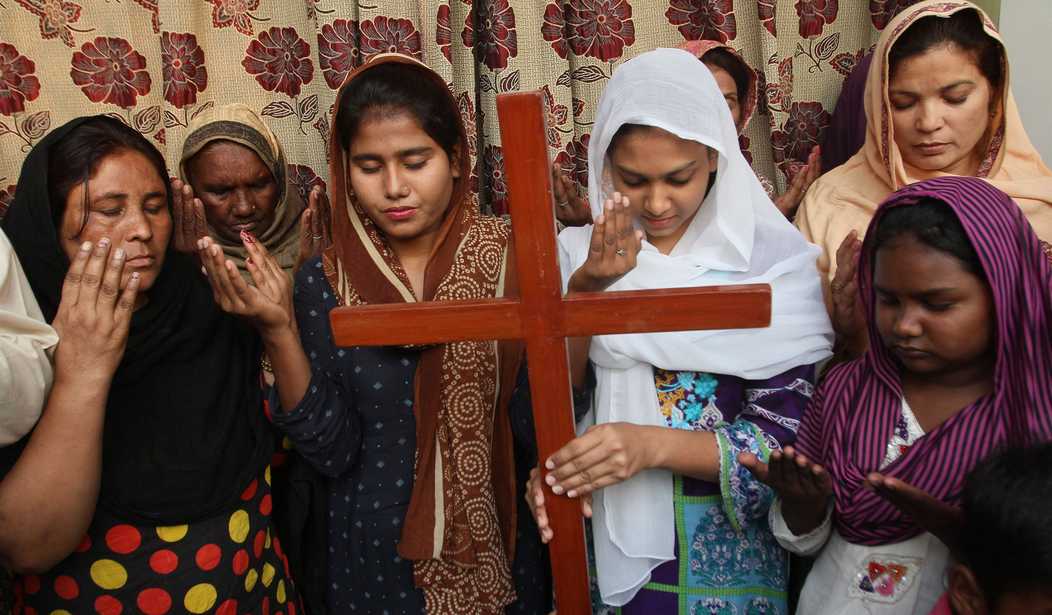
August 11 was declared in Pakistan the official "National Minorities Day" in 2009 in response to a campaign led by Shahbaz Bhatti, Pakistan’s first Catholic federal minister for minorities and a prominent advocate for religious freedom.
The date commemorates Muhammad Ali Jinnah’s historic address to Pakistan’s Constituent Assembly on Aug. 11, 1947, in which the country’s founder declared that citizens were free to practice their religion and that faith should have no bearing on equal citizenship.
Bhatti was assassinated in Islamabad on March 2, 2011, for his vocal opposition to Pakistan's blasphemy laws. Those laws carry the death penalty for insulting Islam or Mohammed.
Two assassins sprayed the Christian minister's car with gunfire, striking him at least eight times, before scattering pamphlets that described him as a "Christian infidel." The leaflets were signed "Taliban al-Qaida Punjab."
Bhatti's death followed the assassination of Punjab governor Salmaan Taseer just two months prior, who had also criticized the blasphemy laws.
Fifteen years after Bhatti's assassination, Christians, Hindus, Ahmadis and other minority communities continue to report discrimination, attacks on places of worship, abductions, forced conversions and marriages of underage girls, and misuse of the country's blasphemy laws. All of these abuses stand in contradiction of Pakistan's constitutional guarantees of equal citizenship.
One of the thousands of victims is Aneeqa Ishaq, a 16-year-old Christian girl in Lahore, who was abducted by a Muslim man who then forced her to convert to Islam and coerced their marriage. After her recovery from captivity in July of this year, she filed a petition in a Lahore family court seeking to have the marriage declared void. Aneeqa's family have since moved away from their rented home and even changed their phone numbers, fearful of being traced.
On August 11, 2026, marking Pakistan's National Minorities Day, Christians and members of other religious minority communities as well as civil society activists gathered in three major Pakistani cities for the annual Minority Rights March.
They called for constitutional equality and religious freedom, urging the government to move beyond ceremonial celebrations to address long-standing discrimination.
Rallies in Karachi and Faisalabad pressed for constitutional amendments allowing non-Muslims to serve as president or prime minister. They also asked for curbs on blasphemy law abuse. Protesters confronted the unfulfilled promise of equal citizenship first outlined by Muhammad Ali Jinnah, the founder of Pakistan, in his historic August 11, 1947 address. They presented an 11-point charter which demanded systemic and legal reforms.
In Karachi, more than 2,000 protesters gathered at the mausoleum of Jinnah. They carried placards reading “My religion, my will” and featured photographs of victims of mob lynchings, forced conversions, blasphemy-related attacks, and assassinated Christian leaders.
“Young people are saying: ‘We shall snatch our freedom,’” Luke Victor, organizer of the Minority Rights March, told EWTN News.
Addressing the rally, speakers demanded an end to faith-based discrimination and violence against religious minorities. They also called for changes to constitutional provisions which deny minorities equal access to public office. Victor said protesters wanted Articles 41 and 91 of the constitution amended to allow minorities to become president or prime minister on merit.
The Minority Rights March’s 11-point charter called for stronger political representation, curriculum reforms, protection of minority property and worship places, safeguards against blasphemy-law abuse, and independent national and provincial minority rights commissions. The groups said rising violence, discrimination, and attacks on minorities had fueled fear and insecurity, particularly among young people.
In Faisalabad, Catholic lawyer Akmal Bhatti, a nephew of Bhatti, led a rally for greater protection of freedom of religion and belief. Participants demanded a ban on the forced conversion of minors, a 5% quota for minorities in public services and educational institutions, direct elections for reserved seats, removal of religious qualifications for the president and prime minister, and the creation of a constitutional National Minority Rights Commission.
Non-Muslims accounted for about 14.2% of Pakistan’s population in the country’s first census in 1951. According to the 2023 Population and Housing Census, non-Muslims now constitute roughly 3.5% of the country’s population of about 247.5 million.
Pakistan’s religious minorities include Christians, Hindus, Sikhs, Ahmadis, Baha’is, Zoroastrians, Buddhists, and followers of the Indigenous Kalash faith. Pakistan’s constitution establishes Islam as the state religion.
In its 2026 annual report, the U.S. Commission on International Religious Freedom (USCIRF) recommended that Pakistan be redesignated as a Country of Particular Concern (CPC) for "systematic, ongoing, and egregious violations of religious freedom." According to the USCIRF's 2026 report,
In 2025, religious freedom conditions in Pakistan continued along a troubling trajectory. The government continued to enforce its strict blasphemy law, impacting people of all faiths, including religious minorities. Increasing vigilante attacks and mob violence targeting religious minorities, specifically Ahmadiyya Muslims and Christians, contributed to an intensified climate of fear and intolerance.
Authorities continued to wield the blasphemy law and its death penalty provision to punish those deemed to have insulted Islam:
In January, four individuals were sentenced to death for allegedly posting blasphemous content on social media. The same month, a mentally ill Christian man, Farhan Masih, was imprisoned on blasphemy and terrorism charges. Despite being acquitted, Masih could not return to his village out of fear for his safety.
In February, a sessions court sentenced another man to death after a member of Tehreek-e-Labbaik Pakistan (TLP) accused him of “insulting religious sentiment.”
The following month, the Lahore High Court removed from its case list Professor Junaid Hafeez’s appeal hearing related to charges of blasphemy. Authorities have held Hafeez in solitary confinement since 2014, and a sessions court sentenced him to death in 2019. His trial has been pending since 2020.
While Pakistani authorities acquitted several individuals accused of blasphemy throughout the year, societal discrimination and years of poor treatment in prison continued to severely impact the released prisoners.
In July, Pakistan’s Supreme Court acquitted a Christian man, Anwar Kenneth, of blasphemy charges after he served 23 years on death row.
In October, a high court acquitted Christian pastor Zafar Bhatti of blasphemy charges after he spent 13 years in prison. Days after his release, Bhatti succumbed to cardiac arrest after years of medical neglect.
Christian community members criticized the Pakistani government for failing to deliver justice and accountability for the 2023 Jaranwala attacks, where mobs destroyed churches following blasphemy allegations. In June, Christian communities accused authorities of ignoring evidence after a Pakistani court acquitted 10 Muslims involved in burning a church during the 2023 attacks. In August, victims of the Jaranwala attacks held protests to mark the two-year anniversary and reiterated calls for government action.
In July, Justice Ishaq Khan of Islamabad’s High Court ordered the government to open an investigation into the use of the blasphemy law. This announcement received widespread opposition by the TLP, and the order was subsequently suspended.
In 2025, violent attacks against religious minorities occurred with impunity and in some cases under accusations of forced conversions.
In March, a Muslim man attacked his coworker Waqas Masih, a 22-year-old Christian man, by slitting his throat, accusing him of committing blasphemy by touching an Islamic textbook with “unclean hands.”
Days later, a Muslim man shot and killed a Hindu man, Nadeem Naath, after he allegedly refused to convert to Islam.
In September, two gunmen attacked Christian pastor Kamran Naz as he traveled to Islamabad to lead a church service. The pastor previously received death threats and was accused of “proselytizing among Afghan refugees.”
Reports of forced conversions among Hindu and Christian girls in Punjab and Sindh Provinces continued throughout 2025.
In February, a 12-year-old Christian girl was reportedly forcibly converted to Islam and married to a 35-year-old man in Sindh Province.
In July, the Sindh Human Rights Commission expressed concern about the alleged abduction and forced conversion to Islam of a 15-year-old Hindu girl, Shahneela, in Matli. In a police report, her uncle alleged that two armed men forcibly entered the family’s home and kidnapped Shahneela.
In 2025, throughout Pakistan, authorities continued to impose restrictions on Ahmadiyya Muslims’ ability to practice their faith and allowed for assaults against Ahmadiyya mosques.
In February, a mob of TLP members destroyed minarets of an Ahmadiyya mosque in Sialkot without police intervention.
In March, authorities arrested dozens of Ahmadiyya Muslims, including children, for offering Friday prayers.
Days later, police issued two First Instance Reports against two dozen Ahmadiyya Muslims, based on a complaint from TLP members that the community was sacrificing animals for Eid-ul-Adha. In April, a mob affiliated with the TLP stormed an Ahmadiyya mosque to prevent the community from offering Friday prayers. During the attack, the mob beat to death an Ahmadiyya man, Laeeq Cheema. Police allegedly did not intervene to stop the attack.
In its latest report, the USCIRF called on the US government to "impose targeted sanctions on Pakistani officials and government agencies responsible for severe violations of religious freedom by freezing those individuals’ assets and/or barring their entry into the United States under human rights-related financial and visa authorities, citing specific religious freedom violations; and to enter into a binding agreement with the Pakistani government, under Section 405(c) of IRFA [the International Religious Freedom Act], to encourage substantial steps to address violations of freedom of religion or belief (FoRB)."
USCIRF added that the U.S. Congress should "incorporate religious freedom concerns into its larger oversight of the U.S.-Pakistan bilateral relationship through hearings, letters, resolutions, and congressional delegations and advocate for the release of FoRB prisoners in Pakistan."
Whether the US governments and Congress will heed these calls or not remains to be seen.
Editor's Note: Do you enjoy PJ Media's conservative reporting that takes on the radical Left and woke media? Support our work so that we can continue to bring you the truth.
Join PJ Media VIP and use promo code FIGHT to receive 60% off your membership.

Join the Conversation
VIP members get the ability to comment on articles.