
“There are three things all wise men fear: the sea in storm, a night with no moon, and the anger of a gentle man.” —Patrick Rothfuss, The Wise Man’s Fear
When I was 29 or 30, I spent two weeks at the Hedonism II nudist/swingers’ resort in Jamaica for the filming of National Lampoon’s Strip Poker. There were Playboy models, WWE divas, centerfolds, and a young Olivia Munn. (Plus hot tubs, nude beaches, and unlimited booze.)
Every night there, I stayed in my hotel room, reading the Bible.
Look, folks. Some stories don’t pass the sniff test: Your B.S. detector is flashing red. Even without a smoking gun, you know self-serving, misleading, dishonest drivel when you see it.
This brings us to Vice President JD Vance’s now-infamous X post:
One of the things the data analysts on our side obsessed over was "composition"—whether the electorate looked close enough to 2024 for Republicans to win. And despite polls that showed a Democrat blowout, the data kept on telling us the same story: in some states turnout was merely OK, in other states it was downright amazing, and in no state was it catastrophic. There was a genuine sense of optimism on our team: our people were showing up. So, I asked the smartest data guy I know, does that mean we're going to shock the world? "No," he told me. "We might do better than the polls suggest. But the data is telling us that a lot of Trump/Vance 2024 voters are pissed and planning to vote for the other guys. Our voters are turning out, but they may not vote for us." Well, that looks prophetic now. Our voters did show up. In Florida, for example, the electorate was 9 points more Republican than Democrat, just a couple points worse than 2024. Undoubtedly there were places we could have done better on turnout. But the main problem is not turnout. The main problem is that many people who voted for Trump/Vance in 2024 voted for Democrats in 2026. There will be a lot of infighting and arguing over what happened and why that is. One of the pollsters I really respect told me that our economic messaging wasn’t sharp enough down the stretch. I’m sure that’s true. But the real reason we lost is obvious to almost everyone. Another pollster—one of the smartest people I know in politics, told me yesterday we’d lose the generic ballot by 13 points. I felt negative going into Tuesday, but even I was shocked by this. In his polling, he saw that a lot of Trump 2024 voters were angry and planning to vote for Democrats. He asked those voters who had abandoned us what would cause them to come back on our team. The top four answers, accounting for nearly all of the responses were: 1) End the war 2) Focus on cost of living/inflation 3) Put America First 4) Change our relationship to Israel Our voters showed up. And the above four reasons are why many of them voted for Democrats. This is according to a pollster who nailed the results. While many spent Monday attacking Rachel Campos Duffy for calling for a diplomatic resolution to the conflict, it turns out her political advice was sound. (She’s also a great person.) In the next few months, there's going to be a lot of gaslighting. Expect to hear any number of establishment politicians say the solution to our woes is amnesty. I'm open to the idea that we should change enforcement—by focusing more on businesses that hire illegal labor, for instance. But anyone pushing amnesty is lying to you. The reason we lost is the war. The president himself said so last night. If you'd like to argue it was worth it, that losing the Senate for the next 6 years was worth it, then do so. Argue it was a worthwhile cost to pay. Agree or disagree, that's at least honest. But everyone knows why we lost. And any honest conversation about where we go from here must start there. I remain hopeful about our country. To the people who are pissed off and want to say, “I told you so”: you’re right, you did tell us so. Take that energy into electing Republicans who share your worldview. To the people who are just pissed at the results, you should be. Let’s take that anger and get back to the work of saving our country.
— JD Vance (@JDVance) November 4, 2026
The fallout was extraordinary. Most commentators — including yours truly — focused on the immediate carnage: President Trump quickly “relieved” Vance of his foreign policy responsibilities, and publications like the New York Times and CNN noticed the rising stature of Secretary of State Marco Rubio. Soon, this was reflected in the 2028 polling, where Rubio shot 16 points (!) past Vance to become the new GOP presidential frontrunner.
This was a yuuuge deal and a major breakthrough: For the first time since 2015, someone other than Trump or Vance is in pole position. That alone was a “Stop the presses!” moment.
But the real story is the aftershock.
When it comes to big, momentous events, our brains can’t absorb everything all at once. Emotions must “marinate” in our minds before hardening.
And for Republicans, the size and scope of the blue wave was a big, momentous event. Even if you figured we’d lose the House and probably the Senate, losing this dramatically was jarring. It was emotionally devastating.
Our base needed time to take it all in.
Now we have. And today, a new consensus has emerged — a consensus that will give birth to a new Republican Party:
- Donald Trump was one of one, for (mostly) better or (occasionally) worse. There won’t be a “next” Donald Trump.
- Electability is king. We simply can’t risk the Dems controlling the House, the Senate, and the White House in two years.
- The MAGA coalition shattered in 2026 — so in 2028, the GOP nominee must build a new coalition.
Number one rebooted the 2028 debate by stripping Vance of his inevitability: If there won’t be a “next” Donald Trump, then obviously, his veep can’t run as his automatic successor. Because, clearly, Vance and Trump are VERY different. They’re different men with different policies, different beliefs, different allies, different styles, different advisers, and different temperaments.
So even if you loved Trump, you’re not necessarily all-in on Vance. (And if Vance can’t rely on Trump supporters in 2028, he’s in a world of trouble.)
Number two prioritized electability over status or ideology. Since Vance’s VP status and America First ideology were his primary selling points, that further hurt his 2028 chances.
But it boosted Rubio, because electability is seen as his strength.
Number three is where things get dicey. Because if you’re Team Vance, you could make an argument that his X post represented the smartest, most high-probability path to Republican victory.
The MAGA coalition that won in 2024? With Ben Shapiro, Tucker Carlson, Mark Levin, Candace Owens, Joe Rogan, Nicki Minaj, Charlie Kirk, Sean Hannity, Thomas Massie, Theo Von, Lindsey Graham, Dave Smith, Alex Jones, Kid Rock, Dana White, and RFK Jr.?
Sorry, but we ain’t getting that gang back together again.
Our 2024 coalition was a product of its time. Demographically, culturally, and emotionally, our country has changed. Not completely, of course.
But enough so that a “greatest hits” 2028 campaign that partied like it’s 2024 would crash and burn. It would come across as sad, pathetic, unoriginal, and (badly) dated. We’re not gonna win the future by going retro.
We win by moving forward.
This was one of Vance’s arguments: Instead of reassembling the past-its-prime 2024 MAGA coalition, we need to build the Next Big Thing. Forget about where the puck was two years ago; we’ve got to skate where it’s going.
JD Vance’s solution is the New Right.
The New Right is similar to MAGA, but anti-Israel, isolationist, less ideologically opposed to socialism, hostile to tech, open to conspiracies, and more aligned with Tucker Carlson. In Vance’s mind, this is the backbone of the next great GOP coalition.
And maybe he’s right.
Maybe the Democrats will be so over-the-top in their Jew-hatred and Israel-bashing that Zionist voters won’t have anywhere else to go. Maybe the GOP could slide considerably in the anti-Israel direction, attract more Zoomers and undecideds, and still retain enough Zionists to juice its numbers. Maybe, with Boomers dying off, that’s the direction the puck is moving.
Maybe Carlson is a strategic genius. Maybe he’s not an antisemite at all. Maybe his fixation on Jews and his obsession with Israel was smart, data-driven politics.
And hey, maybe I spent every night at Hedo II in my hotel room, reading the Bible.
The most charitable interpretation of Vance’s screed was that he’s making common-sense, pragmatic concessions to political reality. Since the voters have abandoned Israel, we should, too. There are now more Zoomers than Boomers in America, and Zoomers are highly anti-Israel.
Like it or not, that’s where the puck is going.
So we sacrifice the Zionists in 2028, pick up Carlson and the podcast bros, add the anti-war/isolationists, and win back the Zoomers. Potentially, that’s a winning coalition — and the perfect pragmatic solution.
This is also the problem: A majority of Republicans — especially in the early states — view Israel not as a pragmatic problem, but a moral calling. (And they feel similarly about antisemitism, too.)
It’s a dealbreaker. Vance is trying to kick us out of our own movement; his X post was his mission statement, and it’s triggering ferocious blowback.
Until now, most of the GOP blowback was online — where it can be ignored. But a few days ago, it finally went mainstream.
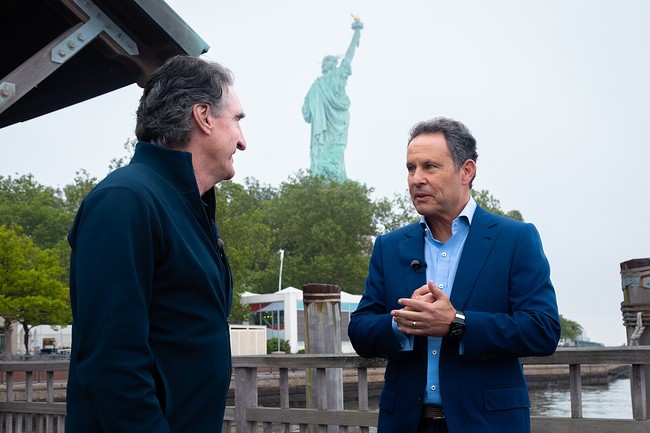
Enter Brian Kilmeade of Fox News.
Fox’s Brian Kilmeade Goes Scorched Earth On JD Vance: ‘Never Should Have Been Vice President’ https://t.co/07rM0k73VG
— Mediaite (@Mediaite) November 18, 2026
In PR, the messenger shapes the message. Brian Kilmeade is a familiar face; he’s co-hosted Fox & Friends since 1998. For decades, American families have woken up with him, drank coffee with him, and listened to him as we got ready for work. He’s likable, sincere, kind, and credible.
We’ve watched him enough to know that he’s not a nutjob, a bomb-thrower, or someone who needlessly bashes his fellow Republicans. He doesn’t chase clicks like Tucker Carlson; he doesn’t court controversy like Candace Owens. That’s just not who he is.
Brian Kilmeade is as mainstream, middle-of-the-road, and noncontroversial as it gets!
Folks, when you’ve lost Brian Kilmeade, you’ve lost the Republican middle. It sends a signal to the rest of the party that Team Vance isn’t ready for the big leagues. Not now, and maybe not ever.
If Team Vance were smart, it would course correct. A pragmatic argument won’t win a moral debate. Even if he were right, his approach is wrong.
But it's not. It's doubling down instead, insisting that attacking Vance is tantamount to attacking Trump.
Even though that’s absurd — and Kilmeade, correctly, isn’t ceding an inch:
Critical of Trump ? no
— Brian Kilmeade (@kilmeade) November 19, 2026
Kilmeade just made it permissible for the rest of the GOP to condemn Vance, too. He opened the floodgates.
It’ll quickly become a mainstream GOP position. I don’t think Vance will recover.
Because the righteous rage of a gentle man is the most powerful force in PR. It’s mesmerizing and hypnotic — we couldn’t look away, even if we tried.
This was a Joseph Welch-Joe McCarthy, “Have you no sense of decency, sir?” moment.
But now, at least, we have clarity: The MAGA movement will end in 2028. There won’t be a “next” Donald Trump; we’ll be starting over with a new face, a new vision, new priorities, and a new coalition.
This will need to be built from the ground up.
Israel, taxes, tariffs, tech, foreign policy, the role of government — whoever wins the GOP nomination will rewrite the Republican playbook. If Vance wins, he’ll rewrite it one way; if Marco Rubio, Ron DeSantis, Ted Cruz, or someone else wins, it’ll be rewritten another way.
If you want your vision to prevail, be prepared to fight like hell for it.
And that’s the honest-to-God truth about what’s coming next. Trust me, folks, I’m not lying to you.
(Well, maybe I’m lying a tiny bit about Hedo II. But not about the rest.)