
The fatal flaw of the “War on Terror,” from its beginning in the wake of the 9/11 jihad terror attacks to its ignominious end with the fall of Kabul in Aug. 2021, was that “Terror” is not really an enemy; it’s a tactic. A “War on Terror” was akin to a “War on Bombs” or a “War on Ballistic Missiles.” Various countries have employed terror as a weapon of war throughout the ages; it is not an element of one particular belief system or ideology.
That is, in fact, why the George W. Bush administration dubbed its response to the 9/11 attacks a “war on terror.” The hijackers weren’t acting directly on behalf of any particular government or governments, so the U.S. couldn’t go to war with specific countries. Anxious not to antagonize Muslim countries that the U.S. counted as allies, Bush declared that Islam was a religion of peace, and set the nation on the path it is still on today, of resolutely ignoring the motivating ideology that powers the global jihad. After that, he couldn’t very well say we were fighting “jihad” or even “Islamic terrorism.”
It was around this time that the non-Muslims in the West invented the concept of “Islamism,” which does not exist in Islamic theology or law, in order to distinguish the actual religion of Islam from the crimes done in its name and in accord with its teachings. We fought “Islamist extremism” until 2010, when Barack Obama removed all mention of Islam (and “Islamism”) from counterterror training materials.
Since then, we’ve been fighting “violent extremism” or just a vague, non-specific “terrorism,” by which virtually everyone has meant “Islamic jihad,” at least until the Biden regime started behaving as if the “violent extremists” were loyal Americans who dissented from its agenda. But the concept of “terrorism,” as well as that of “violent extremism,” remains problematic, for as pro-Hamas leftists are fond of saying, one person’s terrorist is another person’s freedom fighter. Terrorism is largely a subjective judgment, as the Islamic Republic of Iran confirmed by naming one of the world’s most inoffensive military forces a “terrorist organization.”
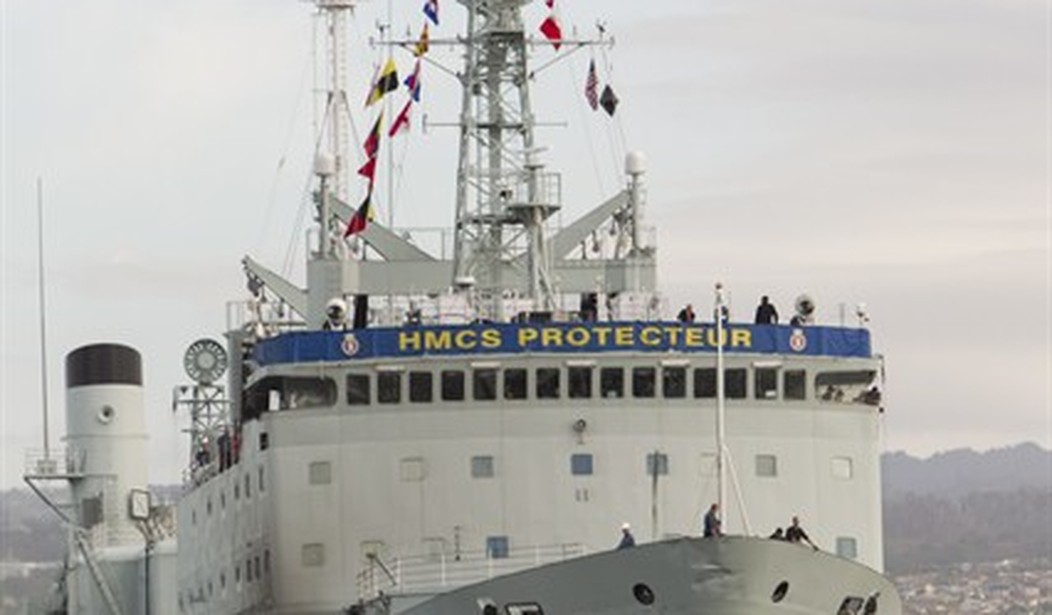
Newsweek reported Tuesday that the Islamic Republic’s embattled mullahs have “labeled Canada's navy a ‘terrorist organization,’ escalating tensions between the two countries and raising fresh concerns over diplomatic fallout.” Wait, what? The Canadian navy is a terrorist organization? That’s like saying Pee Wee Herman was a champion pugilist. Are marshmallows IEDs now?
Of course, it’s all just an elaborate game of tit-for-tat, as the Iranian government admitted, saying that the move was “a response to Canada's decision to designate the country's Islamic Revolutionary Guard Corps (IRGC) a ‘terrorist entity’ in June 2024.” This designation made it “illegal for anyone in Canada or with Canadian citizenship to knowingly deal with property owned or linked to the IRGC and froze all IRGC-related property in the country. Canadian authorities said the listing also helped to block financing for terror groups and bring charges against those implicated in terrorism.”
And so now, apparently, nobody in the Islamic Republic of Iran is going to be able to deal with the Canadian Navy. Was Canada’s seafaring fleet doing brisk business with Tehran before this? Whether it was or not, it will be no longer, as the law by which it has been designated a terrorist group has been in place since 2019, and was passed in response to the first Trump administration designating the IRGC a terrorist organization.
The Iranians responded furiously to that: “Tehran's Supreme National Security Council said in April 2019 it would treat the U.S. Central Command (CENTCOM) as a ‘terrorist organization’ and the U.S. as a ‘state sponsor of terrorism.’ CENTCOM is responsible for U.S. military operations in the Middle East, northeast Africa and parts of Asia.” And since Canada followed the U.S.’s lead on this, it is coming in for the same treatment.
Related: Islamic Republic of Iran Says It’s In a ‘Total War’ Not Just with Israel Alone
As far-left as it is, and has been for years, the Canadian government actually analyzed the IRGC more or less realistically, and stated in June 2024: "There are reasonable grounds to believe that the IRGC has knowingly carried out, attempted to carry out, participated in or facilitated a terrorist activity, or has knowingly acted on behalf of, at the direction of, or in association with an entity that has knowingly carried out terrorist activity."
Iran's foreign ministry, however, angrily rejects that assessment, saying that the designation was "contrary to the fundamental principles of international law." That’s unlikely, but the Iranians do have a point: these designations are subjective and come as the result of political calculation, not a sober assessment of what terrorism is and isn’t and careful scrutiny of the activities of the group that is being investigated. More honesty and precision from all Western governments would be, to put it quite mildly, refreshing.