
Back when the world was young and America had no illusions about it, an idea gained traction among the global elite: "real" power was exercised by, well, being nice to everyone.
Tanks, planes, guns, and missiles were fine for the "old" world. The modern world eschewed those symbols of oppression and coercion in favor of "soft power." Historically, Washington relied heavily on soft power, a term that political scientist Joseph Nye coined to describe influencing others through attraction, culture, values, and persuasion rather than coercion or payment.
Europe envied our soft power. European countries dreamed of being able to cut their defense budgets to the bone and simply influence events by smiling broadly and guiding the Third World toward humane, democratic socialism. In the 1930s, that was the official policy of France and Britain: appeasement.
In trying to be nice to everyone, the Europeans forgot one small detail about soft power: it's useless without hard power. Without the tanks, planes, guns, and missiles bristling in the face of potential adversaries, all the goodwill, foreign aid, cultural exchanges, and solemn international agreements on climate, immigration, and other global issues mean squat.
In 2010, when David Cameron succeeded Gordon Brown as British prime minister, the Brits went all in on soft power. They "pledged to meet the UN target of spending 0.7 percent of national income on overseas aid by 2013," writes Rupert Darwall of The Spectator. "The government produced a strategic defense and security review that would see defense spending fall by 22 percent in real terms."
The British nuclear deterrent was weakened considerably; the number of warheads was cut by 25%. And climate change was treated as a bigger national security threat than Russia. "Britain had checked out of geopolitics," writes Darwall.
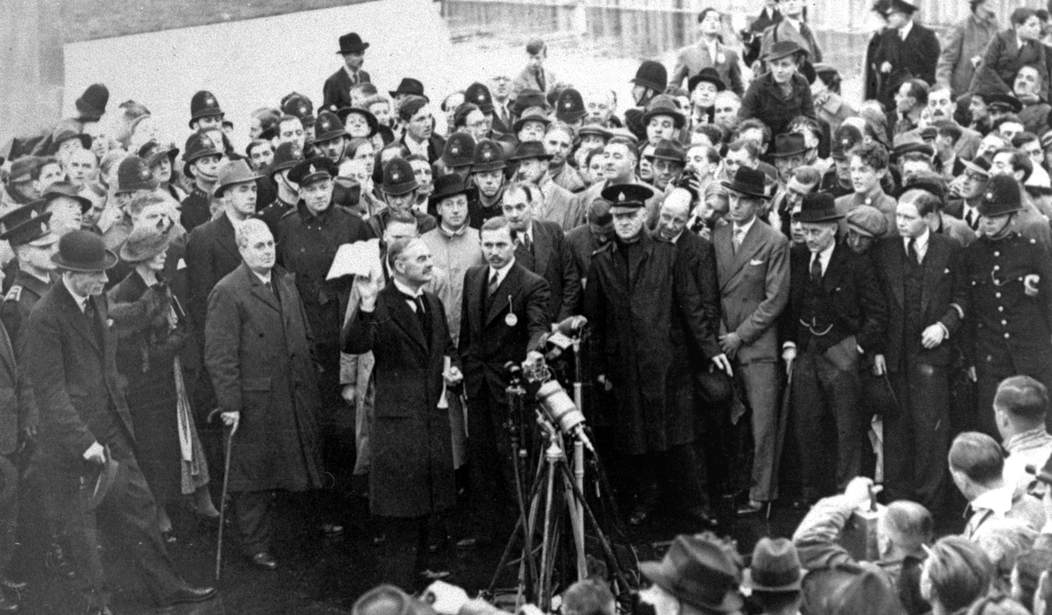
Russian Prime Minister Vladimir Putin had already made that policy obsolete by invading Georgia in 2008 and promptly occupying 20% of the country. French President Nicolas Sarkozy rushed to Moscow and, in a scene that must have been eerily reminiscent of Neville Chamberlain's trip to Munich in 1938, gave Putin everything he wanted territorially. All that was missing was Sarkozy waving a piece of paper when he stepped off his airplane.
This was the pattern set for the next decade and a half: appeasement to aggressive powers while supposedly saving the world from climate change. Three months after Russia attacked Georgia, parliament passed the Climate Change Act, imposing a commitment on Britain to cut its greenhouse gas emissions by 80 per cent by 2050.
The impact assessment, signed by the then energy secretary Ed Miliband, put the Act’s cost at between £324 billion and £404 billion (excluding transitional costs) and highlighted the intractable free-rider problem of climate policy. If the UK acted, but global emissions continued to rise, the £404 billion to £964 billion of supposed climate benefits would be distributed globally. The legislation, then, was about virtue-signalling. It was, in the words of the assessment, about ‘demonstrating the UK’s leadership’.
Huh? How does damaging your economy by withdrawing hundreds of billions of pounds of productive capital and labor and giving it to kleptocratic Third World leaders "demonstrate leadership"?
The delusional thinking was especially prevalent when it came to Russian intentions in Ukraine. "Philip Hammond, then foreign secretary, chimed in to urge Kyiv to fulfill its side of the Minsk agreements to 'make sure they can look the Russians firmly in the eye.'" Then, in 2021, at a meeting of the Organization for Security and Co-operation in Europe (OSCE), with Russia poised to invade, "US ambassador Michael Carpenter was astonished to find his European colleagues still going on about climate change when ‘all I wanted to talk about was the risk of a full-blown war.'"
That December, the OSCE asserted that climate change could ‘negatively affect prosperity, stability and security in the OSCE area’. The conclusion was praised by Britain’s ambassador, Neil Bush, who also spoke of the need to ‘mainstream gender across all dimensions of the OSCE’s work’. The Canadians, however, complained about OSCE’s weak language regarding ‘the disproportionate impact of climate change on women’. Twelve weeks later, Russia launched its full-scale invasion of Ukraine.
National delusions can be comforting to leaders of a certain mindset who refuse to face the horrifying reality that the world can be an incredibly dangerous place. If you're not ready to deter or defend against those who mean you harm, you will be forced either to surrender or go to war.
Europeans have blamed Donald Trump for NATO's woes, refusing to acknowledge that the alliance's weaknesses predate his entry into politics. A few Europeans understand what Trump was trying to accomplish. Sir Alex Younger, who led MI6 for six years, told The Economist, "We’ve been huge beneficiaries of an incredibly generous security guarantee from the United States. My strong view is that we’ve actually been infantilized by it."
Trump knows the difference between soft power and hard power. Most of Europe doesn't.