
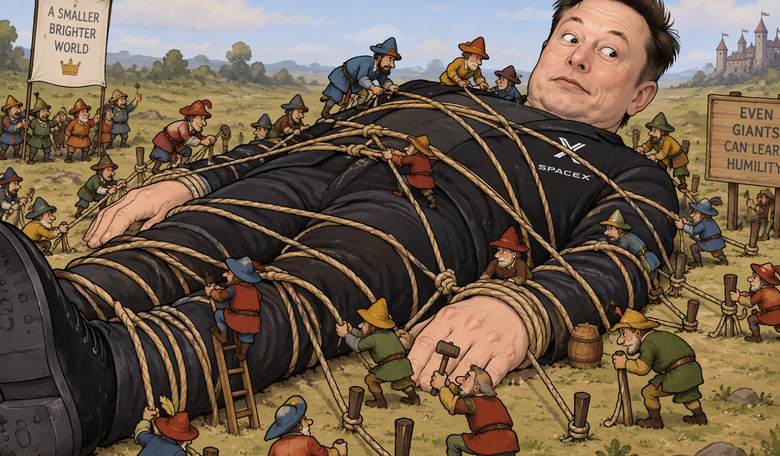
America's historical relationship with its super-rich has alternated between admiration and resentment. Americans have traditionally loved a rags-to-riches story, as the cultural mythos, from Horatio Alger novels in the 19th century to modern-day profiles of self-made tech founders, celebrates upward mobility as proof that the economic system works.
Yet, that same public harbors an ingrained suspicion of inherited wealth or fortunes built through market manipulation, viewing unearned privilege as fundamentally un-American.
"Trust fund babies" are often despised, especially if the kid shows an arrogance of privilege that puts him above the law, as was the case with the Kennedys. But ambivalence toward massive wealth also reflects a healthy skepticism about money's corrupting power and its inherently anti-democratic nature.
We have never been an egalitarian people, although we worship at the altar of equality. We talk a good game about creating a "level playing field" for all, but we honor that idea in the breach. In fact, we've never been able to reconcile our notions of individual liberty with a broad definition of "equality for all." To create that kind of society, a powerful arbiter must broker a compromise that inevitably destroys both: liberty is choked by regulation, and true equality is undermined by the very arbiter granting it.
We've only been at it for 250 years. We'll get there eventually.
No one should feel sorry for Elon Musk. He's the richest man in the world, and he's about to be attacked by a bunch of Lilliputians dressed just like Democrats who believe he should be punished for: 1) being friendly with Donald Trump; 2) supporting Republicans; and 3) being rich and successful beyond the dreams of avarice.
It's #1 that really rankles for the hysterical TDS crowd. If Musk had a picture taken with his arm around the devil, yukking it up, it would probably go over better with the Democrats.
Whenever extreme wealth concentrates at the top, the public debate quickly adapts to reflect the dual view of aspiration vs. suspicion. The exact same tycoon can be seen simultaneously as an innovative "captain of industry" who creates jobs and drives progress, and a predatory "robber baron" or member of "the 1%" who rigs the rules of the game.
For Democrats like Bernie Sanders and DSA acolytes, fabulous wealth is a trigger. Sanders and his cohorts may rail against wealth and privilege, claiming the rich don't pay "enough" taxes, but the one place they tried to punish great wealth, ordinary people rose up and smote them down.
California's Proposition 40, which would have levied a "one-time" 5% levy on those worth more than $1 billion, went down to defeat 53-47. To anyone who believes this tax would have been a one-off, I got a beautiful bridge over the Chicago River I'd like to sell you.
The flight of wealthy people from California even before the vote was significant. They aren't stupid. They know that this would be only the beginning, as the state is already running out of other people's money to spend. The next step would be to prevent the rich from leaving. In the name of diversity, equity, and inclusion, of course.
It's not enough for Democrats that Musk was humiliated by spending $475 million on Republicans running in the midterm elections, where "more than 99% of his traceable spending goes to losing candidates," according to Axios. Democrats are targeting the entire basis of Musk's wealth and, not coincidentally, threatening the future of America itself.
Armed with subpoena power, Democrats are preparing to investigate Musk's DOGE operation, its access to sensitive government data and whether his companies benefited from his extraordinary influence over the Trump administration.
Musk is already downplaying his dependence on Washington, claiming government contracts will account for less than 5% of SpaceX revenue a year from now. "Happy to cancel any that the government doesn't want," he posted Friday.
The scrutiny also extends to national security: Lawmakers are demanding answers about Musk's reported communications with Vladimir Putin and his role in the October slowdown of Starshield that disrupted Ukraine's drone operations.
For better or worse, Elon Musk's ideas and unquenchable desire to shape the future have created much of the modern world and will continue to impact the U.S. economy in ways both large and small.
He's also a key cog in American national security.
The midterms have given the backlash against AI new political muscle, threatening both the massive data centers powering Musk's ambitions and the technology behind Grok itself.
Democrats are preparing legislation that would require independent safety testing of advanced AI models and hold developers liable for harmful outputs. Lawmakers have already demanded SpaceX's AI safety records.
Voters sided against data-center development in 44 of 45 local referendums, while incoming Democratic governors in Georgia and Ohio pledged tougher restrictions. Musk joked on X: "Data centers in space looking pretty appealing right now."
The bottom line: Democrats must find a way to separate Musk the political combatant from Musk the industrialist, whose companies are central to America's technological and military power.
I predict they will be unable to do so. Their hatred of Musk and Trump, their burning envy of anyone more successful, and their messianic vision of "equity" will set back the two most important industries shaping America's future: AI and space.
Yes, but at least Musk will be humbled (or jailed), and the world will be made safe from a rich man's dreams of the future.
Exclusively for our VIPs: Manufacturing in Space, Once a Pipe Dream, Is Closer to Becoming a Reality