
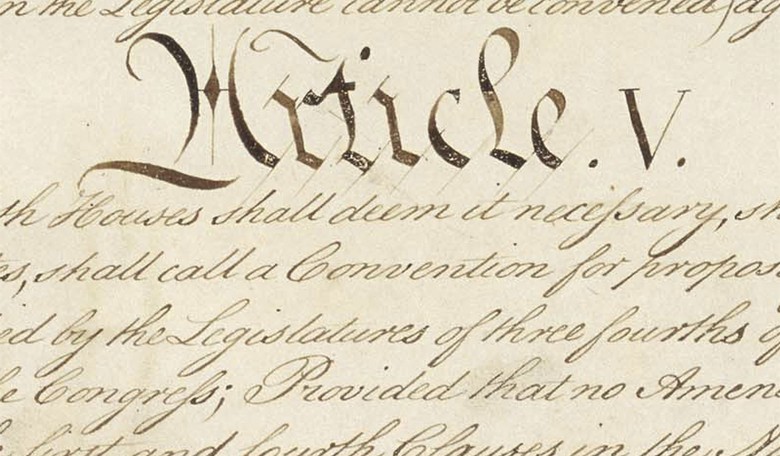
One of their first procedural actions at the Constitutional Convention was to adopt a rule of secrecy and conduct debates behind closed doors. Delegates agreed not to publicly disclose the discussions while the convention was in session.
There were sound reasons for this. Delegates wanted the freedom to float ideas, change their minds, and criticize proposals without worrying that every statement would immediately become public. Delegates also believed state governments, interest groups, newspapers, and constituents could pressure them to stick to positions before negotiations were complete.
The convention dealt with highly contentious issues such as representation, executive power, and the balance between state and federal authority. Privacy allowed delegates to bargain and revise positions more freely.
Finally, delegates feared that if they published preliminary plans, opposition might harden before they could complete a workable constitution.
I seriously doubt that any of those safeguards would be voted into place today if, by some misfortune, advocates managed to convince enough states to call for a Constitutional Convention.
So when the delegates adjourned sine die on Sept. 17, 1787, one of the most interested spectators outside the hall was Elizabeth Willing Powel, one of the most important and least known heroes of the Revolution and the early republic.
Powel was one of Philadelphia's most plugged-in people. She hosted frequent dinner parties, teas, concerts, and private chats at her salon, bringing delegates together from all sides and all classes. She was an intellectual with an extraordinary political mind. Friends with George Washington since the Revolution, Powel became a close advisor to him and other leaders of the new country.
Powel knew very well what the delegates had been talking about, despite the gag order. She had been advising Washington and other delegates from the early days of the Convention. The story goes that Powel "confronted" or "accosted" Benjamin Franklin on the steps of Independence Hall, or closer to her home on Society Hill, the day the convention adjourned and asked, "So what do we have, Dr. Franklin? A monarchy or a republic"?
"A republic, ma'am, if you can keep it," retorted Franklin.
Delegate James McHenry of Maryland (later Secretary of War) immediately noted the exchange and included it in his account of the convention. McHenry also recorded a further exchange between the two during the same conversation, not generally included in contemporary accounts, but more relevant to us today.
Powel: And why not keep it?
Franklin: Because the people, on tasting the dish, are always disposed to eat more of it than does them good.
Wise, old Benjamin Franklin.
A statement usually attributed to Jefferson or Franklin, but that is almost certainly apocryphal, fleshed out Franklin's "If you can keep it" observation:
"A democracy cannot exist as a permanent form of government. It can only exist until the voters discover that they can vote themselves largesse from the public treasury."
Forty trillion dollars later, America finds itself gorging on that "largesse from the public treasury" to the point of bursting.
We are living, as many like Glenn Reynolds point out, in a stage they call "late democracy."
Democracy — even in a democratic republic like ours, rather than pure democracy — is contingent. When you try it in the less developed parts of the world, you typically get “one man, one vote, one time.” And by less developed I don’t mean less economically developed — though that generally applies too — as less morally and civically developed. But now that kind of “less developed” describes us too. . . .
We used to say “politics ain’t beanbag,” but there were limits, on both behavior and rhetoric. The opposition was a political movement to be defeated, not an evil to be extirpated. The stakes in elections may have been high, but they weren’t existential. Nobody feared death or prison just for losing an election.
That sort of thing was for banana republics, like Brazil.
"Now we have prominent Democrats talking about throwing their opponents in jail, seizing Elon Musk’s companies — after throwing him in jail for, I dunno, the crime of being in opposition, I guess," Reynolds continues, "and enacting various changes, like packing the Supreme Court, adding Puerto Rico and DC as states, and opening the borders to ensure that no election can remove them from power again."
The combination of some voters demanding more and more services, more goodies, more freebies, and Democrats with a Vladimir Lenin complex, calling for the total destruction of their political opponents, shines a spotlight on the kind of government and people we're morphing into.
Lenin framed politics as an existential, violent class struggle where the survival of the revolution depended on wiping out opposition. He repeatedly wrote and spoke about using merciless violence and terror to secure power. Mainstream and most elected Democrats have eschewed violent rhetoric, speaking only of persecuting people like Musk for the crime of being in opposition.
Today, the political discourse has moved away from standard policy disagreements and toward framing opponents as existential threats, which degrades civic trust and mimics patterns seen in less stable democracies.
Democracies, even republics, are prone to break down over time. The Roman Republic did. Caesar crossed the Rubicon because word reached him that his political enemies planned a sham trial that would probably cost him his life. Instead he took his legion across the Rubicon and took Rome. That was the end of the Roman Republic, which had broken down morally and civically to the point that sham prosecutions were common and politics had become a death match.
Same thing today: Politicians (mostly, but by no means exclusively, Democrats) have been tearing down the guardrails for decades, doing things that earlier generations knew were suicidal for the republic. In those earlier generations, most of our politicians were products of political machines, which, whatever their flaws, had a vested interest in society holding together and a deep firsthand understanding of people and institutions.
Republics are defined as societies that are bound by a supreme set of laws rather than individuals.
Republics are defined by "representative democracy," where citizens elect representatives to make laws and govern on their behalf.
Republics are defined by instituting checks and balances, a separation of powers, and protections for individual liberties and minority rights so they cannot be easily overridden by a majority vote.
Most importantly, a republic is defined as a society that relies heavily on the civic duty, engagement, and moral responsibility of its citizens to maintain its institutions.
We are failing in all aspects of republican governance. We have lost the ability to live together, all 340 million of us. Compromise is seen as "weakness," or worse, "traitorous." As a result, nothing gets done, and critical problems threatening the safety, the health, and the well-being of millions of people go unaddressed. Most citizens have abdicated their "moral responsibility" to hold government accountable for its mistakes and crimes. They have tuned out, dropped out, and averted their eyes and ears to avoid the cacophony of millions of people screaming back and forth at each other.
I don't see how we fix it. Perhaps it's not fixable. Perhaps after 250 years of republican governance, we have played out the string, kicked the can down the road until there's no more string and no more road.
It's not the end of the United States of America, at least not right away. Maybe our genius for invention, organization, and drive to excel will find another way for 340 million people to live together. As an old man, I am not optimistic.
Related: The Democratic 'Civil War' Is Over. The Crazies Won.