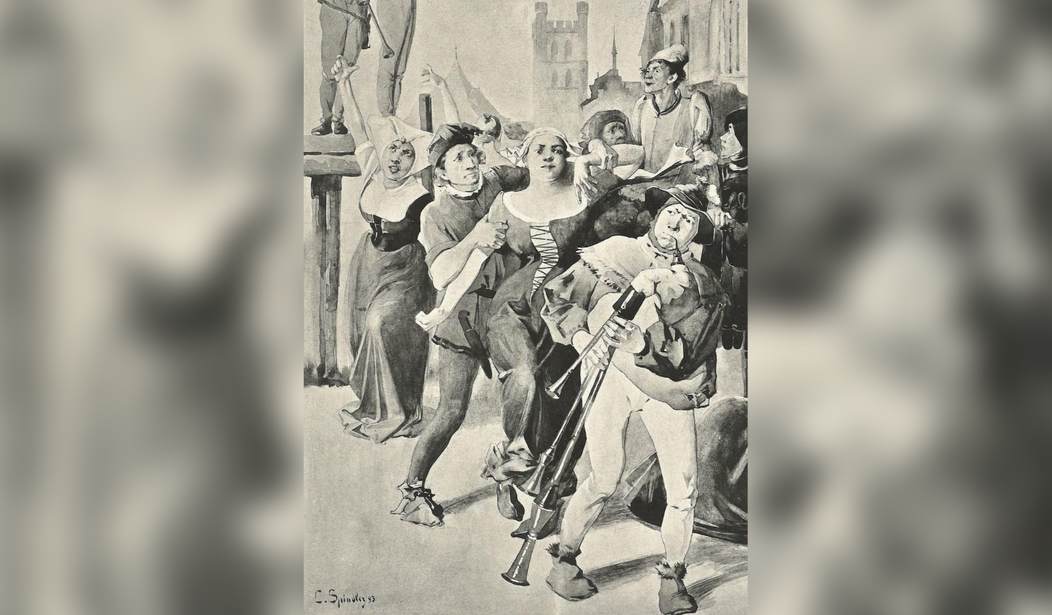

The summer of 1518 in Strasbourg, France, was hot and muggy. The city's poor were in a bad way after a couple of years of failed crops, bad weather, social unrest, religious tensions, and illnesses like smallpox.
On July 14, a woman named Frau Troffea started dancing in the street. As day turned to night, she kept dancing, not stopping to eat or sleep. Eventually, she exhausted herself and fell upon the ground and went to sleep.
The next morning she was at it again, dancing away. It's a condition known as choreomania (also known as a dancing plague) that refers to an uncontrollable, collective urge to dance that historically overcame large groups of people, most notably during outbreaks in western Europe between the 14th and 17th centuries.
Troffea’s dancing appeared to be contagious. In the next few weeks, first dozens, then hundreds, of Strasbourg residents succumbed to the dancing plague.
What evil did these people do to deserve this affliction? Medieval physicians looked to their faith for an explanation and found it in the travails of St. Vitus.
Vitus, a fourth-century Sicilian martyr, was believed to punish sinners by making them dance. Once St. Vitus decided the sinners had suffered enough, he would lift the curse.
“If people were believed to have been cursed by God or a saint for some kind of immorality, well, dancing was associated with hedonism and that was fundamentally immoral,” John Waller, associate professor of the history of medicine at Michigan State University and author of a book on the dancing plague, tells Popular Science. “A way of basically punishing oneself would be to dance to the point of exhaustion and pain and potentially even death. It would make sense with that penitential framework.” In other words, from the leaders’ perspective, if dancing was their punishment, let them be punished.
As the "plague" spread, people began to die of exhaustion, heat stroke, and heart attacks brought about by the overexertion. There was no official count of the dead, although one contemporary writer claimed 15 people a day were dying.
“They essentially banned dancing, except for some people in the privacy of their own homes, and then instituted a program of penance and prayer,” says Waller. “They clearly realized that what they’d been doing before was causing harm and I suspect they got the impression that it was making things worse.”
Strasburg wasn't the only example of this strange affliction.
The dancing plague of 1518 wasn’t the only such incident of its kind. Numerous other outbreaks of uncontrollable dancing occurred in western Europe between the late 1300s and mid-1500s—and Waller thinks it’s no coincidence that many were clustered along the Rhine River and its tributaries.
“Rivers are very good for, obviously, transporting trade goods, but they’re also very good for spreading ideas,” he says. “From the headwaters in Switzerland all the way down to where the Rhine flows into the North Sea, you’ve got this belief in a saint who curses with a dance.”
"Waller thinks there’s only one plausible theory that truly makes sense," notes Popular Science. "He suspects the dancers of Strasbourg were all victims of mass hysteria, also known as mass psychogenic illness, brought on by intense psychological distress."
There are several recent examples of mass psychogenic illness (MPI). In an incident known as the Tanganyika Laughter Epidemic in 1962, a mission boarding school for girls in Tanganyika (modern-day Tanzania) quickly escalated into an uncontrollable outbreak of laughing and crying. Spreading to neighboring villages and schools, the episodes lasted anywhere from a few hours to 16 days per person. It afflicted more than 1,000 people — mostly schoolchildren and teenagers — causing physical symptoms like fainting, respiratory problems, rashes, and crying fits.
In a modern example of culturally conditioned physical symptoms, a group of teenage girls at a high school in Le Roy, N.Y., suddenly began exhibiting neurological symptoms resembling Tourette’s syndrome, including involuntary twitching, verbal outbursts, and tics. The mystery attracted national media attention, with early public fears focusing on environmental toxins or industrial spills. Extensive evaluations by neurologists eventually determined that the outbreak was a case of mass psychogenic illness, compounded by stress and the amplifying effects of social media.
As for the dancing plague of Strasbourg, it may be that the townspeople simply had enough.
Waller suspects the people living in Strasbourg simply reached their breaking point, then entered into a trance-like state that rendered them largely insensitive to their extreme fatigue and sore feet. They danced, Waller argues, rather than weeping, fighting, praying, or engaging in some other behavior because of their belief in St. Vitus and his dancing curse.
MPI is a likely explanation for many social phenomena, including the recent unexplained affliction of U.S. embassy personnel in several countries. Our diplomats and their families suffered several severe neurological symptoms that had been theorized to have been caused by a sonic weapon of some sort. But comprehensive studies by federal health institutions, such as the National Institutes of Health (NIH), have found no evidence of detectable brain injury, structural brain damage, or biological abnormalities unique to the syndrome.
It's not "all in their head." These are real symptoms that have led some of our diplomats to retire because the symptoms were so debilitating. It may yet prove to be a sonic weapon, as the case remains open.