
How will the Earth end? That's been the subject of novels, movies, plays, short stories, and myths for centuries. The question is also tied to our deeply held religious beliefs.
We're familiar with some of the more probable end-of-the-world scenarios. The planet-killing asteroid or comet that pulverizes our planet and cracks it open like an egg. The nuclear scenario, the killer virus scenario, and the alien invasion scenario have all happened several times already, so no surprises there.
But scientists have some beautifully geeky, jaw-dropping ways that our planet could die that I now present for your reading pleasure.
Earth Swallowed by the Sun
Suppose we avoid nuclear disaster, death by Fauci, and collisions with asteroids and comets. Our sun will eventually begin to expend the last of its hydrogen, the nuclear fuel it needs to keep it alive.
Once that happens, a predictable sequence of events unfolds.
While our star isn’t by any means big enough to become a black hole or even explode into a supernova, that doesn’t mean its death would be good for Earth’s biosphere. As the sun collapses, its temperature will increase and its atmosphere will expand to completely engulf Earth. If any life manages to survive that long into the future, it would—for lack of a better term—get totally fried.
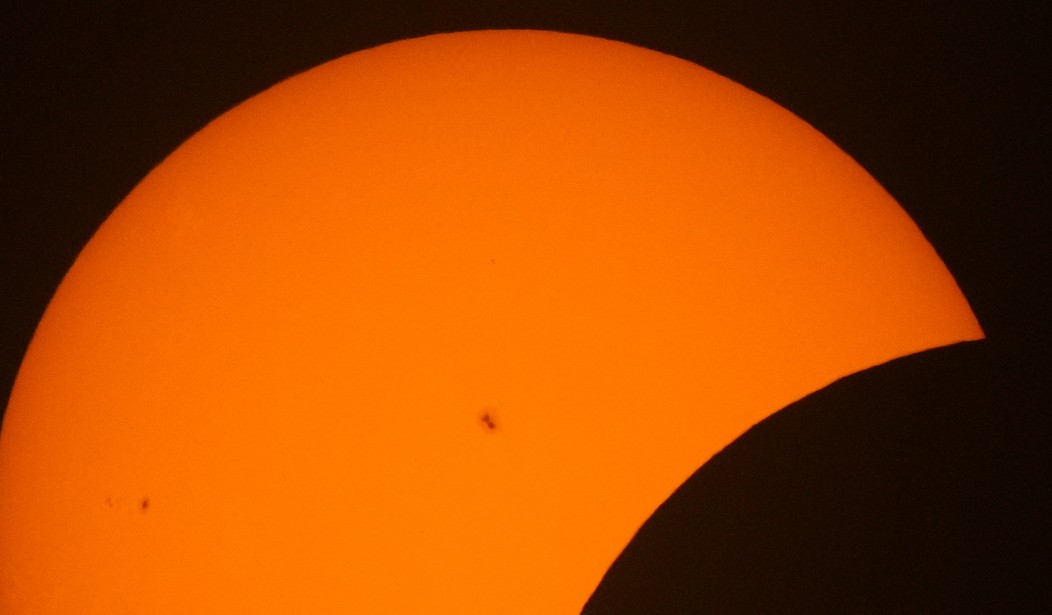
Our friendly, warming sun will become a raging Red Giant, expanding all the way out to beyond Mars. Since this scenario will happen about 4 billion years from now, most of us have little to worry about.
Except Joe Biden, of course.
The "Big Rip"
Suppose you woke up one morning and discovered to your chagrin that the universe was coming unglued. Every molecule, every atom was separating into its component parts and drifting away.
It's called the "Big Rip," and it presupposes that there's enough dark energy in the universe to maintain our expansion.
Most scientists agree that dark energy is silently accelerating our universe’s expansion, but that characteristic could be the very thing that leads to our inevitable end. Some experts believe that the universe will eventually expand so rapidly that it essentially tears itself apart—or end in one “Big Rip,” per the theory’s name. In short, the idea is that objects in the universe, from galaxies all the way down to atoms, would dissolve from each other, inevitably making the cosmos uninhabitable.
Too much space, not enough matter, and no nuclear "glue" (forces) to hold it together. It would look like we were in a Star Trek movie being transported somewhere.
The only problem is that we'd never rematerialize.
The "Holy Crap, What the Heck is That" Theory
I call it this because that’s about the only thing you’ll have time to say before your mortal coil mixes with the flotsam and jetsam from the rest of the universe.
Suppose it’s a bright sunny day and you’re out sunning yourself when all of a sudden, you notice it gets brighter. I mean really, really bright — as if someone had thrown a switch and floodlights more powerful than sunlight were streaming down. You look up, and the last thing you see before your eternal spark flees for safer climes is a great big chunk of the sun bearing down on Earth like a runaway train moving 2 million miles an hour.
It seems our stable and friendly sun suffered an extremely minor solar event; in effect, it hiccuped. It expanded and contracted extremely rapidly. As it expanded again, a couple of minor pieces that it didn’t need were flung out into space. One of them, about twice the size of Earth, headed straight for our planet. Ideally, we’d have about 45 minutes' warning, but don’t bet on it. Any solar scientist worth their salt wouldn’t be able to tear themselves away from this once-in-a-lifetime observational opportunity. Besides, do you really think anyone would tell us?
The "Big Crunch"
The opposite of the Big Rip is the Big Crunch. This one's even weirder.
Some scientists suggest that the universe will collapse back into itself, rather than expand into oblivion. “Big Crunch” theory subscribers argue that the rate of the universe’s expansion will eventually slow so drastically that gravity will win and begin pulling the universe back together—essentially undoing the Big Bang.
"In another version, the universe expands and contracts cyclically, like a lung might—so maybe this wouldn’t be the end of everything after all," says Popular Mechanics. There is mathematical evidence for this version of infinity, but we'll probably never really know.
I didn't include a scenario for AI ending humanity because the more I read about and understand AI, the less I look at it as a humanity-ending technological advance. So many horrible things would have to go wrong, and a lot of people would have to deliberately cause a catastrophe. AI ending civilization is also very remote, but slightly more possible, in my opinion.
Also for our VIPs: Physics of the Apocalypse: Testing the ‘Self-Destruct’ Button of Reality