







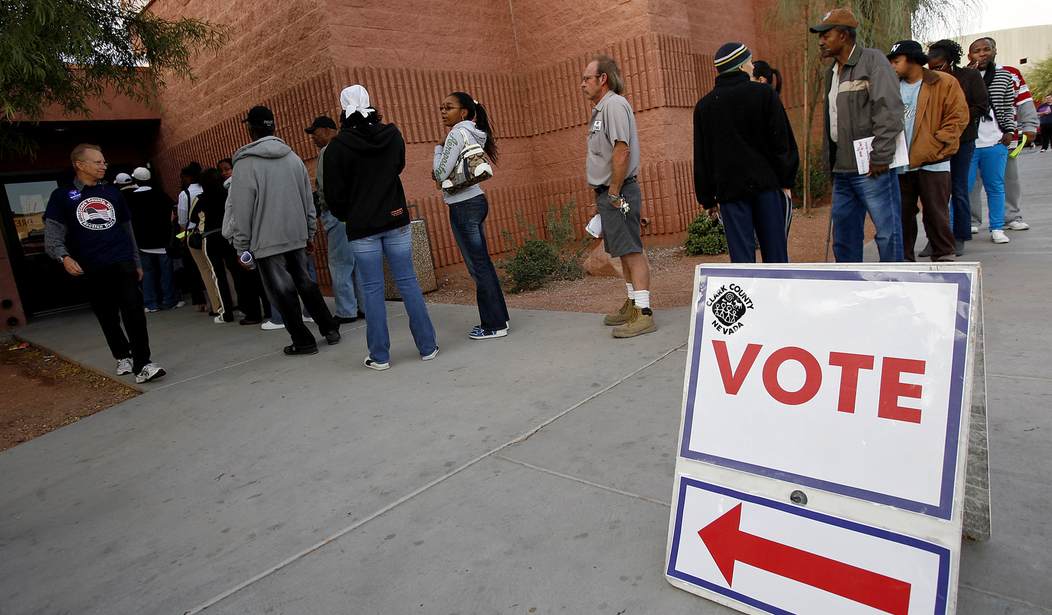
Democrats are perfectly willing to kick the Voting Rights Act of 1965 to the curb if it means gaining power in Washington, according to a Politico poll published on Wednesday.
The Republican push for redistricting across the South has Democrats in full panic mode. They may still be caterwauling about "disenfranchising" black voters in the Supreme Court's Callais decision, but when it comes to the raw exercise of power, they feel no compunction about breaking up black-majority districts to make red districts in blue states more competitive for the Democrats.
Republicans have long argued that the Voting Rights Act (VRA) was unconstitutional. Indeed, in the last two decades, the Supreme Court has chipped away at some of the Act's major tenets. In addition to the recent Louisiana v. Callais, which banned racial gerrymandering, Shelby County v. Holder, decided in 2013, struck down a key element of the act, which required certain states to obtain "preclearance" from the federal government before altering any voting laws or district maps. Section 4(b) contained the formula used to determine which areas were subject to this oversight.
It was ludicrous to claim that conditions in the Southern states in 2013 were similar in any way, shape, or form to those in 1965. The literacy tests, "poll taxes," and other odious requirements to dramatically lessen the black vote were a part of history. In fact, the Voting Rights Act became a victim of its own success, as black voters elected both black and white politicians to office.
The "majority minority" districts were a purely political mechanism to maximize Democratic Party representation in Congress. Ironically, it probably limited the number of blacks in Congress, as the act of concentrating the black vote to guarantee a black representative in a single district no doubt cost a black candidate victory in another district where blacks could have made the difference in a close race.
Facing this reality, a plurality of Democrats want their party to fight back against the GOP's success in mid-decade redistricting, even if it means drawing maps that break up the black vote to make Democrats more competitive in some red districts.
In theory, Democrats want to keep those districts intact. When given no context on the recent Supreme Court decision, a 54 percent majority of people who voted for former Vice President Kamala Harris in 2024 say it is more important to protect the voting power of Black voters and other minorities, even if it means Democrats draw fewer seats.
But that number changes significantly when the question is asked in the context of the Supreme Court ruling and Republican gerrymandering — and a 45 percent plurality instead say that Democrats must counter GOP efforts, “even if it means reducing the number of majority-minority districts.”
"Taken together, the poll results reveal that Republicans’ aggressive redistricting is testing Democrats’ appetite for a maximalist posture in response — and so far, many appear willing to embrace it to win the House," reports Politico.
In Callais, the Court ruled against a Louisiana redistricting map, imposed by a lower court, that required a second black-majority district. Callais altered nearly 40 years of redistricting precedent established under the Thornburg v. Gingles (1986) framework. The Supreme Court majority held that Section 2 of the VRA only applies when there is a strong inference that a state intentionally drew lines to afford minority voters less opportunity because of their race. Furthermore, the Court required a strict legal "disentanglement" of race and political party, ruling that states can legally defend skewed district maps by claiming they discriminated on the basis of partisan advantage rather than race. Since 90% of black voters are Democrats, it's really a no-brainer to say that Republicans are drawing a district based on the partisan numbers, just like Democrats do in California, Illinois, New York, and every other blue state that they control.
Because Democrats can no longer use the argument that the VRA requires black majority districts, they are going to be forced to run candidates who can compete in red and purple districts. That means candidates, regardless of their color, will have to moderate their views if they want to be competitive.
The black radicals in Congress recognize the necessity of Democrats acceding to breaking up black districts in order to gain power in Congress.
“Do I think you should do all of these carve outs? No. But do I think what we’ve just witnessed should have happened? No. Do I think that the Supreme Court should have come down with Callais? No,” said Rep. Sydney Kamlager-Dove (D-Calif.). “At some point you do have to stop and say, ‘This is madness, and all this is doing is unraveling democracy.’”
But Democrats’ conversations “probably will have to” involve carving up majority-minority districts, said Kamlager-Dove. “It’s existential at this point, and this is a larger battle that we’re fighting for.”
It’s a stunning admission from a Black lawmaker who represents a majority-Hispanic Los Angeles district: Defeating Republicans might be more important than protecting districts like hers.
That's why the Callais decision might force the Democrats to confront their radicalism. If they don't, they're likely to fade away, becoming a coastal party with pockets of blue in college towns.
Exclusively for our VIPs: A 'Measurable, Generational Collapse' in Sustained Reading and Writing in College Students
Editor's Note: President Trump is leading America into the "Golden Age" as Democrats try desperately to stop it.
Help us continue to report on President Trump's successes. Join PJ Media VIP and use promo code FIGHT to receive 60% off your membership.
Join the Conversation
VIP members get the ability to comment on articles.