
In 1867, the United States purchased Alaska from the Russian Empire for $7.2 million. The deal was widely ridiculed. Critics called it "Seward's Folly," after the secretary of state and lead negotiator, William Seward.
In hindsight, given the state's immense natural resources and strategic location, it's tough to think of Alaska as anything other than one of America's most important territorial expansions since Thomas Jefferson's Louisiana Purchase.
Yet many have still not learned their lesson about the Monroe Doctrine, which warned foreign powers not to meddle with the U.S. in our hemisphere. Even fewer have learned their lesson about America's national interest in the Arctic region.
President Donald Trump's new Greenland deal proves it.
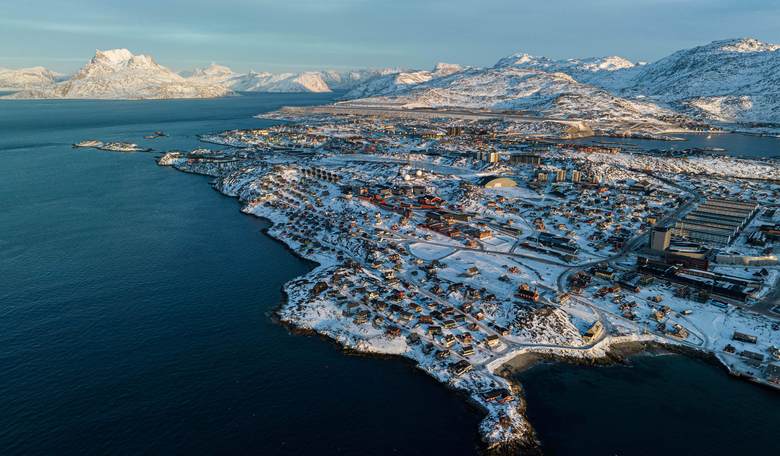
Trump has long sought the frigid, sparsely populated Danish territory.
In August 2019, Trump confirmed he was eyeing Greenland, referring to the massive island as "strategically nice" for the U.S. The Danish prime minister dismissed any American acquisition as "absurd," but the idea never died.
Just before his second term, Trump again declared U.S. ownership of Greenland an "absolute necessity." Shortly afterward, Donald Trump Jr. and the late Charlie Kirk toured the island. Ever since, Trump the elder has repeatedly argued that the U.S. must acquire Greenland, citing its prized location and its coveted rare earth minerals.
Democrats and transatlantic elites scoffed in unison.
Rep. Pete Aguilar (D-Calif.), the House Democratic Caucus chairman, called Trump's rhetoric "completely unhinged." Sen. Ruben Gallego (D-Ariz.) took a break from conveniently ignoring his disgraced friend Eric Swalwell to rebuke Trump as "an idiot." Former British Prime Minister Keir Starmer blasted Trump's threat of tariffs on nations opposed to an American acquisition as "completely wrong." French President Emmanuel Macron attacked the possible duties as "unacceptable."
It was all just as tedious as it was predictable.
In reality, Trump was just doing what he does best on the world stage: Pursue "the art of the deal" by aiming very high, applying massive leverage, and then landing in a place that isn't exactly where he was targeting but that still redounds solidly to the American national interest.
True, the new deal Trump just signed with the Danish and Greenlandic prime ministers on the sidelines of the United Nations General Assembly doesn't acquire Greenland for the U.S. But in every other way, this deal is a yuge win for the administration.
The deal affirms two new sites where the U.S. will station troops and build bases. That's in addition to America's lonely current outpost, the remote Pituffik Space Base, home to about 150 troops. That outpost will also now be "modernized and expanded."
The deal explicitly includes Greenland in Trump's sprawling "Golden Dome" missile defense system. It clarifies that no non-NATO nation can ever establish a military presence in the tundra. And it binds Denmark to working closely with the U.S. to counter Russian and Chinese espionage in the world's largest island.
And finally, the kicker: The deal gives the U.S. "permanent control over security and all other needs" in Greenland, regardless of whether Greenland ultimately wins independence from Denmark.
That's a win for the Monroe Doctrine. It's a win for the United States. It's a win for Trump. And it's another win for Secretary of State Marco Rubio, who ironed out the final deal in his typically smooth fashion. Trump and Rubio sealed the deal by ceding on sovereignty while pressing on America's bona fide, tangible security concerns.
The only surprise here is that people like Gallego and Macron are still triggered, allowing themselves to be repeatedly triggered by Trump's over-the-top opening gambits.
The fact is that Trump's "art of the deal" on the world stage follows a well-established pattern — and has a corresponding record of results.
On NATO, Trump secured a massive win after lots of blustery rhetoric, getting NATO leaders last summer to commit to spend at least 5% of their national GDPs on defense by 2035. On Iran, Trump may not (yet) have instigated the toppling of the radical Islamist theocracy, but he has crippled the mullahs' nuclear ambitions, missile stockpile and petroleum-based economy. He's used trade incentives and economic leverage to secure pro-America peace deals in decades-long conflicts as far-flung as those between India and Pakistan, as well as Armenia and Azerbaijan.
Again and again, Trump's critics freak out over his rhetoric, lambaste him as a lunatic or a tyrant (or both), and then watch as he negotiates a deal that results in him basically getting what he wanted in the first place. And most important: The United States wins big time.
Trump's haters won't see it that way. But Trump doesn't care. He'll stay focused on the bigger picture. It's what the great men of history do.